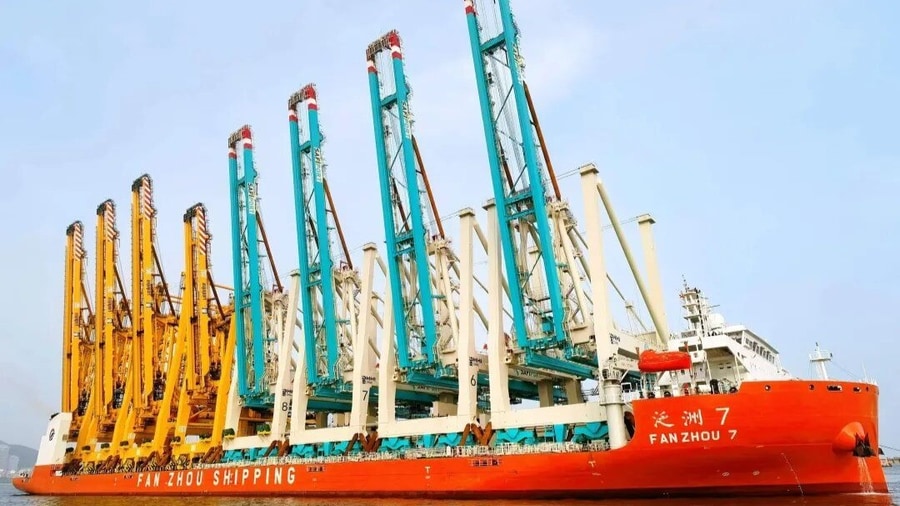
FANZHOU 7 has departed Dalian Port with eight ultra-large ship-to-shore cranes on board, marking the first known marine transport of eight large STS cranes on a single vessel.
The cranes are bound for Türkiye and will be delivered to Asyaport and Safiport as part of a Belt and Road infrastructure project. Together, the eight units weigh 14,750 tonnes, with the heaviest crane weighing more than 1,800 tonnes.
The voyage covers 15,100 nautical miles and passes through China’s coastal waters, the Indian Ocean and the Atlantic Ocean. The route also includes the Sunda Strait, the Strait of Gibraltar and the Cape of Good Hope.
Venti Maris said the operation required detailed planning due to the cranes’ size, weight and height, as well as changing weather and sea conditions across the route. The project team reviewed route planning, vessel capability, cargo engineering, sea fastening and voyage risk controls.
Coordination at Dalian Port was also central to the operation, including berthing, unberthing, cargo positioning and securing. The team worked with port authorities, escort teams, technical specialists and other stakeholders to refine loading port procedures based on site conditions.
Sea-fastening and securing plans were reviewed using equipment, vessel and metocean data. The aim was to reduce risks, including cargo movement, abrasion, and structural stress during the long-distance passage.
FANZHOU 7 is 256 m long, 51 m wide and has a maximum deadweight capacity of 58,000 tonnes. Its 11,700-square-meter flat deck provides the space and deck strength needed to carry all eight STS cranes in one voyage.
The vessel has an endurance of 16,000 nautical miles and a regular service speed of more than 15 knots. It is also equipped with redundant propulsion and twin-rudder control systems, supporting seakeeping performance and emergency response capability.
FANZHOU 7 holds polar navigation qualifications, as well as G-ECO and G-EP green class notations. The vessel uses an energy-efficient main engine and low-carbon operational materials.
Once installed, the cranes are expected to improve port handling efficiency and cargo throughput in Türkiye, while supporting maritime logistics capacity, trade connectivity and supply chain development.
Venti Maris said the voyage shows how advanced heavy-lift vessels, engineering control and project execution are becoming more important as global infrastructure, offshore energy and industrial projects increase demand for complex marine logistics.
Notes: