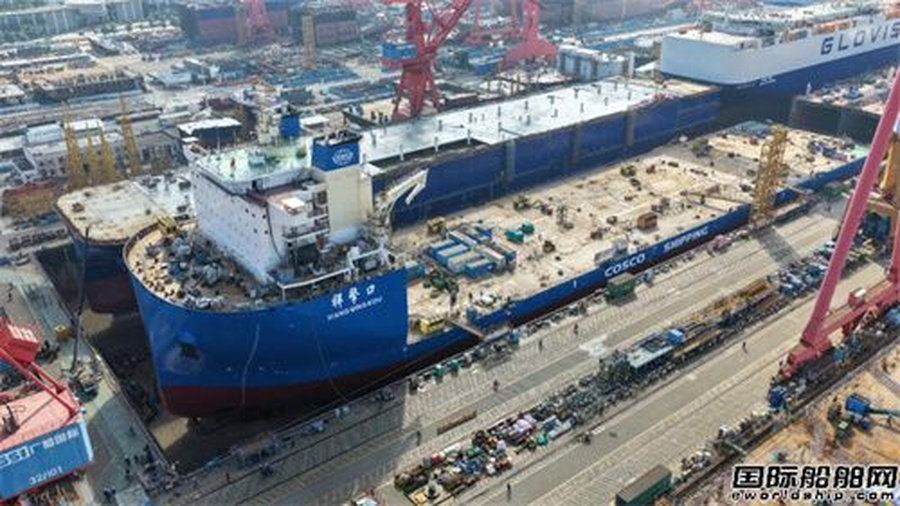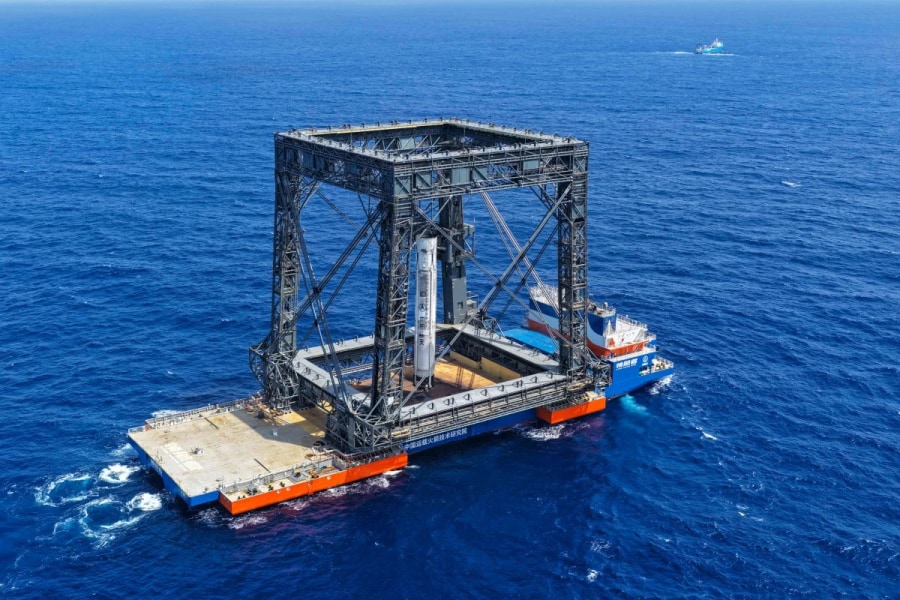
Guangzhou Shipyard International (GSI) has drawn attention to China’s shipbuilding role in reusable rocket operations after a recovery platform developed by the shipyard supported the country’s first controlled sea-based recovery of an orbital-class booster.
The first-stage booster of the reusable Long March-10B rocket returned vertically after its maiden launch on Friday and was captured by Linghangzhe, China’s first offshore rocket recovery platform equipped with a net-capture system.
According to eWorldship, GSI, a subsidiary of China State Shipbuilding Corporation, developed the platform in collaboration with the Chinese Academy of Sciences.
The project required GSI to convert an unpowered barge into a specialised offshore platform capable of maintaining stability and precise positioning in rough seas. As the vessel has no engines of its own and must be towed, its recovery role depends on systems that allow it to provide a steady target for the returning booster.
The platform’s structural requirements also differed from those of a conventional cargo vessel. Forces generated during recovery are transferred through four large deck-mounted supports rather than distributed across the deck. This placed greater demands on the platform’s structural design.
A tall steel capture structure raised the vessel’s centre of gravity and increased its exposure to rolling. The design process therefore included simulations covering wind and sea conditions before conversion work began.
Linghangzhe measures 144 m in length and has a displacement of 25,000 tonnes. It is fitted with a 36 m-high capture net and a DP-2 dynamic positioning system, allowing the platform to maintain position without anchoring through computer-controlled thrusters. The system can continue operating after the failure of one critical component.
The Long March-10B booster does not use the deployable landing legs employed by reusable rockets developed by SpaceX and Blue Origin. Instead, four hooks on the returning stage connect with the net suspended above the recovery platform.
According to eWorldship, GSI completed the platform design by the end of 2024. The report said conversion work began in April and the platform was delivered in December.
The platform uses domestically developed dynamic positioning and real-time ship-to-rocket control systems. Key equipment, including propulsion integration, vibration reduction and monitoring systems, was supplied by Chinese manufacturers.
GSI also builds LNG carriers, roll-on/roll-off ferries and ocean research vessels.