U.S. President Donald Trump has announced plans to reinstate a blockade targeting Iranian shipping and impose a 20% charge on cargo moving through the Strait of Hormuz.
In a Truth Social post on Monday, Trump said the waterway was open and would remain open with or without Iran. He said the renewed blockade would stop Iranian vessels and customers from entering or leaving while allowing ships from other countries to use the strait.
Trump also said the United States would take the title “Guardian of the Hormuz Strait.” Under his proposal, a 20% charge would apply to all cargo shipped through the waterway to reimburse the United States for security costs. He said the process would begin immediately.
The announcement followed four consecutive waves of U.S. strikes against Iranian military targets after Tehran resumed attacks on merchant shipping. The renewed violence effectively ended the June memorandum of understanding that had temporarily halted hostilities and reopened the Strait of Hormuz to commercial traffic.
TankerTrackers estimated that more than 80 million barrels of Iranian crude oil and refined products, valued at over $6 billion, left the region during the 26 days after Washington and Tehran signed the 60-day Islamabad Memorandum of Understanding and lifted the blockade on ships serving Iranian ports.
The monitoring group said about 30 million barrels of Iranian crude oil had yet to depart following Trump’s announcement that the U.S. Navy blockade would be reinstated more than a month ahead of schedule.
Before the blockade was lifted on 18 June, CENTCOM said U.S. forces had redirected 142 commercial vessels that complied with blockade orders and disabled nine ships that attempted to breach the restrictions. It said U.S. forces subsequently assisted more than 800 commercial vessels through the Strait of Hormuz.
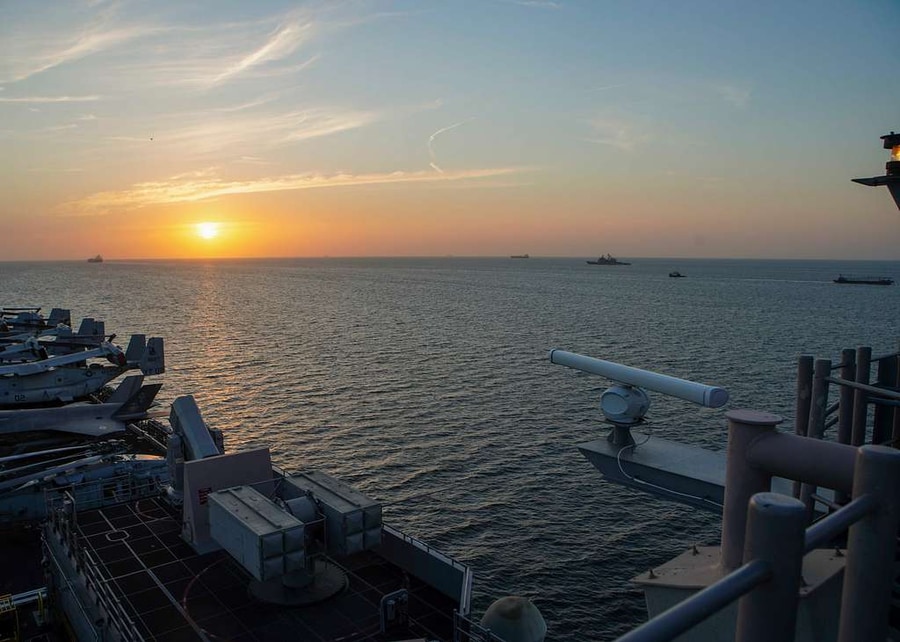
CENTCOM said on Sunday that it had completed another round of strikes against Iranian air defence systems, coastal radar sites, missile and drone capabilities, and Islamic Revolutionary Guard Corps small boats. The operation included the first reported combat use of U.S. one-way attack sea drones alongside aircraft, naval vessels and aerial drones.
The latest military action came less than a day after the Cyprus-flagged container ship GFS Galaxy was struck east of Oman. One crewmember was reported missing, and the crew abandoned the vessel.
Iran’s Persian Gulf Strait Authority said on Monday that passage through the waterway was not feasible because of recent U.S. military action. It suspended the processing of transit permit applications until stability returned.
The Strait of Hormuz carries roughly one-fifth of global oil consumption. Under the United Nations Convention on the Law of the Sea, vessels generally have a right of transit passage through international straits used for navigation. The United States is not a party to the convention but recognizes many of its navigational provisions as customary international law.
Trump’s proposed 20% cargo charge conflicts with the position adopted by the International Maritime Organization Council at its 137th session. The Council reaffirmed that vessels should have non-discriminatory and unimpeded passage through international straits and said transit through the Strait of Hormuz should remain free from tolls and charges.
The Council also said traffic-management measures introduced by coastal states must comply with international law and IMO rules. It called for a coordinated return to unhindered navigation through the internationally recognized traffic separation scheme.
No executive order, legal framework or implementation guidance has been released for either the renewed blockade or the proposed cargo charge. The method for assessing or collecting the fee also remains unclear.