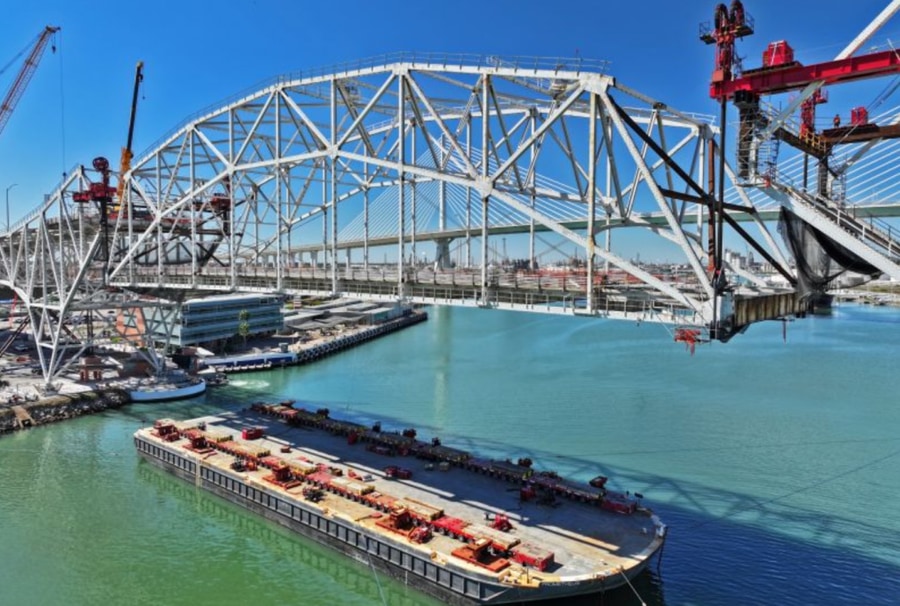
Mammoet helped remove the 2,300 tonne center span of the historic US 181 Harbor Bridge in Corpus Christi, Texas, using a lift and lower method aimed at reducing work at height and limiting disruption to marine traffic.
The work formed part of the Harbor Bridge Replacement Project led by the Texas Department of Transportation. Flatiron/Dragados LLC served as project developer.
The steel truss bridge, opened in 1959, had served the Corpus Christi area for more than 60 years. It is being replaced by a new cable stayed bridge designed to improve road safety, pedestrian access and navigation clearance for port-related traffic.
Project teams reviewed several removal options, including section-by-section dismantling and controlled explosive demolition. The selected method lowered the full center span onto a barge in one piece.
For a bridge above an active ship channel, the approach reduced the need for workers at height, limited dust and noise exposure near sensitive sites including the Texas State Aquarium, and allowed the navigation channel to be reopened in a controlled sequence.
Four 900 tonne strand jacks were placed in pairs at each end of the span. The jacks took the bridge load before crews cut the connection points.
The lowering was scheduled during daylight to improve visibility during the critical stage. Before the initial lift, crews made an eyebrow cut above the pin to create a small opening. The span was then lifted until daylight was visible, allowing the team to check bridge deflection and confirm stability before cutting continued.
Because the span weight was based on historic records, engineers added contingency to the lifting plan. That margin gave the strand jacks additional capacity if the actual load differed from the estimate.
The receiving barge was prepared the night before the lowering with winches, support grillages and Mammoet self propelled modular transporters. Once the barge was positioned under the bridge, crews worked within a tightly managed 36 hour window to lower the span and clear the channel.
The span was lowered nearly 50 m using 54 strand wires. Mammoet initially considered an umbrella setup, with strand wires resting on the bridge deck, but later changed to pre coiled wires to reduce handling time and manual work. Two coilers were assembled at Mammoet’s yard in Rosharon, Texas, and brought to site.
After the span landed on the barge, it was transported about 10 nautical miles to a nearby dock for offloading and decommissioning.
For the load out, Mammoet used two sets of 54 axle lines of SPMTs to lift and move the structure from the barge deck. Before that stage, crews reinforced the underside of the span with steel. Doing this work on the barge deck, instead of before removal, reduced additional work at height and gave crews safer access.
The span was then moved by SPMTs onto steel supports for decommissioning preparation.
The operation highlights the close link between civil engineering, marine transport and heavy lift planning on port-related infrastructure projects. In Corpus Christi, removing the span was also a logistics task over a working waterway, with marine access, public safety, nearby businesses and environmental controls tied into the same schedule.