Hanwha Ocean, HD Korea Shipbuilding & Offshore Engineering (HD KSOE) and Samsung Heavy Industries are expanding cooperation with U.S. partners in naval ship design, digital shipyards, workforce development, autonomous vessels and supply chains.
The initiatives come as Korea and the United States advance bilateral shipbuilding cooperation. The two countries previously agreed to allocate $150 billion of a wider $350 billion investment package to the sector.
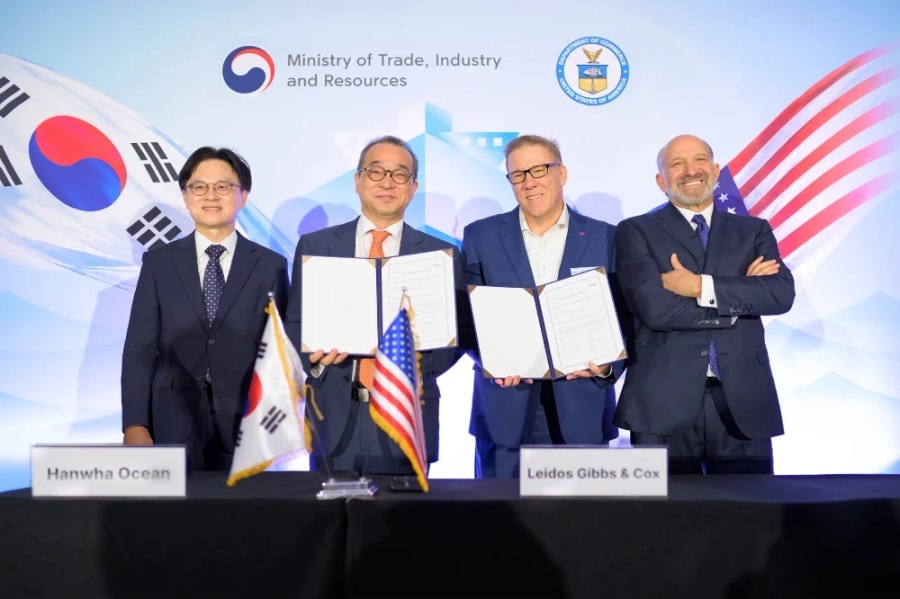
Hanwha Ocean signed a Professional Services Agreement with Leidos for the design of the Global Fast Sealift. The agreement advances an April memorandum of understanding covering next-generation naval ship design, U.S. shipbuilding capacity and global defense opportunities.
Gibbs & Cox, a subsidiary of Leidos, has designed more than 70 percent of U.S. Navy surface combatants built since World War II.
The Global Fast Sealift is designed for commercial logistics operations during peacetime and the high-speed transport of military supplies during conflicts.
Hanwha Ocean also signed memorandums of understanding with Hanwha Philly Shipyard, Delaware County Community College and Philadelphia business groups. The agreements cover shipbuilding workforce training and measures to strengthen the local supply chain.
HD KSOE, the shipbuilding intermediate holding company of HD Hyundai, signed a definitive agreement with Siemens Digital Industries Software to introduce a next-generation marine platform.
The system will digitally connect ship design, production, supply chain management, quality control and maintenance. It will use artificial intelligence, digital twin technology and a single 3D data model to share design changes and production data in real time across the shipbuilding process.
HD KSOE also plans to develop a virtual shipyard that can simulate production processes and equipment operations. The company is pursuing an AI-driven autonomous manufacturing system incorporating robotics and automated production facilities.
Samsung Heavy Industries is extending its U.S. cooperation into ship design, autonomous vessels, research and workforce development.
The company received Approval in Principle from the American Bureau of Shipping for the basic design of a 12,000-cubic-meter liquefied natural gas bunkering vessel developed jointly with Conrad Shipyard.
Samsung Heavy Industries also signed a strategic partnership with Saronic Technologies to develop autonomous surface vessels and AI digital solutions.
Under a separate agreement with Vigor Marine Group, the company will establish a training center in the U.S. Pacific Northwest. The center will use augmented and virtual reality technologies to train welding and painting workers.