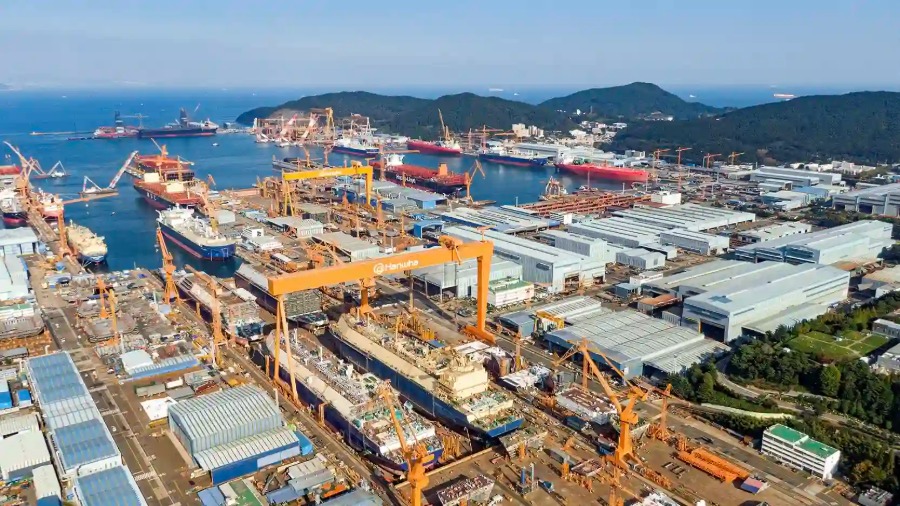
HD Korea Shipbuilding & Offshore Engineering (HD KSOE), Samsung Heavy Industries and Hanwha Ocean recorded operating rates of 100% or more in the first half of 2026 as South Korea’s major shipbuilders continued to work through large order backlogs.
HD KSOE posted the highest average operating rate at 106.1%, followed by Samsung Heavy Industries at 100.2% and Hanwha Ocean at 100%.
An operating rate above 100% means actual working hours exceeded normal or targeted production hours, including additional work during holidays and at night.
Against this backdrop, the three shipbuilders are investing in facilities, automation and digital technologies rather than relying solely on large-scale physical expansion.
Samsung Heavy Industries invested KRW 99.2 billion, approximately $72 million, in facilities during the first half of 2026. A further KRW 330.8 billion, approximately $241 million, is planned for the second half.
The company has also started operating its Pipe Robo-Fab, an automated pipe manufacturing facility with annual production capacity of approximately 100,000 pipe segments. The facility automates processes including design, logistics, processing, measurement, alignment and welding.
Its shipyard development strategy also includes the “3X” program, combining Digital Transformation (DX), AI Transformation (AX) and Robotics Transformation (RX). Samsung Heavy Industries aims to establish a smart, autonomous and unmanned shipyard by 2030.
Hanwha Ocean plans to invest KRW 686.9 billion in shipbuilding facilities during the second half of 2026.
At its Geoje shipyard, the company has applied AI Transformation, or AX, to 67% of indoor welding processes and is targeting full automation of welding processes by 2030.
Hanwha Ocean also plans to add a very large floating dock and a large offshore crane by March 2027, with the aim of reducing reliance on leased equipment.
HD KSOE has invested KRW 142 billion in facility upgrades, including the replacement of aging cranes, and plans another KRW 152.6 billion of investment in the second half of 2026.
Parent company HD Hyundai is developing its Future of Shipyard (FOS) project, scheduled for completion by 2030. The initiative applies digital twins, artificial intelligence and big data to shipyard operations.
Upon completion, overall productivity is expected to increase by 30%, while the shipbuilding cycle is projected to decrease by 30%.
Despite high utilization rates, the three shipbuilders remain cautious about major capacity expansion. The cyclical nature of shipbuilding means that large investments made during a strong market could increase fixed-cost burdens if market conditions later weaken.