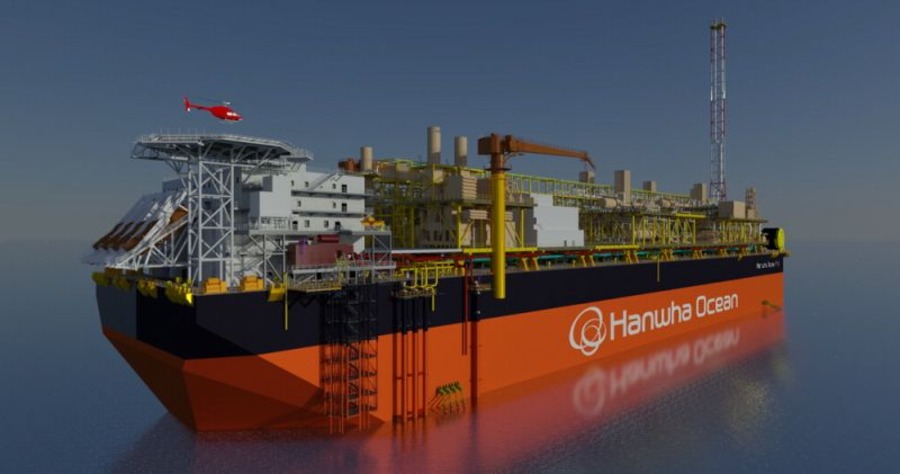
Hanwha Ocean is in the final bidding stage for the FPSO contract for the Venus offshore oil development in Namibia, competing with SBM Offshore for a project valued at $3 billion, or about 4 trillion won.
The Venus development is led by TotalEnergies. According to the shipbuilding industry, the two bidders have reached the final round, while the result of the contractor selection has not yet been announced. TotalEnergies plans to make a final investment decision in the second half of 2026 and targets first oil production in 2030.
Separately, Hanwha Ocean is extending its regional standard FPSO strategy to include carbon-reduction measures. On 25 August 2026, the company said it had received approval in principle from DNV for its low-carbon standard FPSO design system.
The company also obtained approval in principle and a Project Sustainability Execution Plan certificate from ABS. DNV verified a framework that applies emissions-reduction technologies according to individual greenhouse gas emission sources. ABS validated a system for implementing and managing carbon-reduction targets during project execution.
The approvals enable verified carbon-reduction technologies to be incorporated into an FPSO design when requested by a client.
Hanwha Ocean has previously developed standard FPSO designs for different regions. In 2024, it received certifications from ABS and Bureau Veritas for a design that can be applied across West Africa, including Namibia. In 2026, the company secured ABS and DNV certifications for another design optimized for South America.
FPSOs perform three main functions for offshore crude production: processing the extracted oil, storing it and transferring it to tankers.
If Hanwha Ocean secures the Venus contract, carbon-reduction technologies could be incorporated during design discussions with the client. TotalEnergies plans to reinject gas produced during oil extraction underground instead of flaring it as part of its approach to keeping emissions relatively low for the deep-sea development.