Lee Jae-myung has called for stronger government support for South Korea’s shipbuilding industry as domestic shipyards see a sharp increase in orders.
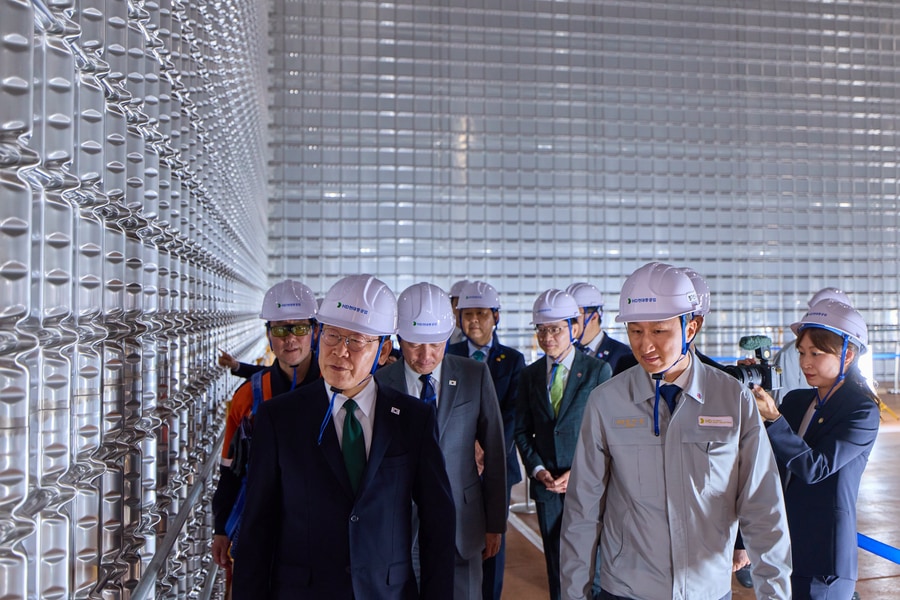
The government announced its “K-Shipbuilding Future Vision” after Lee visited HD Hyundai Heavy Industries’ Ulsan shipyard and held a policy meeting on the sector’s long-term competitiveness. The visit was attended by Chung Kisun, Lee Sang-kyun of HD Hyundai Heavy Industries, and Cho Young-cheol and Cho Seok of HD Hyundai.
During the site visit, Lee inspected block assembly shops, steel plate yards, quays and docks. He also reviewed a 38,000 m³ ammonia carrier under construction at No. 2 dock and boarded a 174,000 m³ LNG carrier to examine its cargo containment system.
Chung Kisun said the company would transform its production structure through smart shipyard development and strengthen future competitiveness through digital innovation.
At the policy meeting, Lee pointed to the shipbuilding industry’s cyclical demand pattern and said employment has remained a key issue during repeated upturns and downturns. He said the government should consider measures such as increasing public vessel orders during market slowdowns to stabilize demand.
He also called for discussions on sharing refund guarantee risks between the government and financial institutions, while stressing that industry growth should benefit workers and subcontractors more evenly.
Under the new vision, the government plans to prioritize domestic orders for public-sector energy vessels, including LNG carriers and offshore wind support ships.
The plan includes up to KRW 525 billion in investment over the next five years to secure cargo containment technologies for LNG carriers, ammonia carriers, hydrogen carriers and liquefied carbon dioxide carriers.
The government and South Korea’s three major shipbuilders also agreed to raise direct employment by 20%, with hiring expected to increase from 2,494 workers this year to 3,254 next year.
A policy to apply the same performance-based bonus ratio to primary contractors and subcontractors will also continue, allowing employees at partner companies to receive equal bonus rates.
Separately, a shipbuilding supply chain finance agreement was signed in Ulsan on the same day. The government will provide KRW 16 trillion in win-win trade finance to support exports, including KRW 1 trillion in supply chain guarantees.
Commercial banks and shipbuilders will establish a KRW 1 trillion supply chain guarantee system. Hana Bank and HD Hyundai Heavy Industries previously contributed KRW 23 billion and KRW 5 billion to the trade insurance fund. On 13 May 2026, Shinhan Bank and Samsung Heavy Industries, as well as Woori Bank and Hanwha Ocean, announced additional contributions of KRW 21.3 billion each.