Two large bulk carriers collided near Singapore’s eastern anchorage area on 20 May, drawing attention to traffic risks in one of the world’s busiest shipping corridors.
The Marshall Islands-flagged CAPE XL, operated by Brave Maritime, and the Japanese-owned HUGE KUMANO, operated by Nissen Kaiun, sustained hull damage after the incident near the AEBA eastern bunkering anchorage.
The collision occurred close to the point where vessels departing the anchorage merge into the eastbound traffic lane of the Singapore Strait traffic separation scheme. The area handles steady movements of bulk carriers, tankers, container vessels, and bunkering traffic.
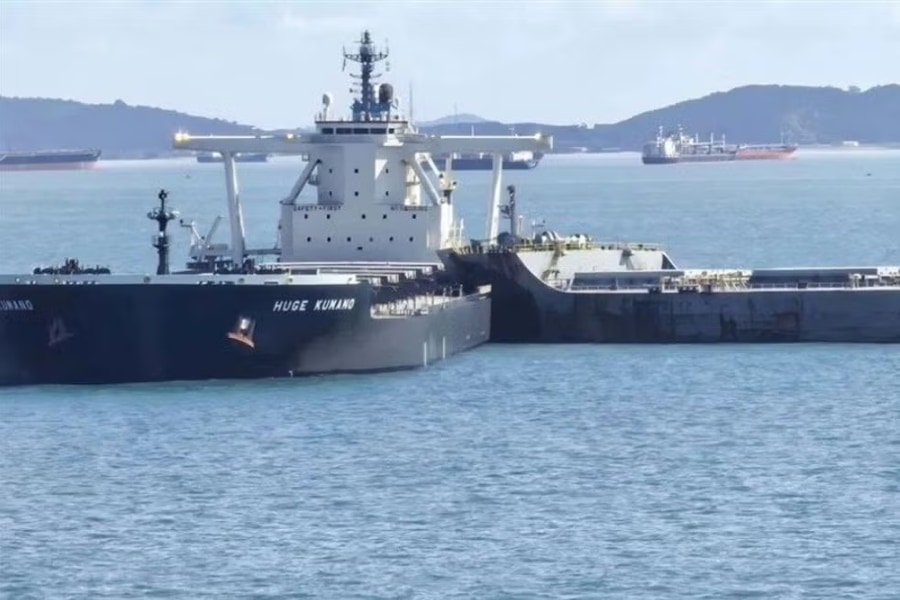
Industry photographs showed the bow of CAPE XL lodged into the port side of HUGE KUMANO near the vessel’s mid-aft section.
AIS data reviewed by shipping analysts showed both vessels later remained almost stationary in the area at very low speeds. Industry reports also said AIS signals temporarily displayed “Not Under Command” after the collision.
According to industry reports, CAPE XL had completed bunkering operations at AEBA before proceeding south to enter the eastbound traffic lane. HUGE KUMANO was already transiting within the lane when the collision occurred.
The incident underlined the complexity of navigation around Singapore waters, where vessels departing anchorage must join heavy traffic streams moving through the strait.
HUGE KUMANO is a 2020-built Newcastlemax bulk carrier with a deadweight capacity of about 208,848 tonnes. CAPE XL, built in 2011, has a deadweight of about 181,458 tonnes.
Shipping data showed CAPE XL was carrying bauxite loaded at Boke, Guinea, and was bound for Qingdao, China, with an estimated arrival around 29 May. The cargo status and destination of HUGE KUMANO had not been publicly confirmed at the time of reporting.
No injuries, flooding, or major marine pollution had been confirmed based on the latest available information.
The Maritime and Port Authority of Singapore had not released a formal statement on the cause of the collision, possible traffic measures, or the extent of damage to either vessel at the time of reporting.
Marine insurers, classification societies, and flag state investigators are likely to examine voyage data recorder information, bridge procedures, vessel speed management, and traffic coordination as part of the casualty review.