Dajin Heavy Industry is expanding its own heavy transport fleet for offshore wind cargoes while holding commercial shipbuilding orders for 24 vessels valued at approximately RMB 12 billion, or about $1.7 billion.
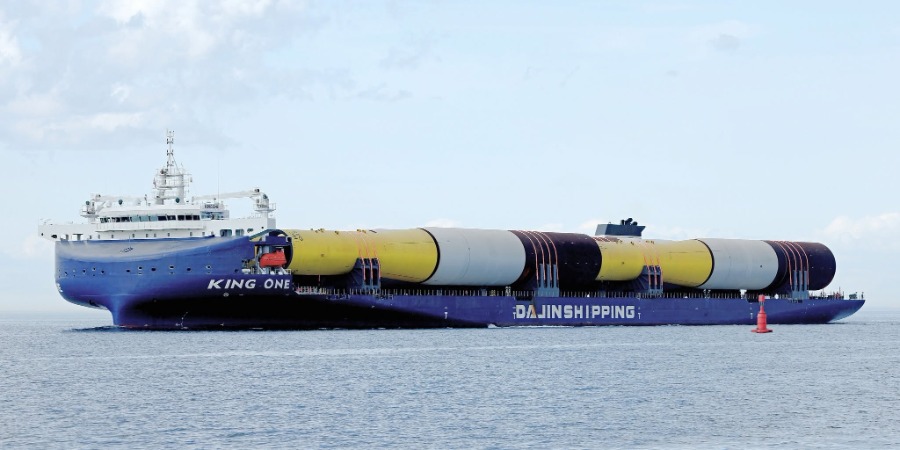
The company is developing KING-series deck carriers for ocean transport of large offshore wind structures. The vessels measure 239.8 m in length, 51 m in width and 13 m in depth, with around 12,000 m² of deck space.
Each KING-series vessel has a maximum deadweight of about 40,000 tonnes, a service speed of approximately 13 knots and a range of around 16,000 nautical miles. They are designed to carry monopiles, jackets and other large structures for offshore wind turbines rated at 15 MW and above.
KING ONE has completed two transatlantic voyages carrying offshore wind foundation structures to Europe. KING TWO has been delivered, while KING THREE has been launched and is scheduled for delivery in September 2026.
Dajin Heavy Industry expects all three KING-series vessels to be in operation by the end of 2026.
The company is also constructing larger EMPEROR-series heavy transport vessels. These units will be about 245 m long and 61 m wide, with approximately 13,500 m² of deck space and a maximum deadweight of around 60,000 tonnes.
The EMPEROR-series vessels are intended to transport fixed-bottom offshore wind structures, floating wind foundations and large oil and gas modules.
Alongside its own transport fleet, Dajin Heavy Industry has a commercial shipbuilding orderbook covering 24 vessels scheduled for delivery between 2027 and 2030.
The orderbook includes 211,000-dwt Newcastlemax bulk carriers and deck carriers. It also covers non-propelled semi-submersible barges and multipurpose heavy-lift vessels.
Earlier in 2026, Dajin Heavy Industry was identified as the builder of two 211,000-dwt Newcastlemax bulk carriers ordered by Danaos. Multipurpose heavy-lift vessels ordered by Jumbo Maritime are also part of the company’s shipbuilding business.
Production capacity has also increased with the start of operations at the company’s deepwater offshore engineering base in Caofeidian during the first half of 2026.
The site covers more than 1,300 mu, or about 87 hectares, and has planned annual production capacity of approximately 400,000 tonnes. It can manufacture monopiles, floating foundations and jackets for offshore wind turbines ranging from 15 MW to 25 MW.
The Caofeidian facility also includes a dedicated deepwater terminal capable of handling vessels of up to 100,000 dwt.
In Europe, Dajin Heavy Industry is developing four offshore wind marshalling port facilities across Germany, Spain and Denmark.
For the first half of 2026, the company reported revenue of RMB 3.253 billion, an increase of 14.48% year on year. Net profit attributable to shareholders was RMB 601 million, while adjusted net profit reached RMB 589 million.
Overseas revenue totalled RMB 2.675 billion and represented 82.25% of overall revenue. Capital expenditure reached RMB 1.708 billion, including investment related to the Caofeidian base, wind power projects and construction of the company’s own vessels.
Dajin Heavy Industry has identified integrated services across the deepwater offshore wind value chain as part of its business direction.