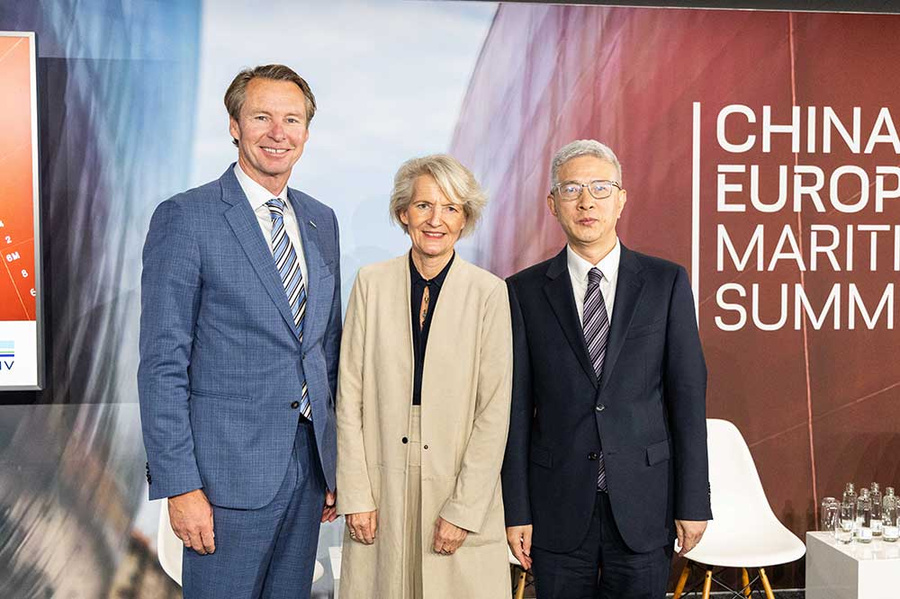
Chinese shipbuilders and European shipowners called for closer cooperation on vessel development, alternative fuels and digitalisation at the inaugural China-Europe Maritime Summit at SMM 2026.
The event was jointly organised by the China Association of the National Shipbuilding Industry (CANSI), the German Shipowners’ Association (VDR) and DNV.
Discussions focused on energy efficiency, operational flexibility and digital innovation as the shipping industry responds to decarbonisation targets, evolving regulation and uncertainty over future fuel pathways.
China’s shipbuilding industry accounts for around 70% of the global orderbook, while European shipowners operate more than one-third of global fleet capacity.
Knut Ørbeck-Nilssen, group president and chief executive officer at DNV, said decisions being made across the industry today will shape shipping for decades and highlighted the importance of cooperation between Chinese shipbuilders, European shipowners and the wider maritime sector.
Xu Peng, chairman of China State Shipbuilding Corporation (CSSC), said China and Europe’s maritime sectors have complementary strengths and scope for broader cooperation across the maritime value chain.
The summit included two high-level panel discussions moderated by Dr. Martin Kröger, CEO of VDR, and Li Yanqing, vice chairman and secretary general of CANSI.
Chinese participants included China Merchants Industry (CMI), Guangzhou Shipyard International (GSI), Shanghai Waigaoqiao Shipbuilding (SWS) and Shanghai Merchant Ship Design & Research Institute (SDARI).
European shipowners and operators represented at the discussions included Vogemann Reederei, Briese Schiffahrt, Bernhard Schulte, MPC Containerships and Grieg Edge, alongside DNV.
Dr. Gaby Bornheim, president of VDR, said new vessel investments are commitments made over decades and require long-term partnerships between shipowners and shipbuilders.
The discussions highlighted closer China-Europe cooperation in vessel development, alternative fuels, energy efficiency, operational flexibility and digital innovation.