Hanwha Ocean will test whether humanoid robots can be used for risky, repetitive, and physically demanding shipyard tasks through a demonstration project with AeiROBOT and NdotLight.
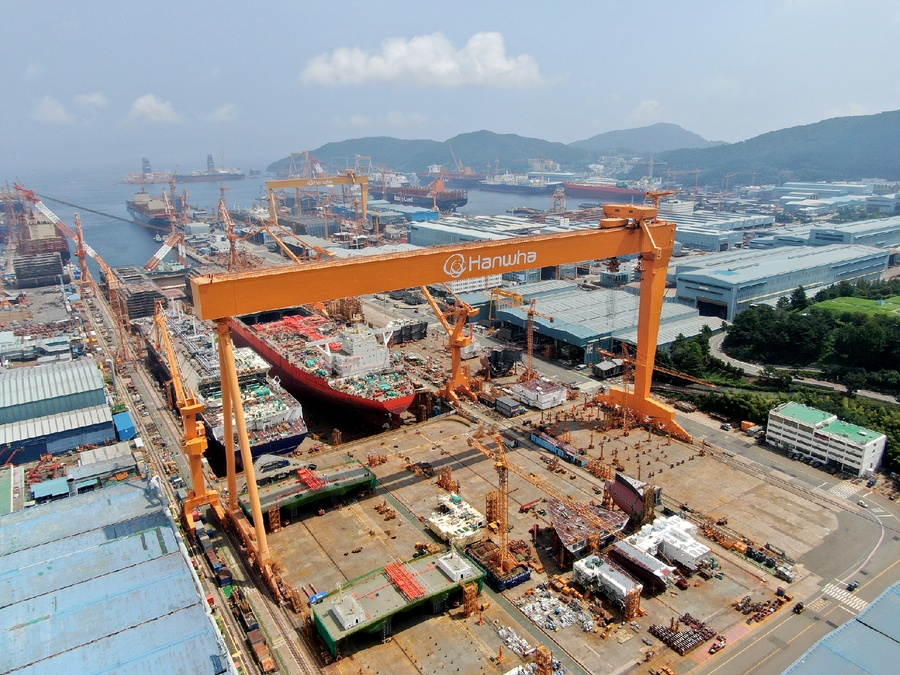
The trial will take place at Hanwha Ocean’s Geoje shipyard and aims to verify the use of Physical AI-based humanoid robots in shipbuilding within one year. AeiROBOT and NdotLight, both participants in the Nvidia Inception ecosystem, will combine humanoid robot technology with 3D simulation capabilities to assess practical deployment at shipbuilding sites.
The project will focus on tasks that are difficult to automate using conventional equipment. Shipyards contain large blocks, complex work routes, confined vessel interiors, and hazardous inspection areas. These conditions make shipbuilding a suitable environment to test whether humanoid robots can assist workers or take over selected physical tasks.
NdotLight will create a virtual shipyard environment before on-site testing begins. Using Nvidia Omniverse and Nvidia Isaac Sim, the company will build a 3D space similar to a shipyard and provide sim-ready data for robot training. This data includes physical properties and structural information that allow robots to recognize objects and learn movement in a virtual setting.
The company will also develop a digital twin environment based on its own 3D CAD engine and 3D AI technology. The digital twin will enable robots to test various scenarios before deployment to an actual shipyard. NdotLight plans to generate 3D assets, physics-based simulation environments, and synthetic data required for humanoid robot training and verification.
AeiROBOT will verify whether its humanoid robot, Alice, can perform physical work required at shipbuilding sites. The company plans to use Nvidia KIMODO and SOMA Retargeter to train the robot with motion data from industrial sites.
The demonstration will examine tasks including heavy-load transport, autonomous movement, walking on rough terrain, obstacle avoidance, and tool manipulation. Alice was introduced as a Physical AI example performing shipyard welding work during Nvidia CEO Jensen Huang’s CES keynote in January.
Through the project, Hanwha Ocean will assess the industrial potential of humanoid robots in shipbuilding. Because humanoid robots can use the same workspaces, equipment, and movement routes as human workers, the company will examine possible applications in hazardous zone inspection, repetitive movement, equipment and goods transport, and worker assistance.