Hanwha Philly Shipyard’s $1 billion order for three Aloha-class container ships for Matson is now scheduled to extend into the second quarter of 2028, later than the delivery timing announced when the contract was signed in 2022.
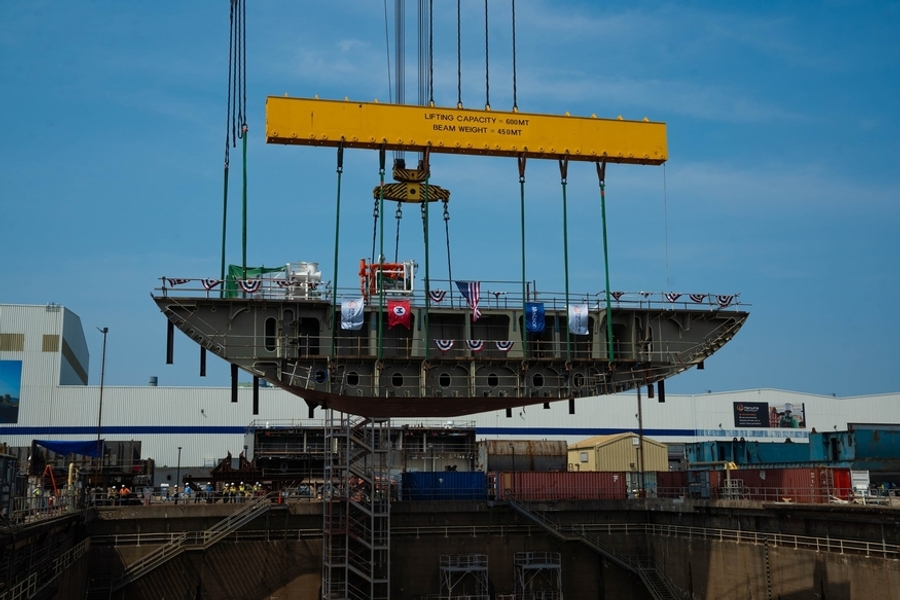
The series includes Makua, Malama, and Makena. Recent progress includes Malama entering the final stage of hull assembly, while steel cutting for Makena was held on the same day. Makua is planned to begin final assembly in August 2025.
The latest schedule places the first vessel’s delivery in the first quarter of 2027, followed by the second in the third quarter of 2027 and the third in the second quarter of 2028. The earlier plan had called for deliveries in the fourth quarter of 2026 and in 2027.
Each ship is valued at more than $330 million. The total contract value reaches $1 billion, making the program a record-setting container ship order for the U.S. shipbuilding sector.
The vessels will measure about 260 m in length and reach a maximum speed of 23.5 knots. Each ship can carry 3,220 TEU and has 408 reefer slots. The design includes a dual-fuel engine able to use conventional marine fuel or LNG, as well as an energy-efficient hull and fresh water ballast system.
Hanwha Philly Shipyard previously built Daniel K. Inouye and Kaimana Hila for Matson, delivered in 2018 and 2019. After five years in service, both vessels were converted to LNG propulsion at COSCO SHIPPING Shipyard (Nantong) and returned to operation by the end of 2024. The retrofit project cost $94 million, above the initial estimate of $35 million per vessel.
Following its 2024 acquisition by a Hanwha Group subsidiary, Hanwha Philly Shipyard is being positioned as a key site for Korea-U.S. shipbuilding cooperation under the MASGA project. Hanwha Ocean plans to install core systems at the yard this year to improve digital capabilities and start building a ship repair, maintenance and overhaul business in North America.
Under Hanwha Ocean’s medium- to long-term plan, Hanwha Philly Shipyard will receive a $5 billion investment for two new dry docks, three berths and a hull production facility. The plan aims to raise annual output from the current 1 to 1.5 vessels to 20 vessels through automated equipment and smart shipyard systems.