
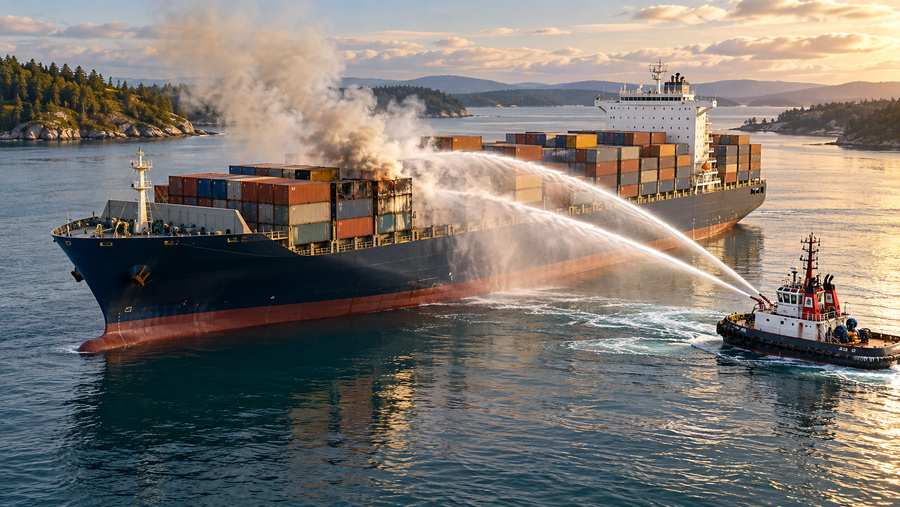
When a ship encounters a serious emergency, the financial consequences can extend beyond property that suffers physical damage. Cargo may arrive intact, yet its owner can still be required to contribute towards the cost of saving the vessel and other cargo.
This is the principle of general average, commonly known as GA. It provides a framework for sharing qualifying sacrifices and expenses incurred to protect property facing a common danger during a maritime voyage.
What is general average?
General average arises when an extraordinary sacrifice or expenditure is deliberately and reasonably made to preserve property involved in a common maritime adventure from danger.
A familiar example is cargo deliberately thrown overboard to save a vessel and its remaining cargo. Rather than leaving the owner of the sacrificed goods to bear the entire qualifying loss, the general average mechanism distributes it among the contributing interests.
The same principle can apply to certain emergency expenses. The central question is whether a sacrifice or expenditure qualifies under the applicable rules, rather than simply whether a ship has experienced an accident.
Many bills of lading and charterparties incorporate the York-Antwerp Rules, which govern the adjustment of general average. The edition specified in the contract matters. The 2016 Rules, incorporating a technical amendment adopted in 2022, do not automatically replace earlier editions used in existing contracts.
Which losses and expenses can qualify?
Potential examples include cargo jettisoned for the common safety, damage caused by water used to extinguish a fire aboard a ship, and certain costs associated with entering a port of refuge. The circumstances and applicable rules determine what is allowed.
The original casualty and the response to it must be distinguished. Damage caused directly by a fire does not automatically receive the same treatment as damage caused by deliberately flooding an area to extinguish that fire.
Likewise, declaring general average does not make every repair bill or operational expense recoverable. Salvage requires particular attention: its treatment depends on the applicable rules and arrangements, and salvors may request security separately from general average security.
How are contributions calculated?
An average adjuster examines the allowable losses and expenses, establishes the relevant contributory values and allocates the total among the contributing interests. These can include the vessel, cargo and other property at risk.
Contributions are based on value, rather than cargo weight, the number of containers or the freight charged. Consequently, an owner whose goods remain undamaged can still face a contribution.
Consider a simplified hypothetical example in which allowable GA expenses total $4 million:
| Contributing interest | Assumed contributory value | Share | Contribution |
|---|---|---|---|
| Vessel | $60 million | 60% | $2.4 million |
| Cargo owner A | $25 million | 25% | $1 million |
| Cargo owner B | $15 million | 15% | $600,000 |
| Total | $100 million | 100% | $4 million |
Cargo owner B would contribute $600,000 even if its goods suffered no damage.
The figures illustrate the calculation only. They are not a typical GA rate or an estimate for a particular casualty. Actual adjustments involve detailed valuation rules and may include deductions and allowances; a cargo’s contributory value should not automatically be equated with its insured value.

Why can cargo be held pending security?
The final contribution is rarely known immediately after an emergency. To protect the right to recover the amount eventually due, shipowners may withhold delivery until satisfactory security is provided.
The CMI guidance for cargo owners and receivers describes the usual arrangements: a general average bond signed by the cargo owner or receiver, supported by an acceptable insurer’s guarantee or a cash deposit.
A general average bond is an undertaking to pay the contribution legally and properly due. An insurer’s guarantee provides security for that obligation. Where suitable insurance security is unavailable, a cash deposit may be required.
Once the required security is accepted, the cargo can normally be released for GA purposes without waiting for the final adjustment. Other delivery requirements may still apply.
Security is therefore not the same as a final settlement. Completing the adjustment can take a considerable time, sometimes years.
Does cargo insurance cover general average?
Cargo insurance can cover GA contributions and allow an insurer to provide the required guarantee, subject to the policy’s terms. Underinsurance can leave the cargo owner responsible for part of the exposure.
Having no cargo insurance does not remove a cargo owner’s potential obligation to contribute. It can instead mean arranging cash security and meeting the eventual liability directly.
What if the shipowner was at fault?
General average does not, by itself, determine responsibility for the incident.
Under Rule D of the York-Antwerp Rules, the adjustment can proceed while remedies and defences concerning fault remain available. Whether a shipowner can ultimately recover a contribution may depend on the cause of the casualty, the carriage contract and the governing law. A declaration is not a final ruling that cargo interests must pay every amount claimed.
Does it cover delays and lost business?
General average does not provide comprehensive compensation for the commercial consequences of a maritime emergency. Rule C excludes losses caused by delay and indirect losses, including loss of market. Certain qualifying expenses at a port of refuge may nevertheless be allowed under the specific rules.
A cargo owner can therefore face a GA contribution while separately suffering delivery delays or lost sales that are not shared through the adjustment.
What should cargo owners do after receiving a notice?
Cargo owners should promptly forward the notice to their insurer or broker, follow the appointed adjuster’s instructions and provide the requested cargo and valuation documents. Any cargo loss or damage should also be reported, as it may affect the adjustment.
The notice should be checked for the precise security requirements, including whether separate salvage security is needed. comitemaritime.org
The practical significance of general average is that physical damage and financial exposure are different questions. Goods can survive a casualty intact while their owners still have obligations arising from the measures taken to save the maritime venture.