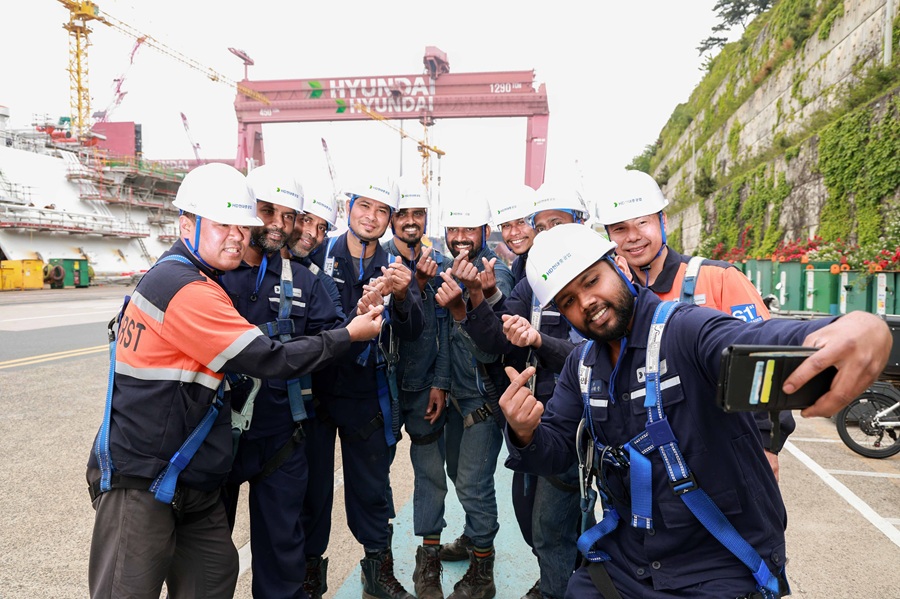
Foreign workers accounted for 22.7 percent of South Korea’s shipbuilding workforce in 2024, up from 3.2 percent in 2007, according to the Korea Offshore & Shipbuilding Association. The increase has come as shipyards respond to labor shortages and labor cost pressures during the current upturn, while concerns remain over safety management linked to language barriers and limits on productivity.
The trend has pushed major shipbuilders to review their hiring structures. HD Hyundai Heavy Industries decided to reduce direct hiring of foreign workers and employ more domestic workers, while other major yards are also internally reviewing plans to increase domestic hiring instead of relying on foreign labor.
The policy debate has also widened at the government level. At a town hall meeting in Ulsan last month, Minister of Employment and Labor Kim Young-hoon took a negative view on any indefinite expansion of the Ulsan metropolitan area-specific visa and said he would consult with the Ministry of Justice. Earlier, at a town hall meeting in Ulsan in January, President Lee Jae-myung also said the structure of dependence on foreign labor in the shipbuilding sector needed to be reviewed.
Based on discussions at a policy meeting held on 11 March, the Ministry of Justice plans to reform the visa system so that it focuses on skilled foreign workers with specialized technical abilities. The government’s direction reflects concerns that rising dependence on foreign labor in shipbuilding is affecting domestic jobs and that the gains from the industry’s boom are not fully reaching local economies.
Foreign workers have largely filled on-site jobs that domestic workers tend to avoid. As of January, 206 people had received the Shipbuilding Skilled Worker (E-7-3) visa. The foreign workforce in shipbuilding also included about 8,000 workers on the Non-professional Employment (E-9) visa and 13,000 on the General Skilled Worker (E-7-3) visa. However, the industry said securing skilled foreign workers remains difficult because many return to their home countries after a certain period or move to other sectors offering better treatment.
Industry officials also said a rapid rebalancing of the workforce would be difficult because of the risk of labor shortages and higher fixed costs. One shipbuilding company official said that while the company is trying to increase domestic employment, adjusting the proportion of foreign labor is currently the most sensitive internal issue because it can directly affect operations in the yard.
Against that backdrop, there is growing analysis that the industry needs to move more quickly to fill the gap in skilled labor demand and shift to new technologies to secure long-term competitiveness. South Korea’s three major shipbuilders are accelerating smart yard investment linked to artificial intelligence, including intelligent autonomous shipyards and smart yards.
The government is also maintaining related support. The Ministry of Trade, Industry and Energy plans to invest KRW 320 billion this year under the Shipbuilding and Offshore Industry Technology Development Support Project. Of that amount, KRW 94.9 billion is allocated to the AI Digital Shipyard sector and KRW 37.8 billion to the AI Autonomous Ship sector.
Experts said the issue should be addressed as part of a broader industry strategy. Dr. Park Jae-hyun of the Korea Marine Equipment Research Institute said rising wage levels in the Korean economy are placing pressure on the labor-intensive shipbuilding industry and that discussion should go beyond adjusting foreign labor ratios to establishing a sustainability strategy for the sector. Yang Jong-seo, a senior researcher at the Overseas Economic Research Institute of the Export-Import Bank of Korea, said maintaining a certain level of domestic skilled labor is important for preserving core technology and productivity, while investment in automation and digitalization is also needed to address labor shortages and cost issues at the same time.