
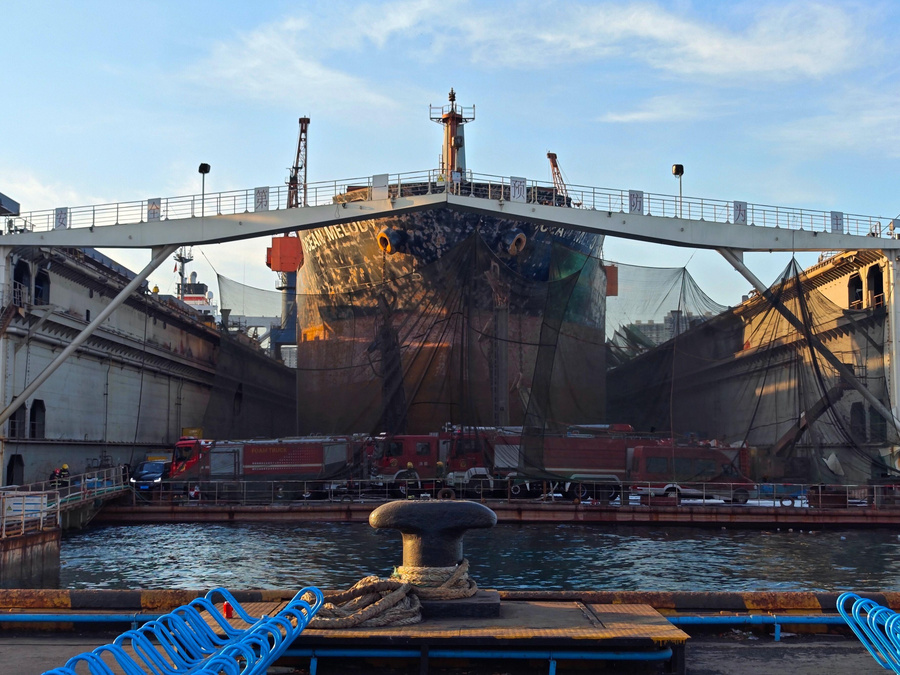
Shipyards are among the most complex industrial workplaces. Heavy structures are lifted above workers, hot work is carried out close to combustible materials, confined spaces can contain hazardous atmospheres, and multiple contractors often work simultaneously within the same vessel or production area.
A review of major fatal accidents since 2000 shows that the consequences can become particularly severe when equipment, vessels or infrastructure are being installed, repaired, modified or used in temporary configurations.
The five accidents below are ranked by publicly documented fatalities.
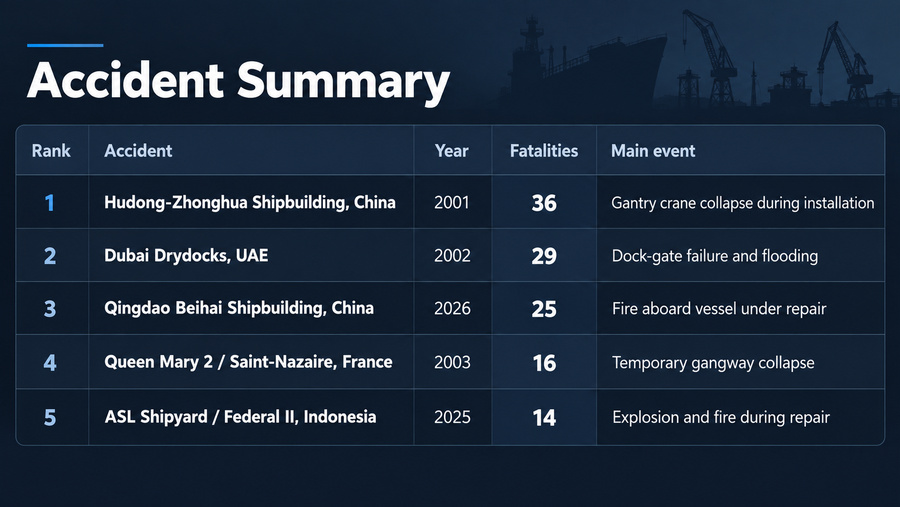
Scope: This review covers major single industrial accidents identified at commercial shipbuilding and ship-repair facilities since 2000. Shipbreaking yards, accidents occurring during offshore or sea trials, military operational accidents, and non-industrial incidents are excluded. Because there is no single comprehensive global database covering every shipyard fatality, the list should be read as five of the deadliest documented accidents rather than a definitive worldwide ranking.
1. Hudong-Zhonghua Shipbuilding gantry crane collapse — China, 2001
36 fatalities, 3 injured
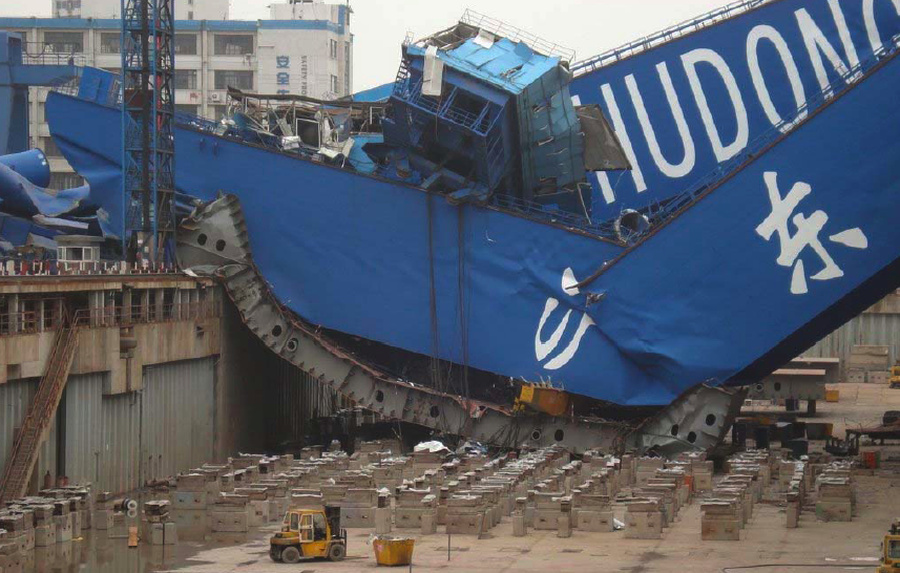
On 17 July 2001, a massive gantry crane under installation collapsed at Hudong-Zhonghua Shipbuilding in Shanghai during the lifting of its main girder.
The 600-tonne-class, 170-metre gantry crane was being erected by contractors at the shipyard when the structure overturned. The accident killed 36 people and injured three, making it the deadliest accident identified in this review. Chinese government records confirm the casualty figures.
The subsequent State Council investigation found that the lifting plan was incomplete, improper commands and operations occurred during the lift, and the work lacked unified and strict site management. Chinese authorities later described the accident as a major responsibility accident and took judicial or administrative action against a number of people involved.
What it shows
Heavy lifting operations are often treated primarily as engineering problems — calculating weights, lifting points, crane capacity and structural strength.
The Hudong accident demonstrates that engineering calculations alone are insufficient.
A major lifting operation also requires clearly defined command authority, an approved lifting sequence, controls governing changes to the plan and the ability to stop the operation when actual site conditions differ from assumptions.
The more contractors and specialist organisations involved, the more important it becomes to establish exactly who has authority over the entire lifting operation.
2. Dubai Drydocks flooding — UAE, 2002
29 fatalities
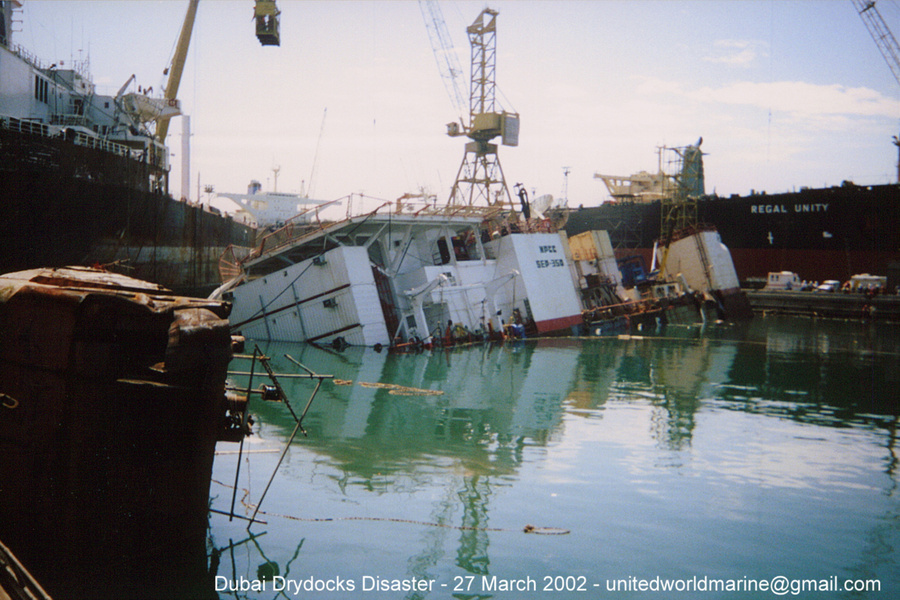
On 27 March 2002, Dock No. 2 at Dubai Drydocks suffered catastrophic flooding while work was being carried out on its dock gate.
According to the contemporary Dubai Drydocks statement carried by the UAE’s official Emirates News Agency, two panels of Dock Gate No. 2 ruptured at around 09:00, allowing seawater to enter the dock uncontrollably for more than an hour. Five vessels were inside the dock at the time.
The final casualty count was subsequently reported as 29 dead or unaccounted for and presumed dead.
The significance of the accident goes beyond the failure of a single component. A dry-dock gate is the primary barrier separating hundreds of workers and large vessels from an enormous external hydrostatic load.
What it shows
Maintenance of safety-critical infrastructure creates a difficult paradox: the system normally protecting workers can itself become temporarily weakened while it is being repaired.
That means maintenance on dock gates, caissons, pumping systems and similar infrastructure should not be treated as ordinary maintenance.
The consequences of failure need to determine the level of control.
For critical barriers, this can mean independent engineering verification, clearly defined permissible work conditions, secondary protection where practicable, emergency evacuation planning and restrictions on other operations while the barrier is compromised.
The lesson is straightforward: when the protection system itself is under maintenance, the entire facility may be operating in an abnormal risk condition.
3. Qingdao Beihai Shipbuilding fire — China, 2026
25 fatalities, 5 injured
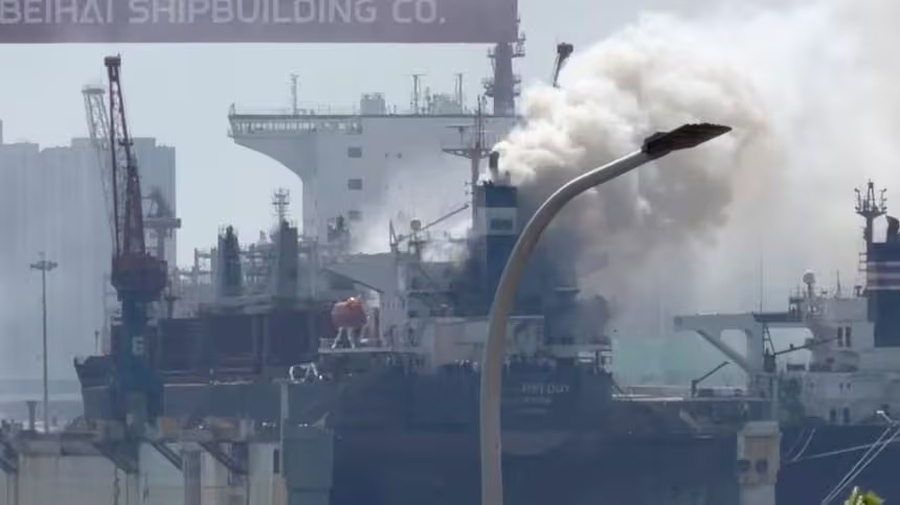
On 10 September 2026, a fire broke out aboard a foreign cargo vessel undergoing maintenance at CSSC Qingdao Beihai Shipbuilding in Qingdao.
China’s Ministry of Emergency Management confirmed that the fire began at approximately 11:15 while the vessel was alongside for repairs. Twenty-five people were killed and five were injured. The State Council subsequently established a national-level investigation team led by the Ministry of Emergency Management.
As of 6 October 2026, the Chinese government has not publicly released a final investigation establishing the physical cause of the fire.
It would therefore be premature to attribute the disaster specifically to welding, gas accumulation, hot work or another ignition source.
What it shows
Even without a final causal finding, the accident highlights the particular difficulty of fire safety during ship repair.
A vessel undergoing maintenance may no longer have the same fire-safety configuration it has in service. Systems can be isolated, access routes can be temporarily obstructed, machinery can be opened, and several contractors may perform unrelated jobs simultaneously in neighbouring compartments.
Unlike an open industrial facility, a vessel also contains complex vertical and horizontal escape routes, narrow accesses and enclosed compartments that can make evacuation and firefighting difficult.
For repair yards, personnel tracking, escape-route control, fire detection, simultaneous-operations management and emergency response therefore need to function as one integrated safety system.
4. Queen Mary 2 gangway collapse — France, 2003
16 fatalities, 29 injured
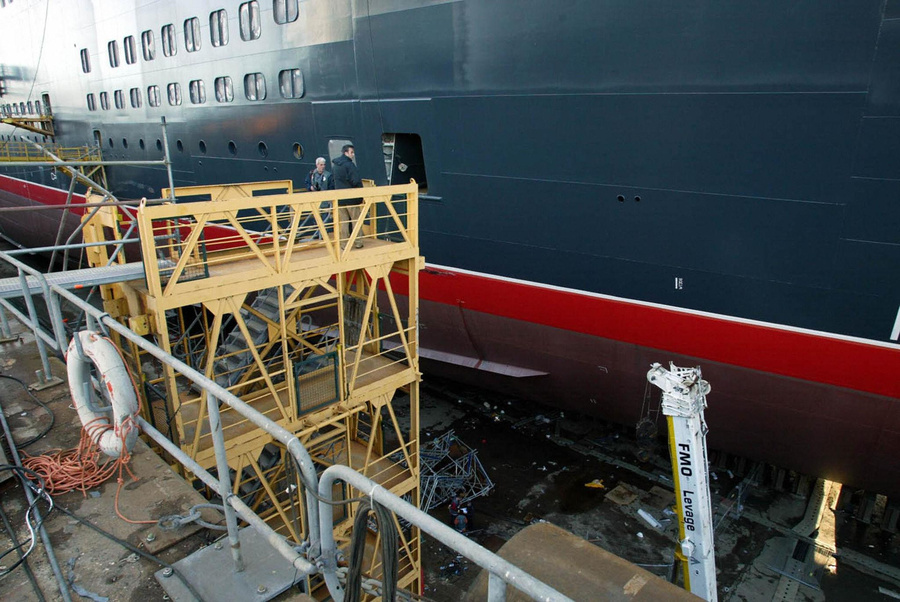
On 15 November 2003, a temporary access gangway leading to the nearly completed Queen Mary 2 collapsed at Chantiers de l’Atlantique in Saint-Nazaire, France.
Forty-six people were using the structure when it failed, sending them approximately 18 metres to the ground. Sixteen people died.
France’s Court of Cassation later recorded that expert investigations found the gangway was physically unstable because of deficiencies in its design and construction, particularly the absence of horizontal bracing.
France’s ARIA industrial accident database provides further detail. The gangway had been modified shortly before the accident, and experts later found that a structure carrying members of the public should have been designed for a load of 500 kg/m² rather than the 150 kg/m² applied to the gangway.
What it shows
The accident is an important example of the risk associated with temporary works.
Shipyards apply extensive engineering procedures to hull structures, cranes, lifting operations and vessel systems. Temporary access platforms, gangways, scaffolding and staging can appear much less significant.
But their consequences of failure can be just as severe.
A temporary structure carrying personnel should have defined design loads, engineering calculations, inspection requirements and formal approval.
More importantly, any change in use must trigger another assessment.
A structure originally intended for materials cannot automatically be assumed suitable for dozens of workers or visitors simply because it physically provides access.
Temporary does not mean low consequence.
5. MT Federal II explosion and fire at ASL Shipyard — Indonesia, 2025
14 fatalities
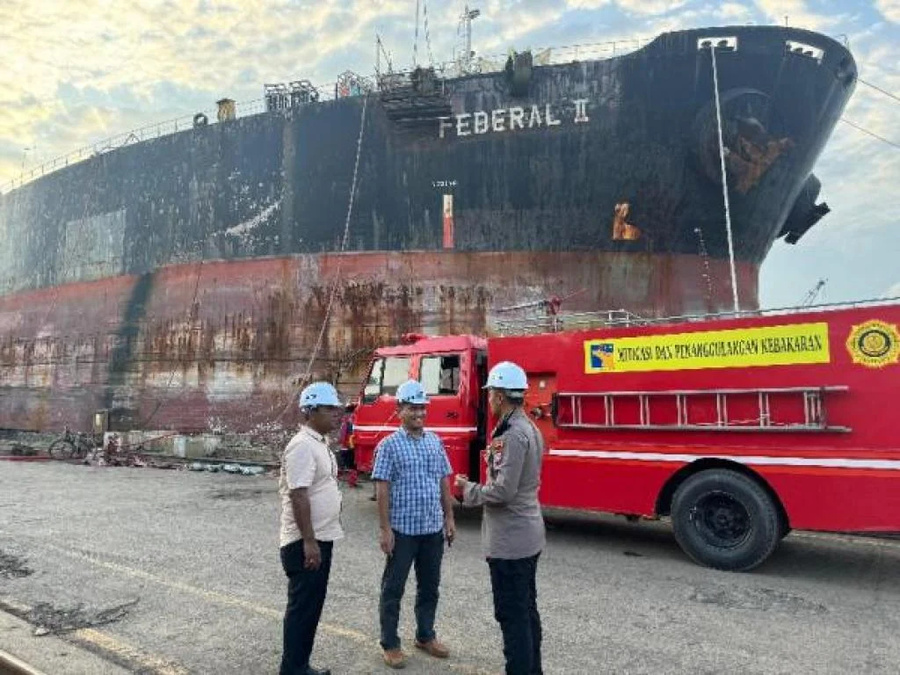
On 15 October 2025, an explosion and fire occurred aboard the tanker Federal II while it was undergoing repairs at PT ASL Shipyard in Batam, Indonesia.
Police records show that workers were repairing a cargo oil tank when fire and an explosion occurred inside the tank area. Initial official reporting recorded 10 deaths, but the toll subsequently rose to 14 as injured workers died.
The case became particularly significant because the same vessel had experienced another fire during repair work several months earlier.
Police subsequently investigated whether hot work, permit controls, contractor supervision and other safety procedures had been properly implemented. Court proceedings in 2026 examined allegations involving work permits, confined-space activities and tank-cleaning arrangements. Seven management personnel were eventually sentenced to prison terms of between one and two years for negligence connected with the deaths.
The precise ignition sequence should nevertheless be distinguished from broader management failures established or examined during the legal proceedings.
What it shows
The Federal II accident illustrates why a permit-to-work system cannot become an administrative formality.
A hot-work permit should represent confirmation that conditions actually permit the work to proceed: the atmosphere has been assessed where necessary, combustible residues have been considered, adjacent spaces have been checked, fire watches are established and interacting work has been coordinated.
The earlier accident aboard the same vessel raises another fundamental issue.
When a serious incident occurs, simply correcting the immediate defect may not be enough. A recurrence should trigger a wider review of the safety-management system, including contractor control, supervision, work authorisation and whether lessons from the first accident were actually implemented.
A common pattern: all five accidents occurred outside normal operating conditions
The five disasters were technically very different.
One involved installation of a giant crane. Another occurred while work was being carried out on a dry-dock gate. One involved a temporary access structure. Two occurred aboard vessels undergoing repair.
But they share an important characteristic:
all five occurred while a vessel, structure or critical piece of equipment was being installed, maintained, repaired or temporarily configured.
That pattern matters.
Normal operations usually have defined procedures, established equipment configurations and known responsibilities. During construction, commissioning and repair, those assumptions can disappear.
A structural component may not yet have its permanent restraint system.
A ship’s normal fire-protection arrangements may be unavailable.
A temporary gangway may be modified to perform a task for which it was not originally designed.
A safety-critical dock gate may itself be the equipment being worked on.
These are not simply variations of normal operation. They are temporary operating states with their own risk profile.
Contractor interfaces are another recurring vulnerability
Another feature visible across several accidents is the involvement of multiple companies.
Major shipyards rely heavily on specialist contractors for erection, fabrication, cleaning, coating, electrical work, tank work and other activities.
Contracting itself is not the problem. The risk emerges when technical and safety responsibilities become fragmented.
Who controls the lift?
Who verifies that temporary works remain within their design envelope?
Who confirms that a tank is safe for hot work?
Who coordinates two contractors working in adjacent compartments?
Who has authority to stop the operation?
If the answer changes depending on which company is asked, the control system is already vulnerable.
The real safety lesson is to manage abnormal operations differently
The central lesson from these five disasters is broader than PPE, toolbox talks or additional safety training.
Shipyards need to identify when an operation has moved away from its normal configuration and apply a higher level of control accordingly.
Installation, commissioning, repair, temporary structures, modification of safety-critical equipment and simultaneous work should be treated as distinct operating conditions.
For high-consequence activities, management should be able to demonstrate that the temporary configuration has been engineered, responsibilities are unambiguous, interacting work has been assessed, emergency escape remains possible and a credible failure scenario has been considered before people are exposed.
The technology used in modern shipbuilding has changed dramatically since 2000.
The fundamental hazards have not.
Heavy structures still collapse when loads or restraints are misunderstood. Water still overwhelms failed barriers. Fire still spreads rapidly through enclosed shipboard spaces. Temporary structures still fail when their actual use exceeds their design assumptions.
The strongest lesson from the industry’s worst accidents may therefore be simple:
temporary conditions require permanent engineering discipline.