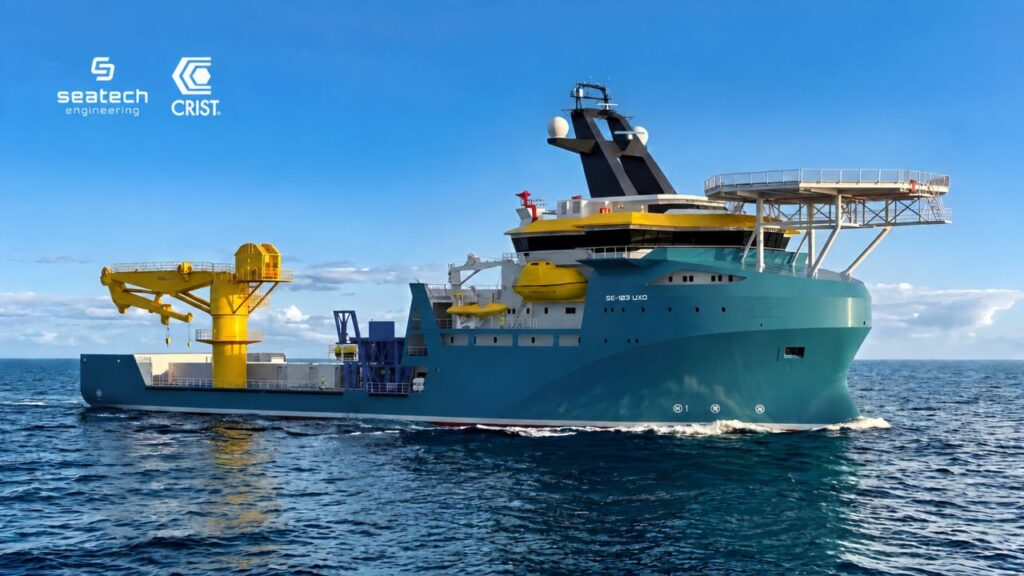
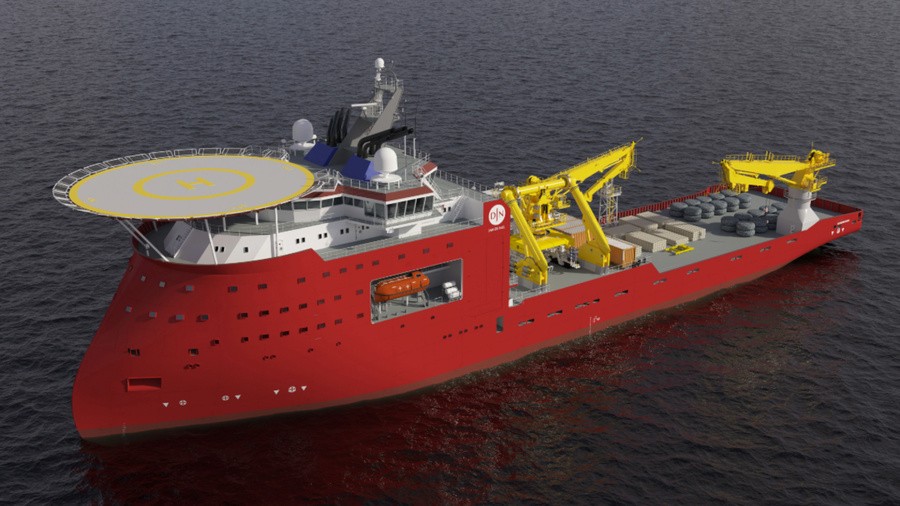
Jan De Nul has ordered a second newbuild trenching support vessel based on a customised design from Ulstein Design & Solutions, adding another vessel for subsea cable burial operations.
The vessel will be an exact sister ship to Isambard K. Brunel, which Jan De Nul ordered in March 2026. The second order follows the exercise of an option included with the first vessel contract.
The two vessels will deploy trenching robots from onboard to bury subsea cables. The equipment will be capable of installing cables as deep as 5 m below the seabed.
Ulstein said the new vessel will use its X-BOW hull design. It will also incorporate Jan De Nul‘s Ultra-Low Emission vessel technology, known as ULEv. According to Jan De Nul, the system can filter up to 99% of nanoparticles from exhaust emissions.
The engines will be able to operate on biofuel and will be prepared for future use of methanol.
With the latest order, Jan De Nul now has five new vessels under construction for subsea cable installation and protection. These include the cable-laying vessels Fleeming Jenkin and William Thomson, the rock installation vessel George W. Goethals, and the two trenching support vessels.
Fleeming Jenkin has completed its first sea trials and is in the final phase of construction. William Thomson is also under construction, while George W. Goethals is being built for rock installation work to protect subsea cables and other energy infrastructure.
The five newbuilds are expected to increase Jan De Nul‘s fleet for subsea cable installation and protection to 14 vessels.
In a separate fleet project, Jan De Nul is converting Henry Darcy from a water injection dredger into a compact trenching support vessel. The converted vessel will use the Crayfish subsea robot for cable burial work in shallow waters.