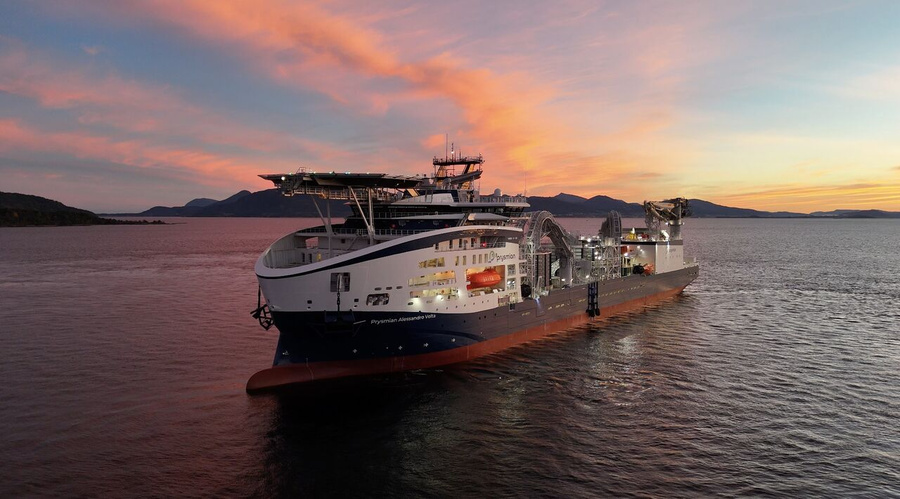
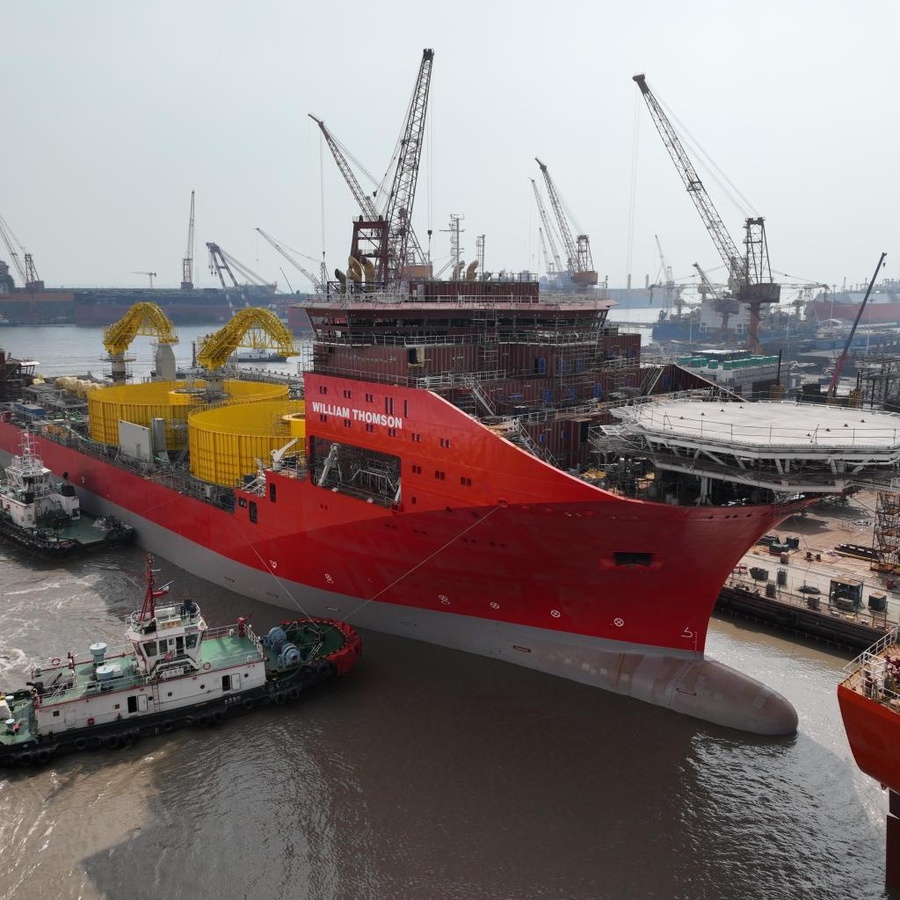
Jan De Nul has launched William Thomson, the second of two identical subsea cable-laying vessels currently under construction.
The vessel follows its sister ship, Fleeming Jenkin, which was launched in October 2025 and is scheduled for delivery in the fourth quarter of 2026. William Thomson is expected to enter service in the first half of 2027.
Each vessel measures 215 m in length and offers a cable carrying capacity of 28,000 tonnes, making them the largest in this segment, according to Jan De Nul. The vessels are designed to install subsea cables in both shallow waters and at depths of up to 4,000 m.
Their high carrying capacity allows longer cable sections to be transported in a single load, enabling extended installation routes with fewer subsea connections. This reduces the need for return trips to reload cables, contributing to lower costs, reduced environmental impact and improved cable quality.
Both vessels and their onboard systems were developed by Jan De Nul’s in-house teams. Wouter Vermeersch, Director Subsea Cables Offshore Energy at Jan De Nul, said the vessels reflect the company’s accumulated experience in cable installation and are designed for efficient operations.
Once operational, the two vessels will begin work on the 2 GW offshore grid programme by TenneT, the transmission system operator in the Netherlands and parts of Germany. The project introduces a new generation of offshore grid connections, each capable of transmitting up to 2 GW, compared with typical levels of 700–900 MW.
Under this programme, the vessels will install more than 2,800 km of 525 kV DC cables across four grid connections.
In 2028, one of the vessels will also be deployed to install three 220 kV DC cables linking Princess Elisabeth Island to shore. The energy island, being developed in a joint venture for Elia, will connect Belgium’s second offshore wind zone and support regional grid integration in the North Sea.