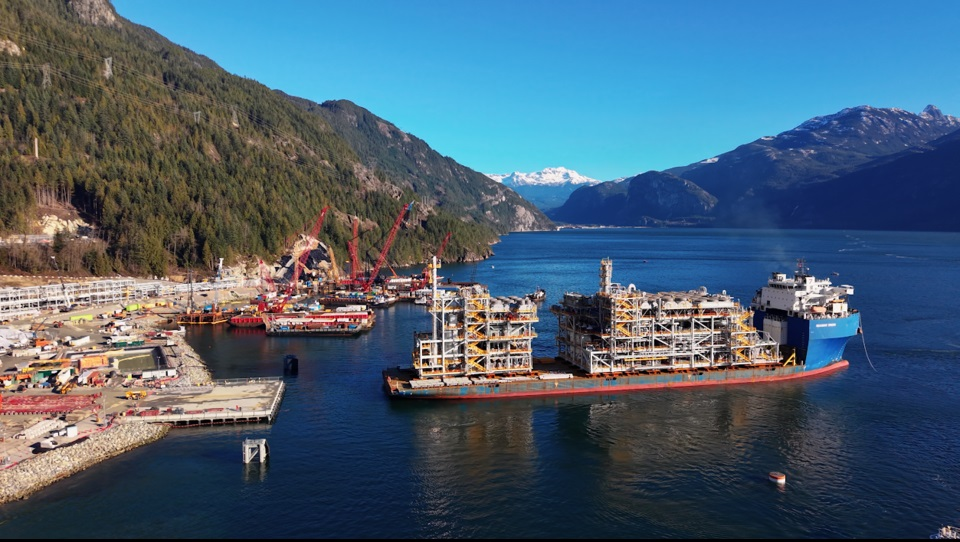
Semi-submersible heavy transport vessel Seaway Swan has delivered two major process modules to the Woodfibre LNG site in Squamish, moving the LNG facility’s construction closer to the 60% completion mark.
The shipment comprises the pretreatment module and the process utility module, identified as modules 13 and 14 out of a total of 19 that will make up the core of the Woodfibre LNG facility. As with previous units, these modules were fabricated at the QMW McDermott Fabrication Yard in Qingdao City, China, before being loaded for sea transport.
Seaway Swan is classified as an HTV—heavy transport vessel—operated by Seaway7, part of the Subsea7 group. Built by Qingdao Beihai shipyard in China, the ship is registered in Norway under the Norwegian International Ship Register (NIS) flag. It is designed to carry larger and longer cargoes than other vessels in the owner’s fleet and features a semi-submersible deck that can be submerged for loading and unloading. The vessel can accommodate up to 48 people in 39 cabins.
Once in service, the pretreatment module will remove moisture and trace gases from the incoming stream so the gas meets strict specifications for liquefaction. This step is essential because materials such as water will freeze solid at temperatures below the -162 C required to produce LNG, creating a risk of process disruption or damage to equipment. The pretreatment unit is among the largest components of the plant, weighing about 12,300 t and measuring more than 90 m in length and 47 m in height—similar in height to a 12-storey building and approaching the length of a soccer field.
The process utility module functions as a support hub for several parts of the LNG process. According to Woodfibre LNG, it houses a tempered cooling water system, a hot oil heating system, and a thermal oxidizer. Together, these systems help maintain the required process temperatures and provide additional emissions reduction management when needed.
After Seaway Swan arrived in Squamish, inspections were carried out, and the seafastening was cut. The modules are now being prepared for unloading and transfer into position using self-propelled modular transporters, in line with the project’s construction sequence.
“These modules are critical building blocks of Woodfibre LNG, each serving important roles in the operation of our future facility,” said Luke Schauerte, CEO of Woodfibre LNG, in a company statement. He added that taking delivery of these units brings the project another step closer to construction completion and to supplying additional Canadian LNG to global markets. A further five modules are scheduled to arrive at the site over the coming months.