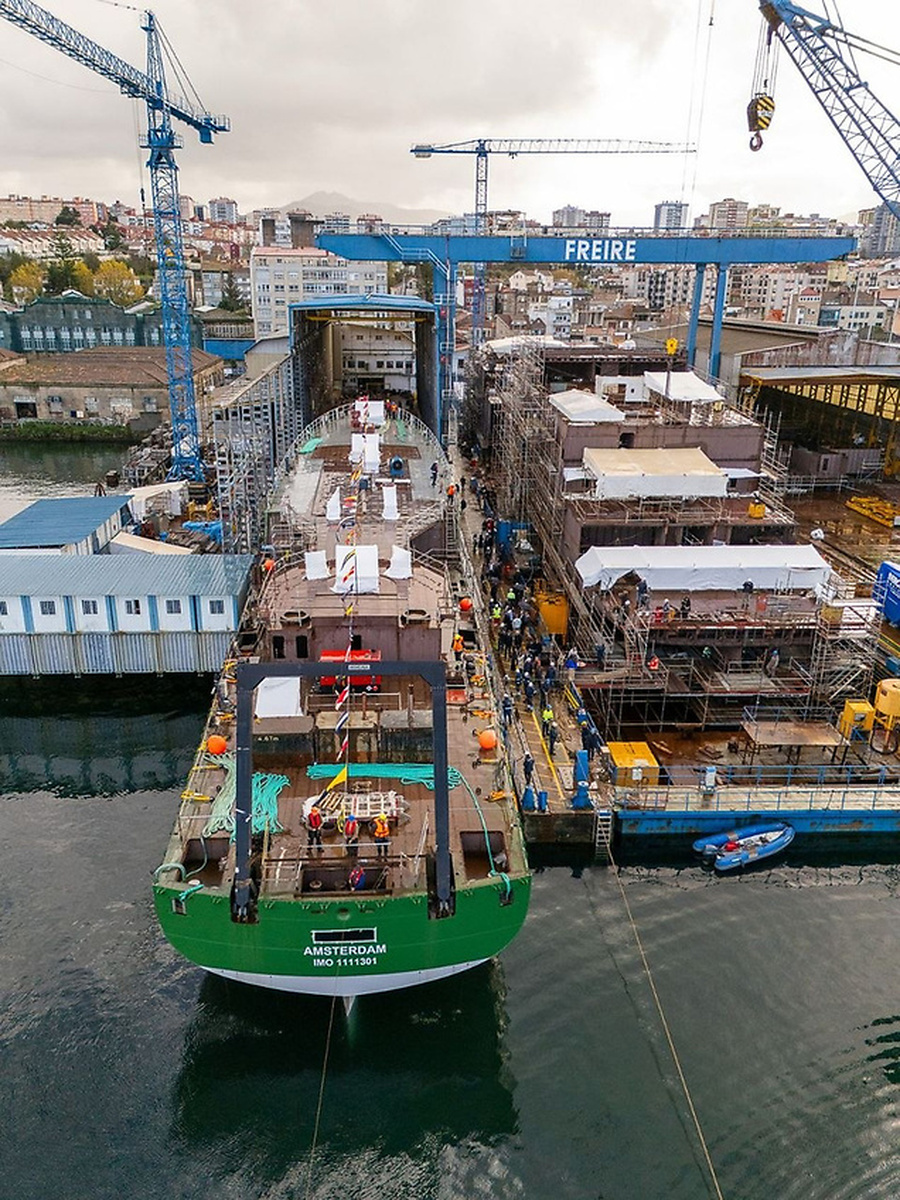
Freire Shipyard launched the new Greenpeace wind-powered flagship in Vigo, Spain, on 25 November 2026. Commissioned by Greenpeace International, the 75-metre vessel carries hull number NB 737 and is scheduled for delivery by the end of 2027.
Designed by Dykstra Naval Architects, the newbuild will support environmental campaigns and scientific expeditions across the world’s oceans, including polar regions.
The vessel will be equipped with laboratories and systems for deploying remotely operated vehicles (ROVs) and autonomous underwater vehicles (AUVs). Its operational equipment will also include a helideck and four auxiliary boats designed to operate in challenging sea conditions.
Wind will serve as the vessel’s principal source of propulsion. An automated DynaRig system will feature two rotating masts with a total sail area of 1,746 square metres. According to the shipyard, favourable weather conditions could allow the vessel to complete a circumnavigation entirely under sail.
The propulsion arrangement will also enable electricity generation through the propellers during sailing. This energy recovery capability will form part of an integrated onboard power system incorporating solar panels, batteries and hydrogen fuel cells.
Additional power will be supplied by four dual-fuel generator sets configured to use green methanol as their main fuel. Small quantities of marine gas oil will be required for ignition.
Greenpeace International aims to eliminate fossil fuel consumption once the necessary fuel supply chains and infrastructure are established. The combination of wind propulsion, energy recovery and alternative fuel technologies forms the basis of the vessel’s approach to reducing dependence on conventional marine fuels.
Following delivery, the new flagship will join the organisation’s existing fleet, which comprises Rainbow Warrior III, Arctic Sunrise and Witness.