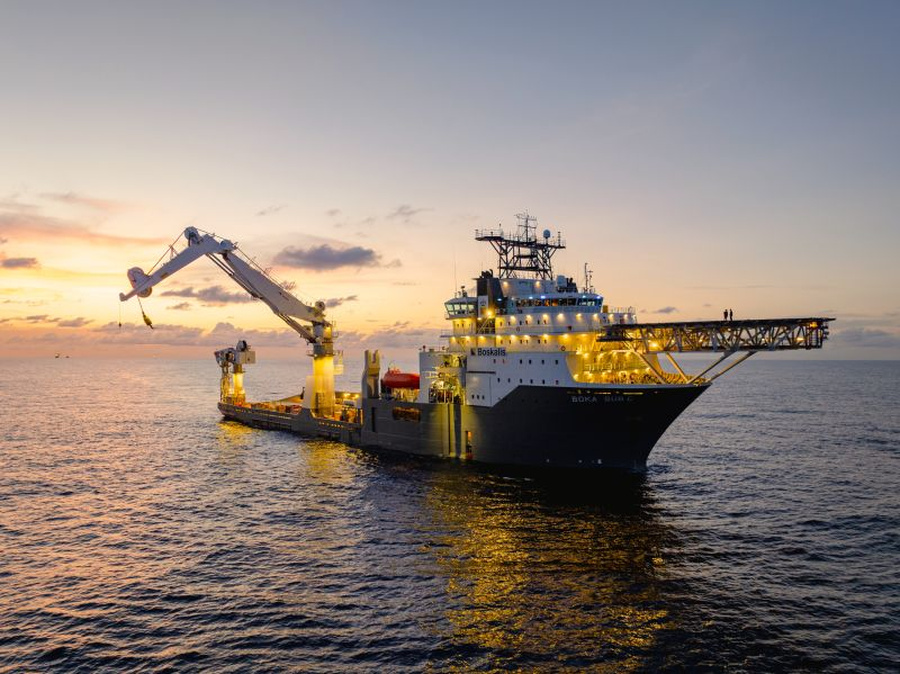
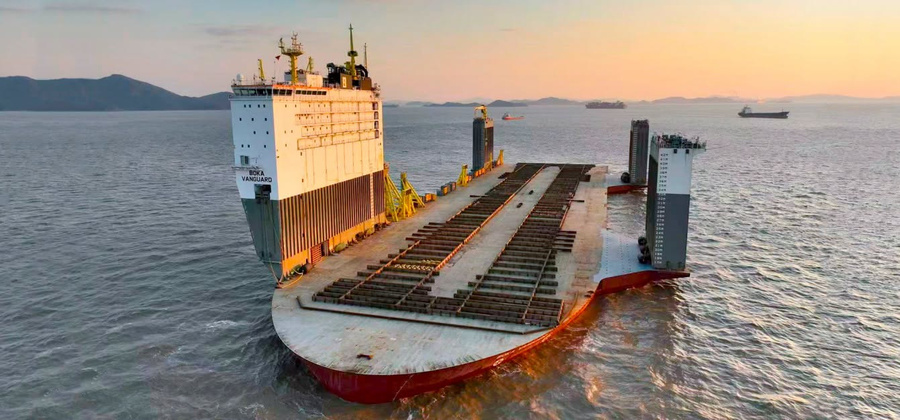
The BOKA VANGUARD heavy transport vessel was designed to move large offshore facilities, ships and other oversized cargo. Built by Hyundai Heavy Industries in 2012, it was developed by Dockwise with Finland-based Deltamarin and first entered service as Dockwise Vanguard. Boskalis acquired Dockwise in 2013 and renamed the vessel BOKA VANGUARD on 30 April 2018.
Dockwise saw a need for a vessel capable of carrying increasingly large floating oil and gas facilities from construction yards to their destinations. The company’s concept was intended to reduce transport time and cost while allowing offshore units to be built economically at shipyards. The resulting vessel has a flat, open deck without a conventional bow, with the bridge and accommodation block positioned on the far starboard side. Four movable buoyancy casings can be repositioned, and the watertight deck is designed to allow water to pass over it.
The original cargo deck measured 275 by 70 metres. In 2024, the vessel was widened by 10.3 metres, taking the deck width to more than 80 metres. The port-side outriggers were relocated and enlarged, increasing the separation between the casings to 80 metres. The modification made room for wider cargoes, including floating dry docks.
The vessel loads floating cargo by submerging its deck. The supplied specifications state that its 93 ballast tanks can lower the deck to about 16 metres below the water’s surface. Cargo is positioned over the submerged deck before the tanks are emptied and the vessel rises. It can also load from a quay or by skidding cargo along tracks. Its stated cargo capacity is up to 110,000 tonnes, and it can accommodate 40 crew.
The first cargo was the 53,000-ton Jack/St. Malo oil platform, loaded in February 2013 at Samsung Heavy Industries in South Korea for transport to the Gulf of Mexico. Other planned assignments at the time included the Goliat FPSO and Aasta Hansteen spar platform, both under construction at Hyundai Heavy Industries. The 193-metre Aasta Hansteen was expected to be the largest floating spar platform built at the time.
The vessel has also been used as a floating dry dock. In 2013, it supported work on the semi-submersible drilling platform Noble Paul Romano in Malta, where local docks could not accommodate the unit. In 2019, it carried Carnival Vista to Grand Bahama for Azipod repairs after a crane collapse put one of the shipyard’s dry docks out of service.
A proposed assignment to transport the Costa Concordia wreck to an Italian scrapping yard did not proceed. The vessel was instead refloated and towed to Genoa in July 2014. After BOKA VANGUARD was widened, it transported a 360-metre floating dry dock to Yalova, Türkiye, in May 2025 and the East End floating dry dock to Grand Bahama in October 2025. The supplied material also lists the 385-metre-long, 60-metre-wide, 36,000-ton fish farm Havfarm 1, also known as Jostein Albert, among its notable cargoes.
The supplied account describes BOKA VANGUARD as currently carrying the semi-submersible drilling rig TRANSOCEAN ENDURANCE to Olen, Norway. HMT News has covered the current transport of the rig.