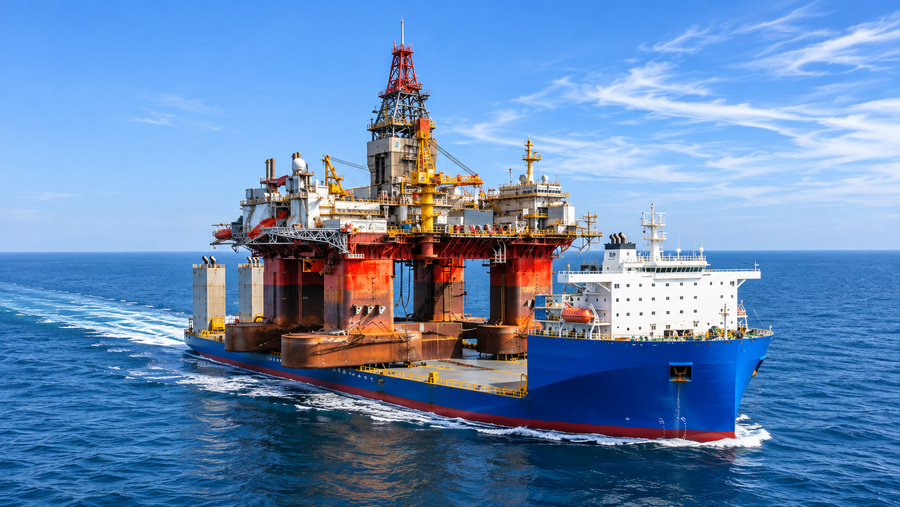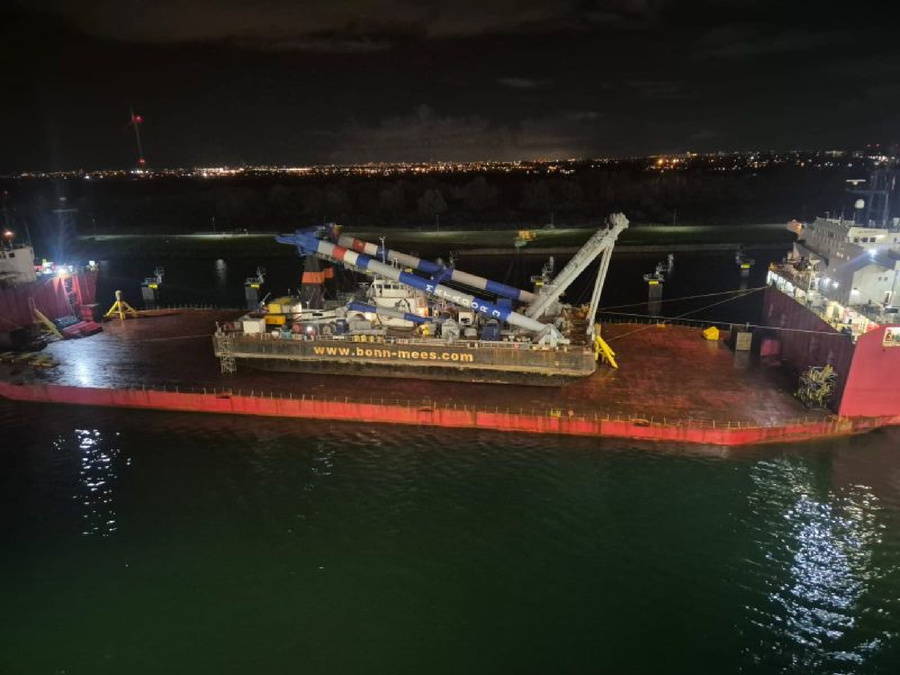
Semi-submersible heavy transport vessels (SSHTVs) are designed to carry large floating structures by temporarily submerging their cargo decks, allowing the cargo to float into position before being lifted clear of the water.
Known as Float-on/Float-off (FLO/FLO), this method is widely used to transport offshore drilling rigs, floating production units, ships and other large marine structures. Although the basic principle has remained largely unchanged for decades, modern operations involve detailed stability calculations, cargo-specific ballast sequences, structural analysis and precise control of load transfer.
The key engineering challenge is transferring the cargo’s weight from buoyancy to the transport vessel’s supporting structure, and reversing that process at the discharge location, without exceeding the operational or structural limits of either.
Planning the Loading Operation
Every Float-on operation begins with an engineering assessment tailored to the cargo and transport vessel.
The cargo’s displacement, draft, dimensions, centre of gravity and structural support locations must be established. Engineers also assess the transport vessel’s stability, ballast capacity, deck strength, longitudinal strength and permitted submerged draft.
Particular attention is given to the cribbing arrangement. Cribbing provides the supporting interface between the cargo and transport deck, distributing the cargo’s weight into suitable structural areas of the vessel.
Support locations, anticipated reactions and structural deflections must be considered to avoid excessive local loading during the transfer process.
The American Bureau of Shipping (ABS), in its 2022 Requirements for Building and Classing Semi-submersible Heavy Lift Vessels, specifies that detailed ballast sequence analysis must be undertaken for each Float-on/Float-off operation, considering the cargo’s properties and sea conditions.
This means the ballast plan must be developed for the specific loading or discharge operation rather than relying solely on a vessel’s general operating procedures.
Controlled Ballasting and Submergence
Once the loading location and operational conditions have been confirmed, the SSHTV begins taking seawater into its ballast tanks.
The additional ballast increases the vessel’s displacement and draft, gradually lowering the cargo deck beneath the water surface.
During submergence, the ballast distribution must be controlled to maintain the required trim, heel and stability. Engineers assess changes in waterplane characteristics, the free-surface effect of partially filled tanks and the vessel’s longitudinal structural loading.
The vessel must retain adequate stability and reserve buoyancy throughout the operation, including at intermediate submerged conditions.
The planned deck submersion must provide sufficient clearance for the floating cargo and its underwater structures, while maintaining the required under-keel clearance for the transport vessel.
The ballast system of COSCO Heavy Transport’s Xiang He Kou illustrates the scale of equipment used on a modern SSHTV.
According to the vessel’s published specifications, it has 61 ballast tanks, four air compressors rated at 6,600 m³/hr each, two ballast pumps rated at 1,200 m³/hr each and two additional pumps rated at 160 m³/hr each.
The vessel has a 177.6 m by 43 m cargo deck and a published deck submersion capability of 13 m.
The compressor ratings describe air-system capacity, not a direct ballast-water transfer rate. Actual ballasting and de-ballasting performance depends on the ballast system configuration, operating conditions and approved sequence.
Positioning the Floating Cargo
After the transport vessel reaches its planned submerged condition, the floating cargo is moved above the cargo deck.
Positioning may involve harbour tugs, towing lines, tugger winches or guide structures, depending on the cargo and loading location.
The cargo must be aligned with its designated support points while maintaining sufficient clearance from the transport vessel’s side structures and cribbing.
Wind, waves, swell and current can affect the relative movement between the cargo and transport vessel. These environmental effects become particularly important when the cargo approaches its final loading position.
The positioning operation must therefore be completed within the approved environmental limits before the transport vessel begins taking the cargo’s weight.
Load Transfer: The Critical Stage
The most critical stage begins when the transport vessel starts discharging ballast water.
As the SSHTV rises, the cribbing approaches the cargo’s supporting structure. Initial contact marks the beginning of the transfer from buoyant support to structural support.
At first, the cargo remains largely supported by its own buoyancy.
As de-ballasting continues, the cargo’s immersed volume decreases, reducing its buoyancy and progressively increasing the load carried by the cribbing and transport vessel.
Under static conditions, the vertical force balance can be expressed as:
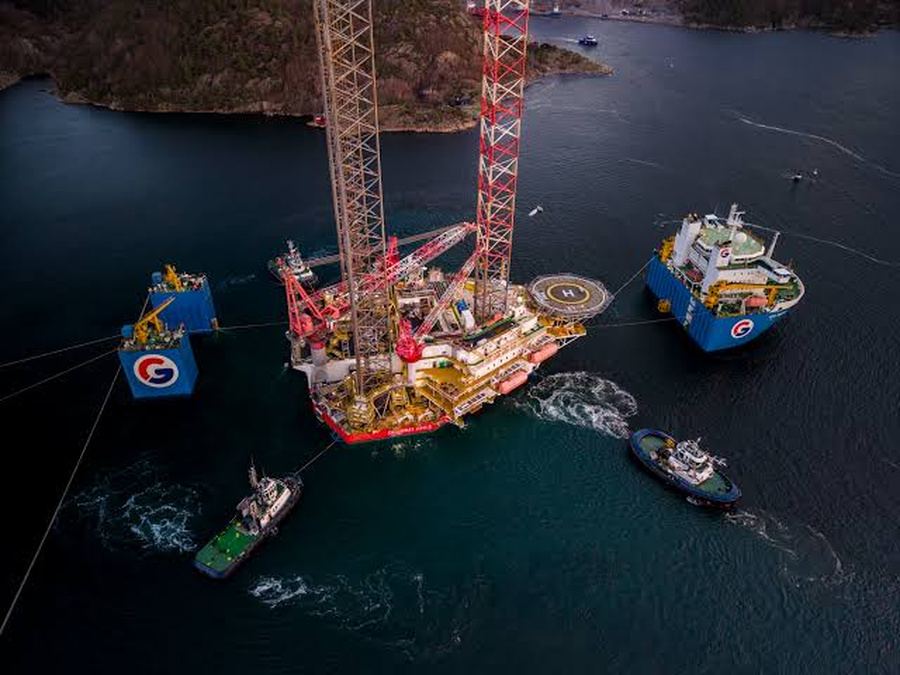
Cargo Weight = Remaining Buoyancy + Total Vertical Support Reaction
However, the transfer does not necessarily occur uniformly across all support points.
Individual cribbing reactions may differ because of cargo geometry, support alignment, hull deflection and relative movement between the cargo and transport vessel.
Consequently, the ballast sequence must account for changes in trim, heel, support reactions and structural loading throughout the operation.
Excessive loading at an individual support point could exceed the allowable strength of the cargo structure, cribbing or transport deck, even when the total transferred load remains within the vessel’s overall carrying capacity.
The approved loading procedure must therefore consider both global vessel stability and local structural reactions.
Once the planned support condition has been achieved and verified, de-ballasting continues until the vessel reaches its approved transport condition.
Sea-fastening and Transport Preparation
After the cargo has been transferred onto the transport vessel, it must be secured for the intended voyage.
Cribbing provides the designed load-bearing interface, while sea-fastening arrangements restrain cargo movement under the forces expected during transportation.
The sea-fastening design considers static and dynamic loads, including those resulting from vessel motions, heel, trim, gravity and wind.
Engineers also evaluate how these loads are transferred into the cargo structure and the transport vessel’s deck.
Before departure, the final transport condition must satisfy the applicable stability, structural strength and cargo-securing requirements.
Float-off: Reversing the Load Transfer
At the discharge location, Float-off reverses the fundamental loading process, but it requires a separately approved operational sequence.
Ballasting and sea-fastening release must be coordinated according to the cargo’s stability, the restraint arrangement and the planned separation procedure.
The timing of sea-fastening removal cannot be treated as identical for every operation. The cargo must remain adequately restrained until the approved conditions for safe separation have been established.
As the transport vessel takes in ballast water and submerges, the floating cargo progressively regains buoyancy.
At the same time, the vertical reactions on the cribbing decrease until the cargo becomes fully afloat.
Once sufficient clearance has been established between the cargo and its supports, the cargo can be manoeuvred away from the submerged vessel.
The SSHTV then discharges ballast water to return to its planned floating condition.
As with Float-on, the discharge procedure must account for vessel stability, cargo behaviour, structural loading, environmental limits and positioning arrangements.
Modern Heavy Transport Operations
Recent transport projects demonstrate the continued importance of Float-on/Float-off engineering, particularly when multiple floating cargoes are carried on a single voyage.
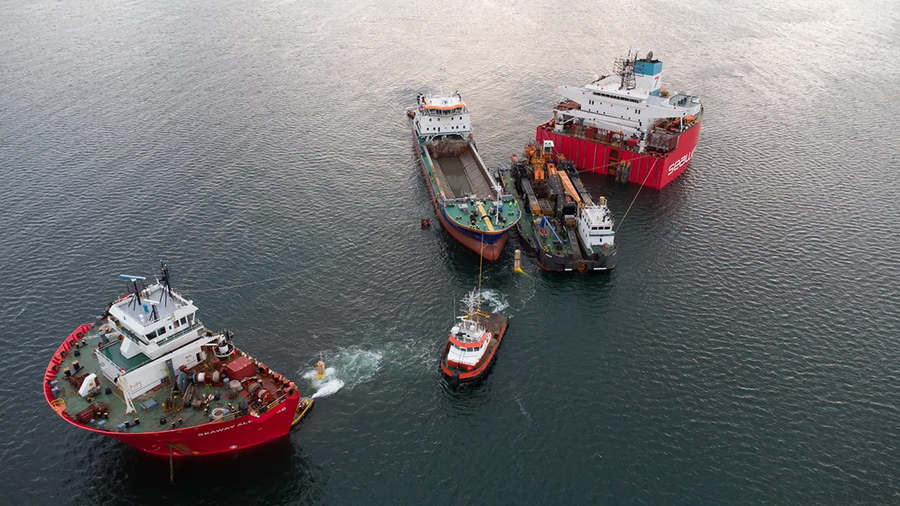
Boskalis reported a transport operation in which its semi-submersible heavy transport vessel White Marlin carried Micoperi’s pipe-laying vessel Seminole and two tugs from Bonny, Nigeria, to Bahía Blanca, Argentina.
The project required three floating cargoes to be positioned above the submerged deck and held in alignment as the transport vessel emerged from the water.
Such operations illustrate the additional positioning and load distribution considerations involved when multiple cargoes share one transport deck.
Modern vessels may also offer enhanced positioning capabilities. COSCO Heavy Transport lists DP2 capability in the specifications of Xiang He Kou, although the DP system is also described as optional.
Dynamic positioning is not a universal requirement for Float-on/Float-off operations. Its availability and use depend on the vessel’s configuration and the approved operational plan.
Float-on/Float-off must also be distinguished from float-over installation. In a float-over operation, an offshore topside is transferred onto a fixed supporting structure rather than being lifted from the water onto a transport vessel.
Engineering Standards and Operational Assurance
Modern heavy transport operations are supported by vessel classification requirements and project-specific marine engineering standards.
ABS requirements address submerged stability, ballast systems, structural strength and operational documentation for semi-submersible heavy lift vessels.
Separately, DNV-ST-N001 Marine Operations and Marine Warranty provides a framework for the planning and assessment of marine transportation, load-out and installation operations. DNV announced a substantial revision of the standard in February 2024.
The applicability of individual class rules and marine operation standards depends on the vessel, project and contractual requirements.
Where required, a Marine Warranty Surveyor reviews the relevant engineering documents, risk assessments and operational procedures before the operation proceeds.
The fundamental challenge remains unchanged: throughout Float-on and Float-off, the forces supporting a floating cargo are continuously redistributed between buoyancy and the transport vessel.
Managing that transition through controlled ballasting, stability assessment and structural load transfer is what enables modern semi-submersible heavy transport vessels to carry some of the largest floating structures in the offshore and maritime industries.