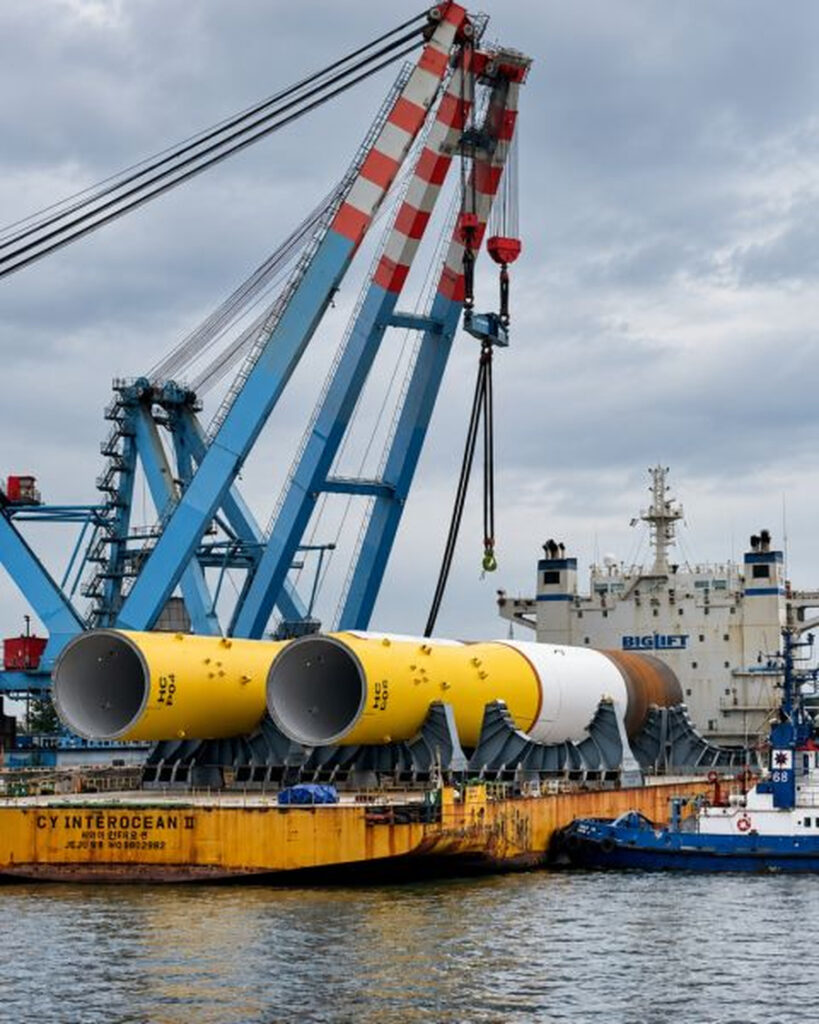

The first transition pieces for the Bałtyk 2 & 3 offshore wind farms have begun their journey from the Smulders facility in Hoboken, signaling the start of a delivery sequence that will supply 100 units for one of Poland’s largest offshore wind developments.
After months of fabrication, the initial structures were transferred from the yard under strict safety procedures and dispatched toward Vlissingen, where they will remain in storage ahead of installation. These large yellow components, which connect monopiles to turbines, require precisely planned lifting and handling—a process in which timing and weather considerations shape every move.
The project’s progress also reflects a coordinated, cross-border manufacturing effort. Smulders and Sif are jointly producing all 100 transition pieces, supported by secondary steel fabrication from Polish workshops in Żary, Niemodlin, and Łęknica. This geographically distributed supply chain links Belgium, the Netherlands, and Poland as the Bałtyk 2 & 3 developments work toward first power in 2027 and full operation in 2028.
Offshore installation activities are scheduled to begin in spring 2026. Each completed load out confirms that fabrication remains aligned with the delivery plan for the 1.44 GW project, which is being developed by Equinor and Polenergia. With additional transition pieces set to follow, the latest shipment moves the Baltic Sea closer to becoming a major renewable-energy hub.