Japanese shipyard investment plans worth about ¥900 billion combine public funding with private spending on dock restoration, lifting equipment and automated production. Eight plans have received government approval as Japan targets 18 million GT of annual shipbuilding output by 2035.
The Ministry of Land, Infrastructure, Transport and Tourism authorised the first three plans on 4 September 2026 under the Economic Security Promotion Act. Five further approvals followed on 11 September 2026, bringing the total government funding ceiling to roughly ¥311 billion. The national output target compares with a shipbuilding capacity figure of 9.07 million GT recorded for 2024.
Dock restoration is part of Hakodate Dock‘s expansion programme in Hokkaido. Its No. 4 dock became unusable after an earthquake in 1993 off Hokkaido’s southwestern coast. In a report dated 26 October 2026, Jiji Press said the company would drain and inspect the structure before carrying out repairs. The report placed the expected resumption of newbuilding in the dock around 2032.
Restoration would allow Hakodate Dock to build more than double its 2024 annual total of about five small bulk carriers. Together with Namura Shipbuilding, the company plans to spend as much as ¥150 billion during 2026–2035. The approved subsidy limit for their joint plan is roughly ¥49.9 billion. Work also includes constructing or extending production facilities in Hakodate and Muroran and adding Goliath cranes at Namura Shipbuilding‘s Imari yard in Saga Prefecture.
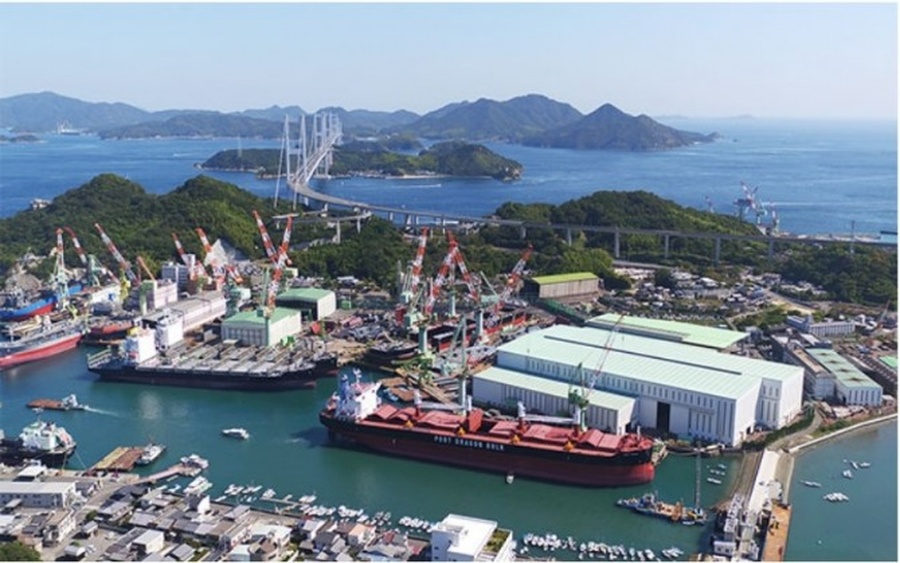
Jiji Press put the expected investment in the Imabari Shipbuilding group at around ¥300 billion. The group plans to add jib cranes for heavy lifting and robotic equipment for steel-plate welding, including at Marugame in Kagawa Prefecture and Saijo in Ehime Prefecture. Imabari Shipbuilding applied jointly with Tadotsu Shipbuilding and Steel Hub for a plan eligible for roughly ¥113.8 billion in government support at most.
At Sakaide in Kagawa Prefecture, Kawasaki Heavy Industries plans capital spending of approximately ¥45 billion. The company said on 11 September 2026 that labour-saving equipment, automation and replacement cranes would strengthen its ability to produce hulls for liquefied gas carriers. The approved public contribution is limited to roughly ¥15.6 billion.
Jiji Press reported that Kawasaki Heavy Industries also intends to introduce robots equipped with AI at Sakaide. The deployment forms part of the plant’s digitalisation plans in response to staffing shortages in welding and other skilled work.
At Koyagi in Nagasaki, Oshima Shipbuilding plans to add cranes and improve its buildings. Jiji Press reported an annual production goal of roughly 10 bulk carriers by around 2031. That would represent 2.5 times the present output. Government support for Oshima Shipbuilding has a ceiling of roughly ¥6.1 billion.
The ministry also approved plans involving the Japan Marine United group, the Shin Kurushima group, Naikai Zosen and Mitsubishi Shipbuilding. Their respective subsidy limits are approximately ¥49.4 billion, ¥32 billion, ¥4.3 billion and ¥40 billion.