South Korean and Japanese shipbuilders are expanding robotics and automated production as labour shortages and competition from Chinese yards increase pressure on the two countries’ shipbuilding industries.
Data from Clarksons showed that Chinese shipbuilders secured 63% of ship orders last year. South Korea and Japan together accounted for about 40% of global vessel production over the same period and retain significant capabilities in LNG carriers, submarines and marine engines.
Shipbuilding remains difficult to automate because vessels vary in design and structure. Production also takes place across large yards and inside narrow or irregular spaces, leaving many processes dependent on skilled workers.
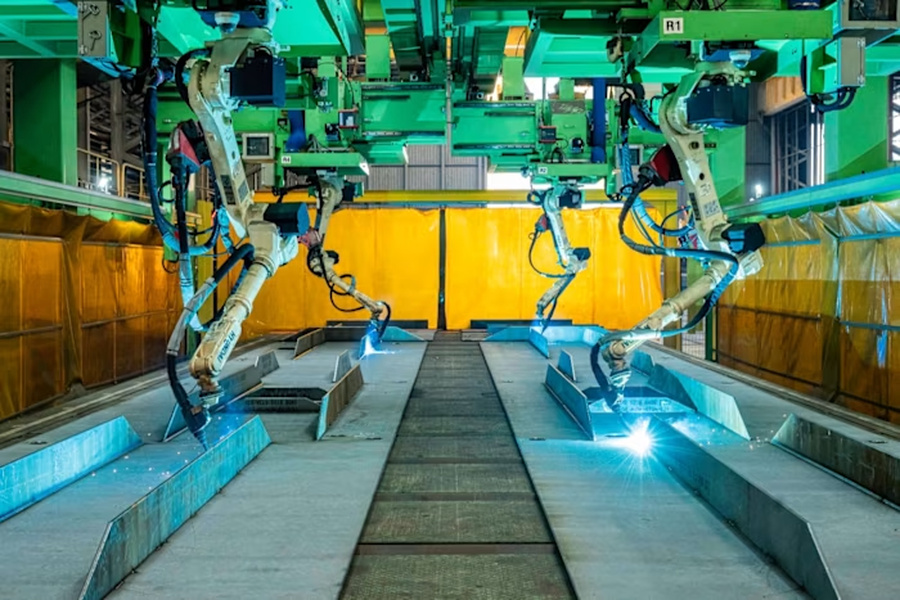
At HD Hyundai‘s yards in Ulsan, robots use design data to identify welding locations, move between ship blocks and carry out simple welding tasks while workers supervise operations through computer systems.
Separately, HD Hyundai Samho estimates that an employee can complete as many as 30 welding cells a day, while robots can increase output to as many as 50. The company sees robotics as a way to address labour shortages while maintaining consistent production quality.
HD Hyundai plans to expand automated production by 2030 using artificial intelligence, big data and digital twins. HD Hyundai smart shipyard plan The group aims to fully automate selected production lines and establish a small-scale facility designed to operate with very limited human intervention.
Hanwha Ocean has invested KRW 160 billion ($120 million) in smart-yard development over the past two years and is targeting automation of 70% of its production by 2030.
For standardised welding work, the company said a single operator can supervise as many as 10 robots. Hanwha Ocean also plans to introduce automation at its US operations as South Korea and the United States expand shipbuilding cooperation.
Japan is also increasing the use of robotics in shipbuilding. HMT News: Japan-U.S. AI shipbuilding robotics Fanuc has produced its first two welding and painting machines developed specifically for shipbuilders.
The robotics manufacturer ultimately wants the number of robots deployed in Japan’s shipbuilding industry to match its workforce of about 75,000 people, including the use of automated systems for night-time production.
The extent to which China is ahead of South Korea and Japan in shipyard automation remains disputed. Seoul National University professor Woo Jong-hun said Chinese yards were adopting robots more aggressively, while Hong Kong Polytechnic University professor George Q Huang estimated that South Korean and Japanese shipyards could be around five years ahead in robot adoption.
Labour availability is also influencing automation in China. Shipyards there face difficulties attracting younger workers to physically demanding jobs as the country’s population declines.
Despite the expansion of robotics, major technical limitations remain. HD Hyundai Samho said robots can perform more than 90% of simple welding tasks, but more complex work including curved-block welding, painting and plumbing remains difficult to automate.
Samsung Heavy Industries also considers automation necessary but has acknowledged that the technology remains technically difficult and expensive to introduce.
In Japan, Imabari Shipbuilding has highlighted uncertainty over the timing and effectiveness of automation investment as yards assess the cost of adopting new production technologies.
South Korean and Japanese shipbuilders also face a different investment environment from their Chinese rivals. Export-Import Bank of Korea researcher Yang Jong-seo said extensive government support allows China’s shipbuilding industry to absorb more of the risks associated with testing and introducing automation technology.