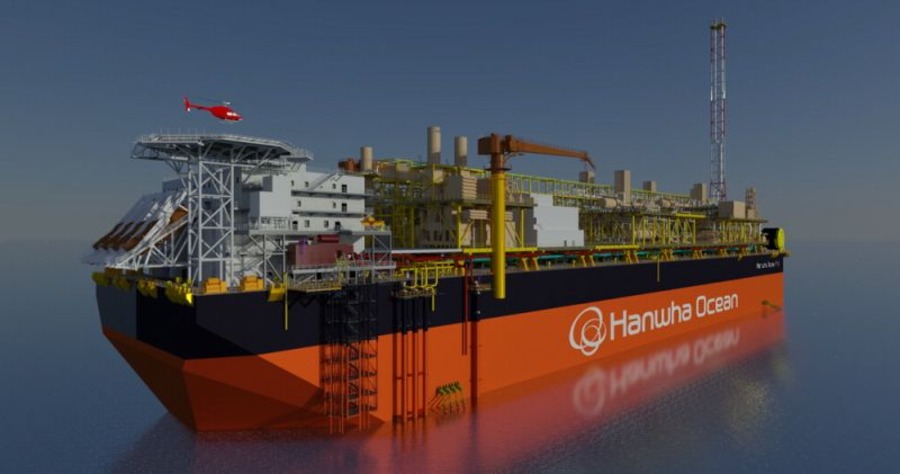
Hanwha Ocean is competing with SBM Offshore for an FPSO contract tied to the Venus oil field offshore Namibia, while a possible delay in the project’s final investment decision is creating uncertainty over the timing of the award.
The Venus development is planned in waters about 3,000 m deep off southern Namibia. Up to 40 production and injection wells are planned on the seabed, with crude oil to be processed and stored on an FPSO before being transferred to ships.
The planned FPSO will have production capacity of 150,000 barrels per day. The total project is estimated at $3 billion, or about 4 trillion won. TotalEnergies, the project developer, is targeting first oil from the Venus field in 2030.
The final investment decision had been widely expected in July, but the schedule was pushed back as the Namibian government and TotalEnergies had yet to complete an agreement on financial terms. At the recent Namibia Oil & Gas Conference, concerns were raised that the FID could be delayed until next year.
Hanwha Ocean and Netherlands-based SBM Offshore are in the final competition for the FPSO contract. The award is expected to be finalized after TotalEnergies makes its investment decision.
For Hanwha Ocean, the bidding comes after several years without a new large offshore plant order. Its last major FPSO project was P-79, which began in 2021 when the company was Daewoo Shipbuilding & Marine Engineering.
The company’s energy plant division recorded an operating profit of 6 billion won in the second quarter of this year. The result included temporary revenue from delivery of the P-79 FPSO for Petrobras. The division also posted an operating profit of 39 billion won in the fourth quarter of last year, reflecting an additional settlement following changes to contract terms for an existing project.
Financial-market analysis cited in the source linked the absence of large offshore plant orders to rising fixed-cost pressure and weaker profitability in the division.
Hanwha Ocean has continued work on standardized FPSO designs. This month, it received approval in principle from DNV for a low-carbon standard FPSO design framework and obtained a Practical Sustainability Execution Plan certificate from ABS. TotalEnergies is reviewing carbon-reduction measures for the Venus development.
The company also received approval from Bureau Veritas last year for a standard FPSO concept design tailored to West African operating conditions. This year, it obtained class certification for a standard FPSO front-end engineering design intended for South American projects.
Price competitiveness and previous FPSO orders have been cited as factors that could influence the contractor selection. SBM Offshore operates 16 FPSOs and is already carrying out an FPSO project with TotalEnergies. It also holds standardized FPSO design technology and contracts hull construction to partner shipyards in China.
During its second-quarter earnings call last month, SBM Offshore indicated that it did not plan to reduce expected project returns to secure the Namibia project. It described Venus as strategically important while stating that it does not lower the expected rate of return for individual projects.
Even if Hanwha Ocean wins the contract, FPSO design alone can take from one and a half years to more than two years, creating a gap before revenue is recognized.
Bae Gi-yeon, an analyst at Meritz Securities, projected that if Hanwha Ocean secures FPSO projects including the Namibia development, its energy plant division could post cumulative operating losses of 317 billion won through 2027 before recording an operating profit of 831 billion won in 2028.
Bae also said that short-term losses can occur even after FPSO orders are secured, while the projected return to profitability in 2028 could change if no new orders are won.