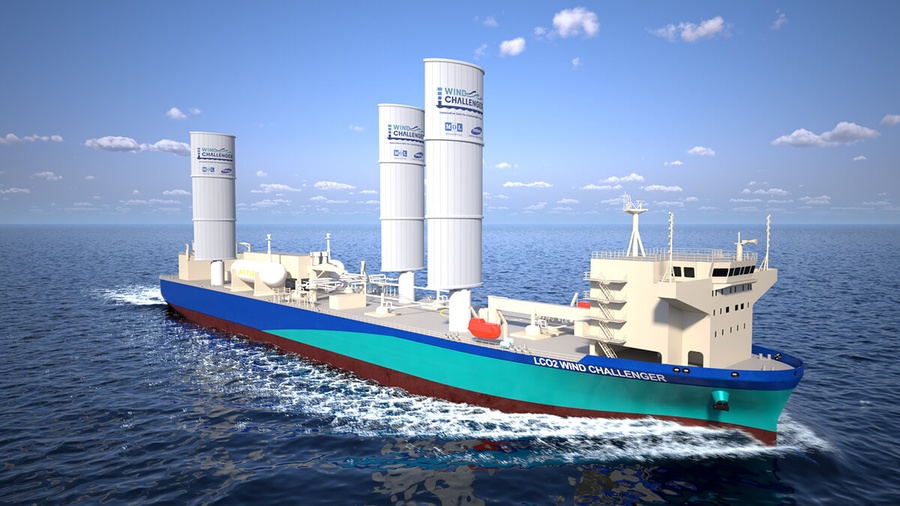
Mitsui O.S.K. Lines, Ltd. (MOL) has obtained Approval in Principle (AiP) from ClassNK for a liquefied CO2 carrier design equipped with three Wind Challenger hard sail wind-assisted propulsion units. The design was jointly developed with Samsung Heavy Industries Co., Ltd. for the cross-border transportation of liquefied CO2.
The AiP was granted on 14 April 2026, and the award ceremony was held on 22 April 2026 at the ClassNK booth during Sea Japan 2026 at Tokyo Big Sight. The approval covers a liquefied CO2 carrier with a cargo tank capacity of about 40,000 m3.
The vessel design places the navigation bridge and accommodation spaces toward the bow. This arrangement is intended to secure the visibility required for ship handling while allowing the installation of three Wind Challenger units. By using wind power to assist engine propulsion, the design is expected to reduce fuel consumption and greenhouse gas emissions.
Safety features were also incorporated into the concept, including a safety passage between the engine room and accommodation spaces, as well as optimized arrangements for navigation lights and lifeboats. MOL, Samsung Heavy Industries Co., Ltd., and ClassNK also carried out a HAZID study to identify and assess risks specific to liquefied CO2 carriers equipped with wind-assisted propulsion systems, confirming the technical feasibility and safety of the concept.
Wind Challenger is a rigid sail system that can be extended, retracted, and rotated automatically. MOL said applying the system to liquefied CO2 carriers is expected to reduce emissions generated during the CO2 transportation process in the CCS value chain and help mitigate environmental impact.
The vessel concept has an approximate LOA of 224m and a breadth of 35.2m. Each Wind Challenger unit is designed with a height of up to 49m, a width of about 15m, and sail material made of fiber-reinforced plastic.
MOL has set a medium- to long-term target of achieving net zero GHG emissions by 2050 under its Environmental Vision -BLUE ACTION 2035 Phase 2-. The group plans to expand the number of vessels equipped with Wind Challenger to 25 by 2030 and 80 by 2035. So far, three vessels have already been delivered, and installation has been confirmed for a total of eight vessels, excluding this liquefied CO2 carrier concept.
The company said the development of the liquefied CO2 carrier concept represents a step toward supporting decarbonization through CCS while also reducing fuel consumption and GHG emissions in marine transport.