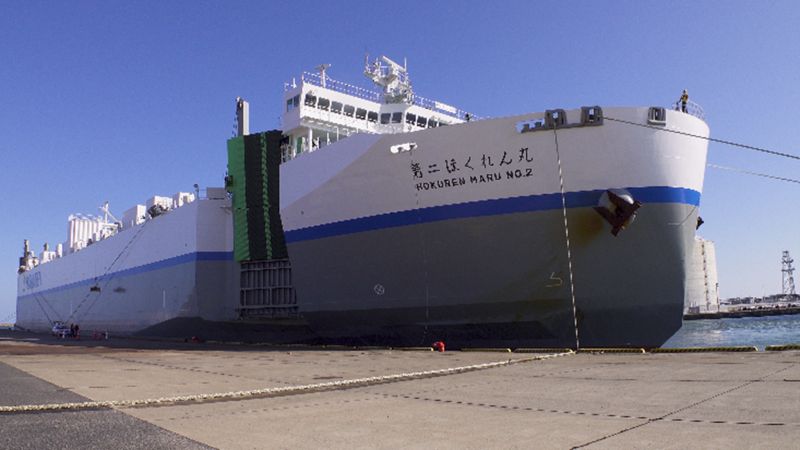
Kawasaki Kisen Kaisha, Ltd. said HOKUREN MARU No.2 has completed autonomous navigation demonstration tests and passed Japan’s statutory ship inspection as an autonomous vessel, making it the first RORO vessel in the country to clear that inspection category.
The approval means HOKUREN MARU No.2 can use autonomous navigation functions during commercial service on the Kushiro–Hitachi route. The company said the system offers functions equivalent to SAE Level 4 automation, allowing highly automated operation in a designated area under specific conditions.
Operated by Kawasaki Kinkai Kisen Kaisha, Ltd., the vessel serves the domestic route between Kushiro Port in Hokkaido and Hitachi Port in Ibaraki Prefecture. It mainly transports agricultural products, including raw milk. The ship is about 173 m long and 11,413 gross tons.
The vessel is one of four demonstration ships in The Nippon Foundation’s unmanned autonomous ship project under MEGURI2040. In the RORO Vessel Working Group, “K” LINE is working with Kawasaki Kinkai Kisen, Japan Radio Co., Ltd., and YDK Technologies Co., Ltd. to develop an integrated bridge officer support system designed to convert existing ships into autonomous vessels through retrofit solutions.
Japan’s Ministry of Land, Infrastructure, Transport and Tourism established standards and inspection methods for autonomous vessels in June 2024 and published the study results in June 2025. To operate as an autonomous vessel, ships must pass inspections confirming that core systems, including collision avoidance and route deviation prevention functions, operate properly.
According to the company, HOKUREN MARU No.2 received notation for autonomous ships from Nippon Kaiji Kyokai (ClassNK) on 27 January 2026 and passed the statutory inspection by the Ministry of Land, Infrastructure, Transport and Tourism on 9 February 2026.
“K” LINE said the project is part of broader efforts to address labor shortages, reduce workload burdens, prevent accidents caused by human error, and support stable domestic logistics and transport infrastructure in Japan’s coastal shipping sector.