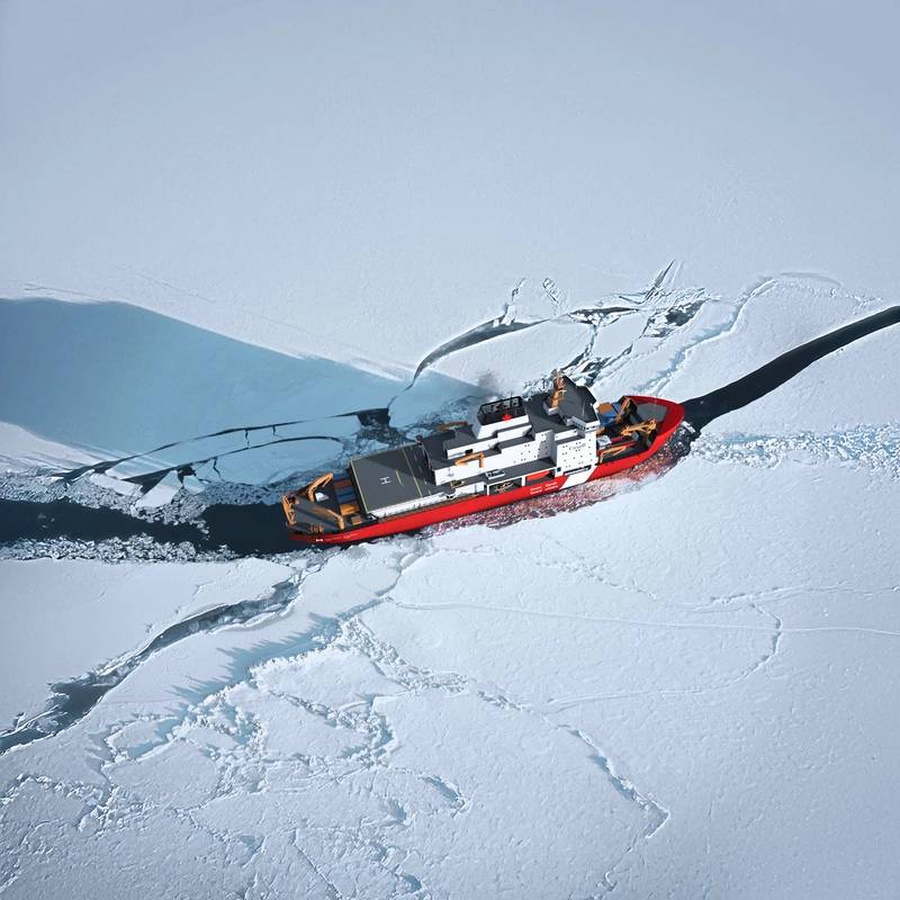
Seaspan Shipyards has licensed its Multi-Purpose Icebreaker design to support the U.S. Coast Guard’s Arctic Security Cutter program, providing an engineering package that includes nearly 47,000 individual technical information files.
The files were transferred to Arctic Security Cutter builders Bollinger Shipyards in the United States and Rauma Marine Constructions in Finland. The two shipyards can use the engineering information as a basis for adapting production details to their own construction processes.
Before the licensing agreement, the Multi-Purpose Icebreaker design had completed class approval. Major equipment selections had also been finalized, while technical procurement specifications had been completed for about 100 major equipment packages. Material definitions and a three-dimensional production model were also part of the engineering work.
Seaspan Shipyards has expanded its engineering organization from about 20 people to approximately 300 engineers. Its engineering workload includes Offshore Fisheries Science Vessels, Offshore Oceanographic Science Vessels, Joint Support Ships, Canada’s future Polar Icebreaker and as many as 16 Multi-Purpose Icebreakers under the Canadian Coast Guard program.
The company uses three-dimensional modelling across its shipbuilding programs before production begins. Engineering models are integrated with a Product Lifecycle Management system, connecting bills of material, planning information, work packages and installation sequencing during construction.
Production teams also use tablets on the shop floor to access models and work orders, check dimensions and address engineering questions. Laser surveying and total station technology are used for dimensional control during block assembly.
For its icebreaker engineering work, Seaspan Shipyards has collaborated with Finnish specialists. Railo Technology, formerly known as Aker Arctic, provided experience related to icebreaking hull forms, while Elomatic contributed detailed design knowledge. Seaspan engineers also worked within Finnish design teams before returning to Vancouver.
Standardization is another part of Seaspan’s Canadian icebreaker programs. Approximately 40% of major engineered equipment packages are common between Canada’s Polar Icebreaker and Multi-Purpose Icebreaker programs. Commonality among commercial components, including valves, fittings, flanges and fasteners, is close to 90%.
The Arctic Security Cutter program is using engineering developed for Seaspan’s Multi-Purpose Icebreaker while Bollinger Shipyards and Rauma Marine Constructions adapt production information for their respective shipyard processes.