The PlemCat test site has received Environmental Impact Assessment (EIA) approval, clearing a key regulatory requirement for the deployment of the NextFloat Project in the LEBA 1 commercial area of the Spanish Mediterranean Sea.
The approval, published in Spain’s Boletín Oficial del Estado (BOE) on 8 July, confirms that the PlemCat test site complies with environmental protection requirements established by the Ministry for the Ecological Transition and the Demographic Challenge (MITECO). The assessment verified compatibility with marine environmental protection and biodiversity conservation, while also meeting a mandatory condition for future occupation of the Maritime-Terrestrial Public Domain for offshore wind development.
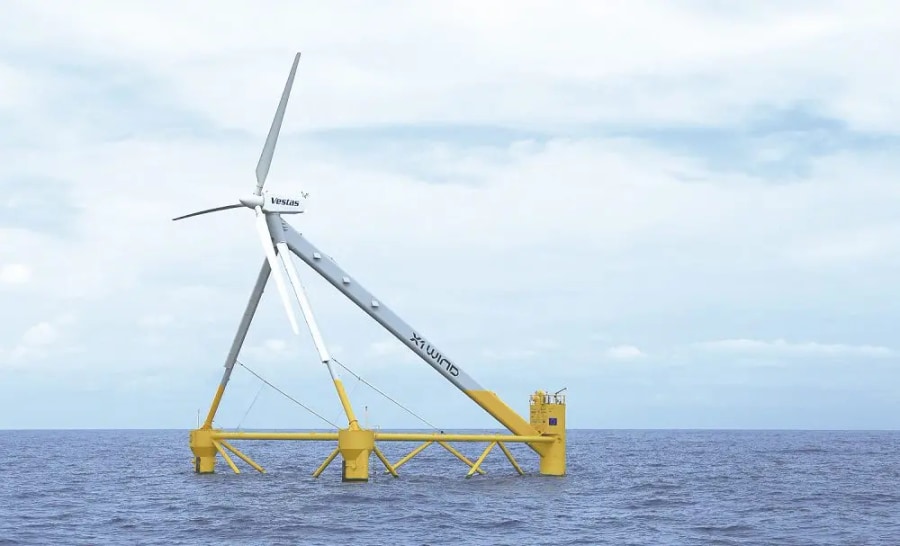
The NextFloat Project is led by Technip Energies and X1 Wind and will deploy X1 Wind‘s X100 8.5 MW floating wind platform. The design combines a Tension-Leg Platform (TLP) with semi-submersible characteristics to reduce environmental impact while maintaining cost efficiency. Its vertical mooring system significantly reduces the seabed footprint compared with conventional catenary moorings, limiting seabed disturbance and underwater noise while supporting coexistence with marine activities such as fisheries and scientific research.
The tripod-based X100 platform is designed for turbines with a rotor diameter of 160 m and requires approximately 1,500 tonnes of primary steel. According to the project, this represents an estimated steel weight reduction of 30% to 50% compared with conventional steel floating foundations used in European pre-commercial projects of a similar scale.
The demonstration unit will be equipped with a downwind turbine rated at 8.5 MW with a 160 m rotor diameter. Operational experience from the pilot installation will support prototype certification and the future commercialization of the larger X150 platform, which is intended for turbines exceeding 20 MW.
Project funding includes private investment together with support from the EU-funded NextFloat and NextFloat+ programs, the PAREF project financed by the French State under France 2030 and operated by ADEME, and Spain’s RenMarinas program.
The environmental approval follows another recent milestone for the project after X1 Wind‘s X100 platform received a Statement of Compliance for Basic Design from DNV. Together, the environmental authorization and independent design validation support the project’s next steps toward offshore deployment.
Alex Raventós, CEO and Co-founder of X1 Wind, said the EIA approval, together with the recent DNV Basic Design certification, demonstrates that the platform is prepared for deployment while meeting environmental and technical requirements.
Jacques Vendé, NextFloat Project Manager at Technip Energies, said the approval reflects the contribution of project partners and supports progress toward financial close ahead of the commercial-scale pilot deployment in the Mediterranean Sea.