Pakistan has begun assembling its first large commercial ship in more than 40 years, a 1,100 TEU containership under construction at Karachi Shipyard & Engineering Works for Pakistan National Shipping Corporation.
The project was announced in 2024, and the contract was signed in February that year. Financial difficulties delayed progress before government support helped restart the program. Steel cutting began in January 2026 and has now been completed, allowing assembly work to proceed.
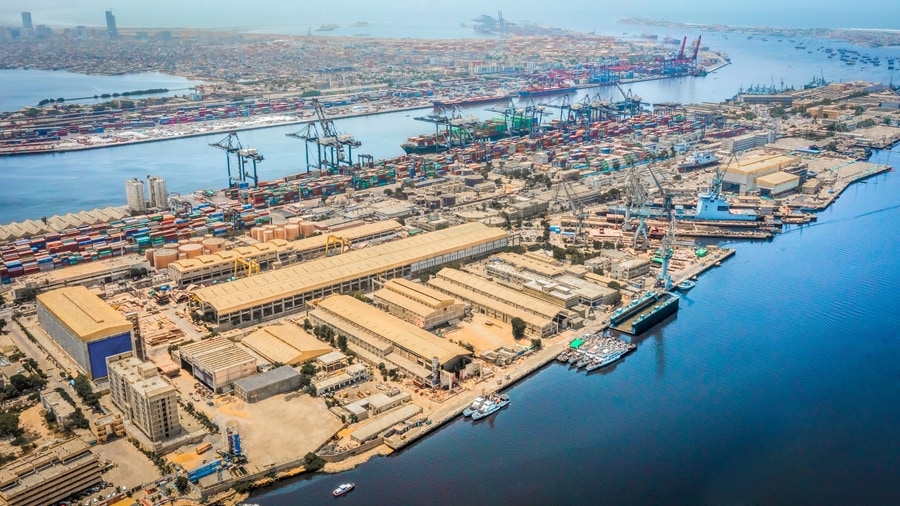
Karachi Shipyard & Engineering Works, Pakistan’s only shipyard, has focused mainly on naval construction since commercial shipbuilding largely stalled in the 1980s. Its recent work has included frigates, corvettes, fleet tankers and logistics ships for the Pakistan Navy.
The shipyard reports that it can build vessels of up to 26,000 dwt. Its stated construction range includes bulk carriers, tankers, dredgers, ferries, fishing boats and tugs.
The containership project forms part of a broader government initiative to develop Pakistan’s blue economy. A maritime task force established in 2024 identified 99 obstacles affecting the sector. The government reports that solutions have been implemented for 84 of them.
Financial reforms have also been introduced to support shipbuilding and vessel ownership. The government abolished a 22 percent sales tax on vessel purchases and shipbuilding materials. It noted that neighboring countries, including India, provide shipbuilding subsidies of up to 30 percent.
The reforms are intended to make Pakistan more attractive to shipowners. The government has also noted that the country’s largest shipowners have previously registered vessels in Panama and Liberia.
Pakistan is separately working to modernize port operations. Measures reported by the government include shorter customs clearance times, advanced container scanners and the introduction of 24-hour port operations.
The maritime plan also covers the recovery of the country’s ship recycling sector, which declined because of financial pressures and new environmental requirements. Pakistan has become a signatory to the Hong Kong Convention, while five ship recycling yards have reportedly achieved full compliance.
The government expects domestic shipbuilding to reduce foreign exchange costs and create employment. It also believes Pakistan could develop the capacity to export newly built ships.