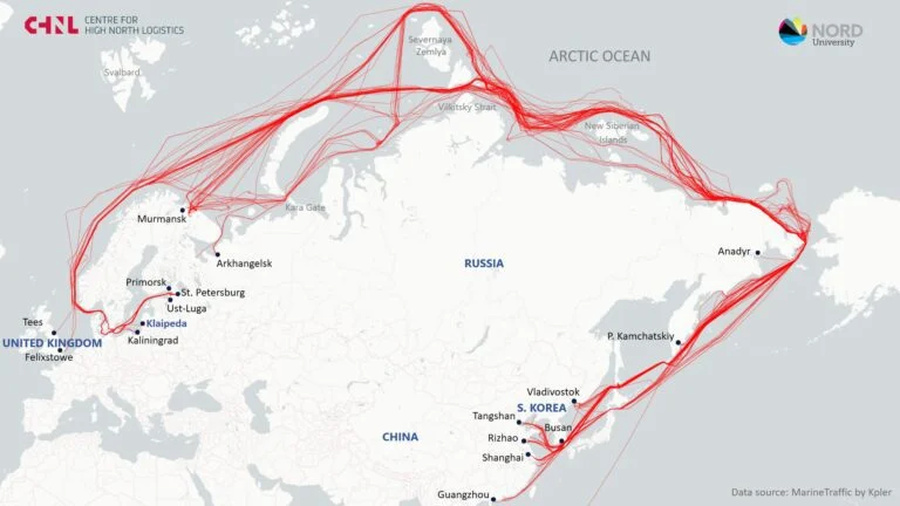
Northern Sea Route transits reached 104 by 30 September 2026, passing the full-season count of 103 for 2025, according to the Centre for High North Logistics (CHNL). In 2024, the Northern Sea Route (NSR) recorded 97 transits.
CHNL’s review estimates cargo movements of about 3.7 million tonnes, against 3.2 million tonnes in 2025, an increase it reports as 15%. Separately, aggregate vessel deadweight for the confirmed voyages was about 7.8 million tonnes DWT, up 26% from 6.2 million tonnes.
Using AIS records supplied by MarineTraffic by Kpler and information about individual sailings, CHNL compiled preliminary results. The reported cargo amounts remain estimates; they are not official totals. Its confirmed count includes ships that have cleared the NSR but are still heading to their destination ports.
Four voyages linked Asia directly with Europe, with neither endpoint in Russia. Only one such journey was completed in 2025. In the container segment, Panstar Acro travelled to the UK from South Korea, while Dubai Tower reached Britain from China and Riyadh Mukaab connected China with Felixstowe. Nan Xin 27, a bulk carrier, made the China–Klaipeda passage to Lithuania. Container vessels accounted for 13 transits overall.
Tankers carried the largest share of cargo. CHNL estimates that 22 passages heading east transported 2.1 million tonnes, mostly crude oil. Murmansk was the leading departure port; Primorsk and Ust-Luga followed.
Bulk-carrier cargo was estimated at 1.1 million tonnes over 13 eastward passages. CHNL also counted 27 westward bulk-carrier movements, many involving the relocation of vessels to Murmansk, Baltic ports and other locations in the west.
Ice influenced where ships could sail. In the earlier half of August, substantial traffic went around the northern side of Severnaya Zemlya, avoiding the usual passage through the Vilkitsky Strait. Improving conditions later in August drew ships back to that passage. By the beginning of September, the open-water areas had increasingly joined up along most of the route.
CHNL reported that these open-water conditions lasted beyond 30 September. In its assessment published on 9 October 2026, the centre expected freezing to begin near the middle of October and increasingly restrict ships lacking an ice class.
The season’s eventual totals depend on voyages still in progress. At the September cut-off, CHNL was tracking 45 additional potential transits. Of these, 25 vessels had entered the NSR, while 20 other sailings had already begun. Completion of most of those passages could bring the count close to 150. The centre also outlined a scenario involving more than 4.5 million tonnes of cargo, stressing that neither figure was a final result.