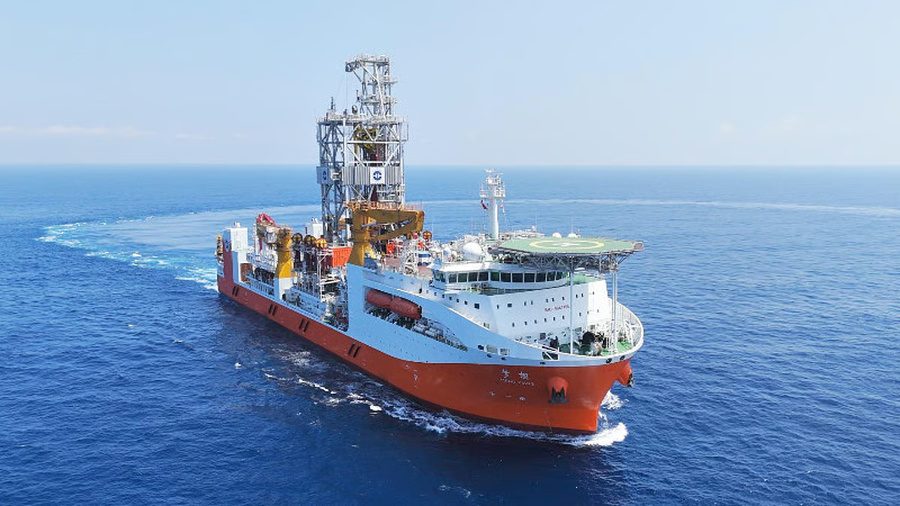
China’s deep-sea drilling vessel Mengxiang has finished its first scientific drilling campaign in the South China Sea, reaching a record depth for China and recovering basalt from beneath a deep ocean basin.
The 30-day programme was led by the China Geological Survey, with field operations conducted by the Guangzhou Marine Geological Survey. Working at two drilling sites in water depths of about 4,100 m, Mengxiang completed coring operations before returning to Guangzhou.
The deepest hole reached 4,929.17 m from sea level, while drilling extended as far as 864.77 m beneath the seabed. The result established a new Chinese record for scientific deepwater drilling.
A rotary coring system developed in China was used to retrieve a 4.27 m section of basalt. With the recovery, China joined the United States and Japan as countries that have obtained hard-rock samples from a deep ocean basin using a drilling vessel.
The recovered geological material will support deep-sea research into the formation and evolution of the South China Sea. Preliminary examination of the samples indicated volcanic activity associated with a shift in the spreading ridge.
Researchers also applied a core-handling process based on International Ocean Discovery Program standards. Samples were documented and processed onboard through a sequence that included cutting, scanning, testing and preservation.
In several drilling runs, the quantity of recovered core exceeded the corresponding drilled interval. This provided longer and more continuous material for subsequent scientific analysis.
At approximately 800 m below the seabed, drilling encountered alternating sedimentary layers together with thick deposits of dark sand and mud. The recovered material contained organic matter and indications of biological activity and was obtained in waters deeper than 4,000 m.
Two remotely operated vehicles were also deployed during the expedition. Together, they logged more than 358 operating hours at depths of around 4,000 m, including one continuous deployment lasting 103 hours.
The campaign tested Mengxiang’s ability to perform scientific coring, maintain stable drilling operations and work efficiently in deep water while collecting geological samples for further study of the South China Sea.