As offshore wind projects move into deeper waters, larger turbine foundations are driving demand for higher-capacity transport and lifting solutions. Responding to this trend, Mammoet has introduced new equipment designed to improve the safety and efficiency of handling next-generation XXL monopiles.
The company’s XXL monopile transport system, first introduced in 2024, and the newly deployed MTC 1600 terminal crane were recently used to support Van Oord during the marshaling of monopile foundations for the Baltic Power offshore wind farm.
The project involved the handling and marshalling of 78 monopiles weighing up to 1,680 tonnes, measuring as much as 86.3 m in length and 9.1 m in diameter. Once operational, Baltic Power is expected to generate approximately 4 TWh of electricity annually, covering around 3% of Poland’s national electricity demand.
The monopiles were transported in batches of three by barge to the Port of Ronne in Denmark. After arrival, they were unloaded using 78 axle lines of self-propelled modular transporters (SPMTs) equipped with Mammoet’s XXL monopile transport system.
Hydraulically operated foldable saddles supported each monopile while integrated jacking spacers safely lifted the structures from their sea-transit grillages. The monopiles were then transported to temporary storage areas and placed onto gravel bunds.
The transport system’s extended jacking stroke provided an additional 0.6 m of lifting height, enabling the larger monopiles to be placed onto and retrieved from storage bunds despite the increased lifting distances required by their growing dimensions.
Its foldable saddle design also reduced the required height and length of storage bunds, lowering gravel consumption and minimizing civil preparation work at the site.
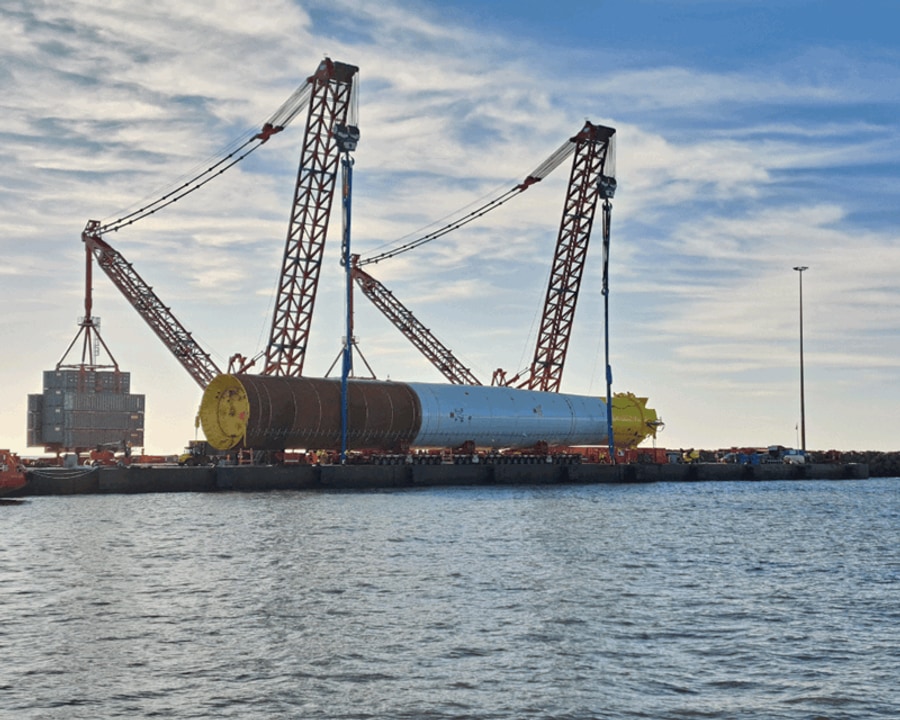
Before load-out, each monopile was transferred to a plugging station where both ends were sealed and tested for airtightness. The foundations were then transported to the quayside, where two MTC 1600 terminal cranes, each with a lifting capacity of 1,600 tonnes, lifted the monopiles into the water for transfer by tug to Van Oord’s heavy-lift installation vessel, Svanen. The foundations were subsequently transported approximately 23 km offshore for installation near the Polish coastal areas of Choczewo and Łeba.
According to Mammoet, the MTC 1600 enables quays to function as efficient heavy-lift terminals for both monopile load-in and load-out operations.
In addition to monopiles, the company also marshalled transition pieces at the Port of Ronne. These components followed a similar logistics process but were lifted onto SPMTs using an LR1800 crawler crane.
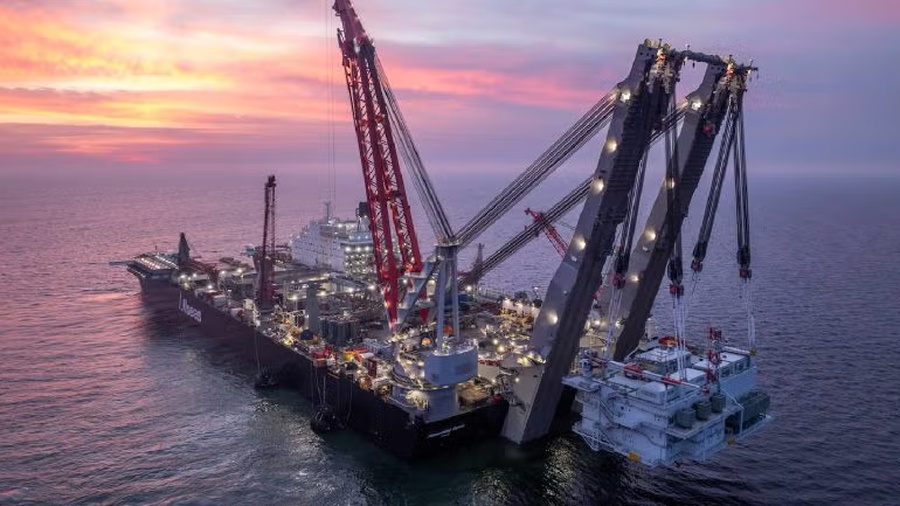
The marshalling campaign followed Mammoet’s 2024 project supporting the upgrade of Svanen, during which the vessel received a new A-frame to enable installation of taller monopile foundations for the Baltic Power development.
Jaap van der Riet, Commercial Manager at Mammoet, said that Van Oord planned to upgrade Svanen to a 3,000-tonne lifting capacity for installing XXL monopiles in the Baltic Sea. He added that Mammoet developed cranes and transport systems with matching capabilities to support those requirements, reflecting the company’s approach of developing customized solutions together with its clients when existing equipment does not meet project demands.
The project also included on-site load testing of the MTC 1600 cranes before they were moved to the lifting area. During execution, the load-in roll-on/roll-off method was modified, with the MTC 1600 cranes taking over monopile unloading directly from barges instead of SPMTs.
This change reduced the time required to ballast each barge because monopiles could be lifted directly rather than transported across the vessel deck.
According to Mammoet, combining the new XXL monopile handling equipment with these operational improvements reduced manual handling during critical phases while enhancing both the safety and efficiency of the overall marshalling operation.