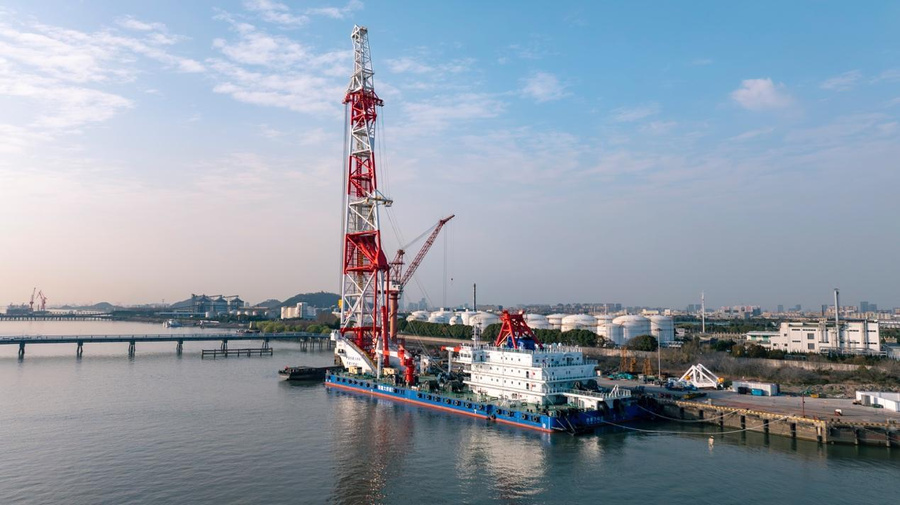
China Railway Construction Corporation (CRCC) has sent its pile-driving vessel CRCC Bridge Piling No. 1 to Brazil for foundation installation on the Salvador–Itaparica Bridge project. The vessel, described by CRCC as the world’s largest of its type, departed Lüsi Port in Nantong, China, on 27 September 2026.
The vessel is destined for the Bay of All Saints in Bahia, where parts of the bridge foundations will be installed in water depths reaching 64 m. Construction in the area must contend with difficult seabed geology, powerful currents and changing sea conditions.
Developed by China Railway Construction Bridge Engineering Bureau Group, the specialized offshore construction vessel measures 130.5 m in length, 40.8 m in width and 8.4 m in depth. It is equipped with a 156 m pile frame and can handle foundation piles weighing up to 700 tonnes. Its maximum operating water depth is 70 m.
To maintain its position during foundation installation, CRCC Bridge Piling No. 1 uses an integrated dynamic positioning (DP) and anchor-mooring arrangement. The system works with China’s BeiDou satellite navigation network to achieve centimetre-level pile positioning accuracy, according to the vessel’s developer.
The vessel also features an automated pile installation system and a hydraulic hammer capable of delivering up to 1,360 kJ of impact energy per blow.
Its closed-loop hydraulic system captures energy generated as the pile frame moves downward or changes angle, converting it into electricity for reuse. According to CRCC, the technology achieves an energy recovery rate of up to 40%.
For the voyage to Brazil, the vessel is expected to travel approximately 11,300 nautical miles via the Strait of Malacca, the Cape of Good Hope and the South Atlantic. The journey is scheduled to take about 45 days.
The Salvador–Itaparica Bridge will provide a 12.4 km crossing between Salvador and Vera Cruz on Itaparica Island. The planned cable-stayed bridge will have a main span of 682 m and form part of a wider 46.8 km infrastructure development, including connecting roads.
The project is being developed through a public-private partnership between the Bahia state government and Concessionária Ponte Salvador–Itaparica (CPSI), whose shareholders include China Civil Engineering Construction Corporation (CCECC) and China Communications Construction Company (CCCC).
The concession arrangement is separate from the ownership and construction of CRCC Bridge Piling No. 1, which was developed by CRCC’s bridge engineering subsidiary.
Delivered in March 2026, the vessel is undertaking its first overseas assignment with the deployment to Brazil.