Boskalis has reported the installation of 570,000 tonnes of subsea rock for the Skarv Satellite Project in the Norwegian Sea, where its subsea rock installation vessel Rockpiper has been involved in offshore operations under challenging weather conditions.
The rock was placed at water depths of 320 to 400 m to protect subsea infrastructure associated with the development of three satellite fields operated by Aker BP.
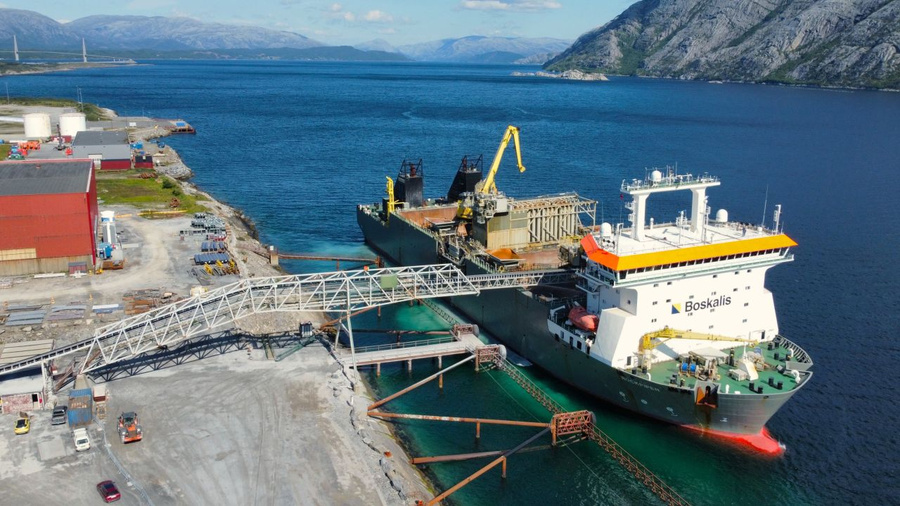
In its latest project update, Boskalis described the weather conditions encountered during rock-loading operations at Sandnessjøen, Norway. The loading location is situated in a fjord surrounded by steep mountain slopes, where strong southeasterly winds affected the operation.
Wind speeds reached 60 knots, with gusts of up to 80 knots. According to Boskalis, the vessel’s crew and project team managed the loading operations by applying the company’s established safety procedures.
Rockpiper is a DP2 subsea rock installation vessel built in 2011. According to the official vessel specifications published by Boskalis, the vessel measures 158.6 m in length and 36 m in beam, with a rock cargo carrying capacity of 23,500 t.
The vessel is equipped with a fallpipe rock installation system capable of placing approximately 2,000 t of rock per hour. Its fallpipe system has a specified installation depth of 700 m, which can be extended to 1,500 m with optional equipment.
The Skarv Satellite Project comprises the Alve Nord, Idun Nord and Ørn fields in the northern Norwegian Sea. The three developments are connected to the existing Skarv floating production, storage and offloading (FPSO) vessel through subsea infrastructure.
Each development consists of a subsea template and two production wells tied back to the Skarv FPSO.
Aker BP announced on 26 August 2026 that production had started from all three satellite developments, approximately one year ahead of the original schedule.
The fields contain an estimated 120 million barrels of oil equivalent in recoverable resources, according to the operator.
Rockpiper has been operating in Norwegian waters for more than thirteen years. The vessel’s latest involvement in the Skarv development follows several other assignments in the region, including work at the Skarv gas field earlier this year.