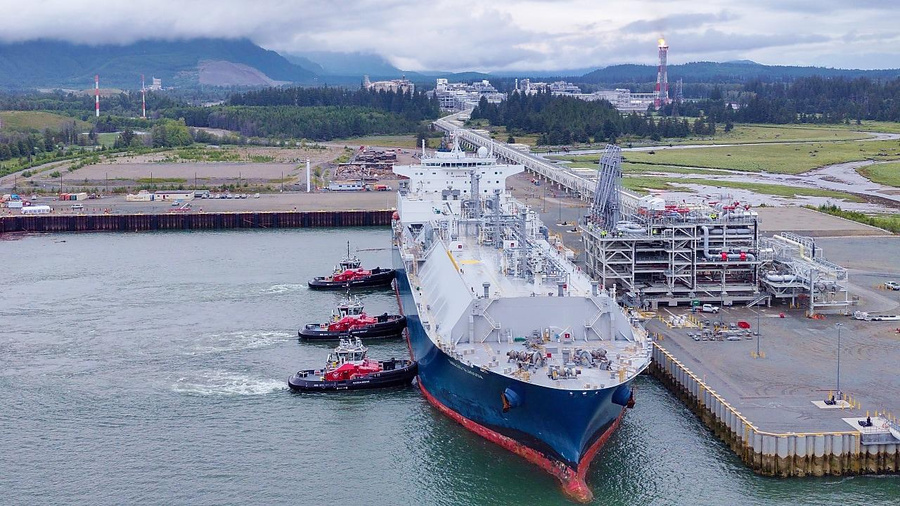
LNG Canada’s joint venture participants have taken a final investment decision on Phase 2 of the LNG export project in Kitimat, British Columbia, doubling production capacity from 14 million tonnes per annum to 28 mtpa.
The expansion will add two LNG processing trains, an additional LNG storage tank, a condensate tank, another loading berth and expanded utility and process systems at the existing facility.
Shell, which holds a 40% interest in LNG Canada, said commercial operations from Phase 2 are expected to begin in the early 2030s. The company expects to receive nearly 6 mtpa of additional LNG from the expansion.
The capacity of the existing 670 km Coastal GasLink pipeline will also be expanded through the construction of five new compressor stations to support the additional LNG production.
Following the FID, Fluor and JGC Corporation received Notice to Proceed for engineering, procurement, fabrication, construction and commissioning of Phase 2. The work will be carried out by JGC Fluor BC LNG II JV, owned equally by Fluor Canada and JGC Constructors (No2) BC.
Fluor said it will recognize its $7.5 billion share of the multibillion-dollar contract in the third quarter of fiscal 2026. The Fluor-JGC partnership also delivered Phase 1, including two processing trains and associated infrastructure. LNG production from Phase 1 began in June 2025.
The FID follows preparatory work carried out earlier this year. On 14 May, the governments of Canada and British Columbia and LNG Canada agreed on measures to close remaining items needed to support a potential 2026 investment decision. This followed a 1 May decision by the joint venture participants to approve additional funding for engineering, potential long-lead items and other project preparations.
LNG Canada is owned by Shell with 40%, PETRONAS with 25%, PetroChina and Mitsubishi Corporation with 15% each, and KOGAS with 5%. Reuters separately confirmed the Phase 2 approval and the planned increase in LNG production capacity to 28 mtpa.