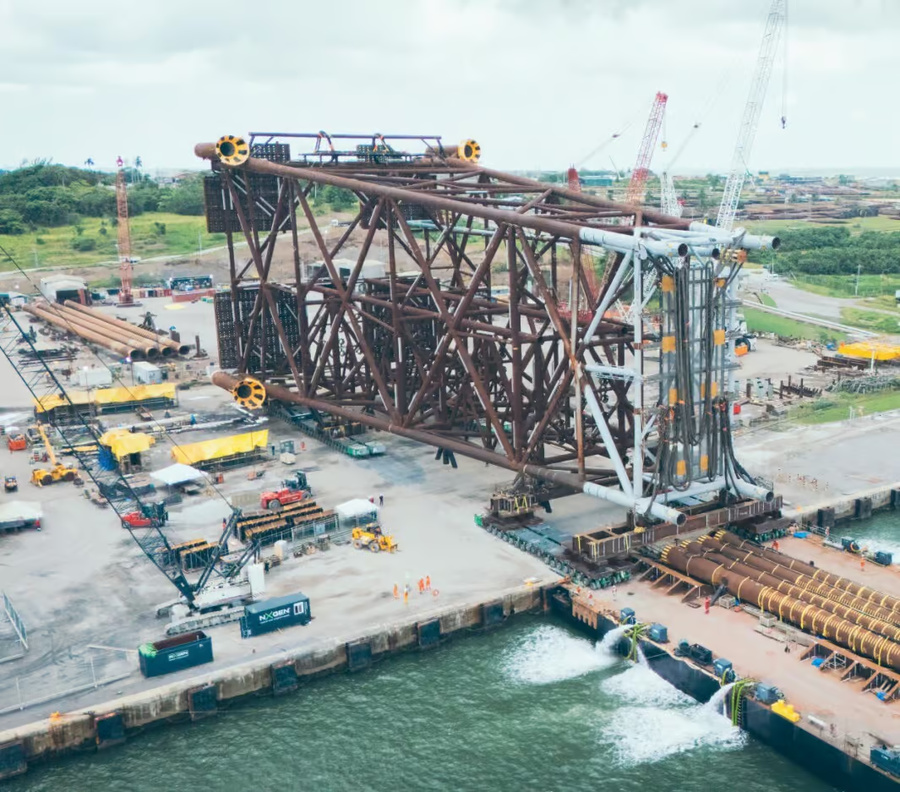
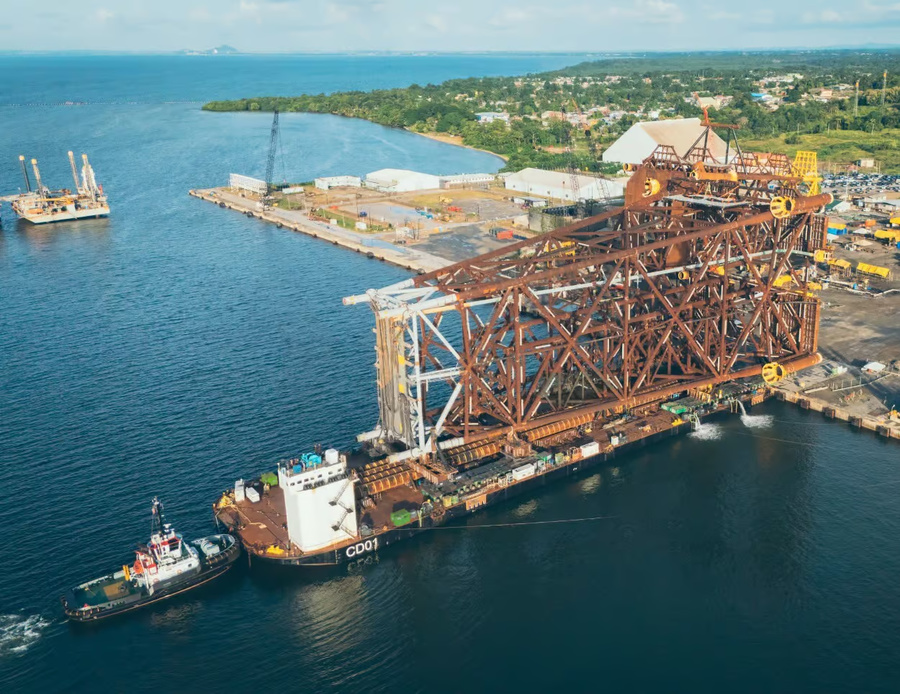
NXGEN has outlined the engineering and operational scope of the Manatee jacket loadout undertaken for Shell in Trinidad and Tobago, covering heavy transport, structural support, weighing, mooring and ballasting operations.
The loadout was carried out on 14 September 2026 at Berth 2 of the Port of Brighton, where the offshore jacket was transferred from the fabrication yard onto a transport barge. The structure was manufactured by Trinidad Offshore Fabricators Company (TOFCO) at the La Brea Industrial Estate and has been described by local project participants as the largest jacket fabricated in the country.
NXGEN provided the self-propelled modular transporters (SPMTs), temporary support steelwork and engineering services required for the operation.
Ahead of the barge transfer, the company used its SPMTs to lower the jacket by 1.5 metres before relocating it within the fabrication yard.
A weighing operation was subsequently performed using 22 load cells, each with a rated capacity of 600 tonnes. The resulting measurements established the load distribution across the jacket’s support points, providing engineering data for the subsequent loadout.
The marine scope included the provision and operation of six mooring winches, each rated at 50 tonnes, together with a high-capacity ballasting system.
While the mooring equipment controlled the position of the receiving barge, the ballast system compensated for changes in loading as the jacket progressively moved from the quayside onto the barge deck. The land transport and marine systems were managed within an integrated operational scope.
According to LABIDCO, the transfer was conducted using the dedicated heavy lift pad at Berth 2 following several months of preparation.
The jacket forms part of Shell’s Manatee offshore gas development in Trinidad and Tobago.
The published accounts of the operation did not specify the number of SPMT axle lines deployed, the duration of the barge transfer, the contract value or the offshore installation schedule.