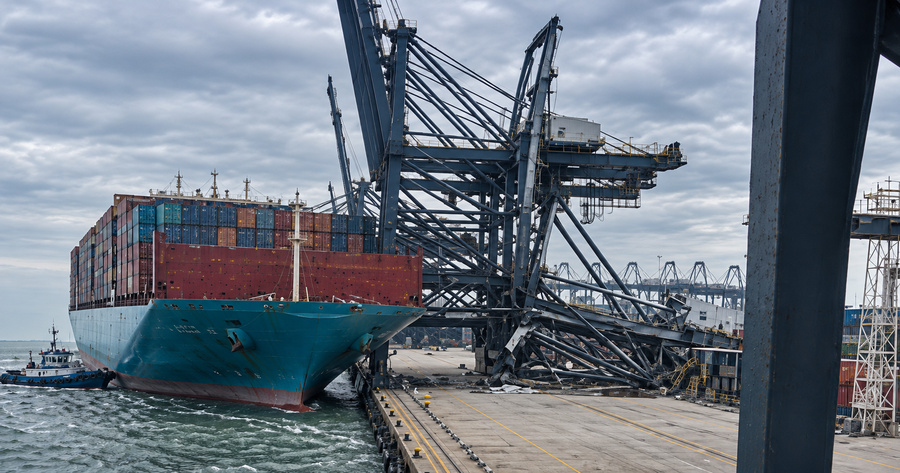
A crane collision at Yantian Port involving the 15,516-TEU containership Maersk Cincinnati on 9 November 2026 caused a ship-to-shore (STS) crane to collapse towards the container yard at the Shenzhen terminal in China.
The vessel reportedly struck the crane while manoeuvring to berth 12 at around midday local time. Photographs and videos circulated on Chinese social media showed sections of the collapsed structure lying alongside the ship and extending into the container storage area.
The extent of damage to the vessel, its cargo and terminal infrastructure has not been established. There have been no confirmed reports of injuries, and neither Maersk nor the terminal operator had issued a detailed account of the incident in the reports reviewed.
Marine claims specialist W K Webster issued an incident notice on 9 November, citing reports that the vessel had made contact with the crane. The company said the ship may have sustained damage, although the extent remained unknown.
According to Vertikal, the Yantian District Emergency Management Bureau confirmed the incident on 10 November and launched an investigation. No official findings establishing the cause were available in the reviewed sources.
Strong winds have been suggested as a possible contributing factor. Shenzhen’s meteorological authorities issued a blue strong-monsoon warning at 06:10 on 9 November for Yantian and nearby waters, forecasting gusts of force 8 or above. However, no official investigation findings have established a connection between the warning conditions and the collision.
The Singapore-flagged Maersk Cincinnati was built in 2024 and measures approximately 366 metres in length. At the time of the incident, the vessel was operating voyage 645W on the Gemini Cooperation’s Asia–North Europe 3 (NE3) service.
In its 4 November operational update, Hapag-Lloyd said Maersk Cincinnati would omit Tianjin Xingang on voyage 636E before joining the NE3 service as part of a schedule adjustment.
Published sailing schedules listed Ningbo and Shanghai as the vessel’s next calls after Yantian, followed by Tanjung Pelepas in Malaysia and onward destinations in Europe. The vessel had been scheduled to depart Yantian on 11 November, but the reviewed reports did not confirm whether that departure took place.
Yantian was already experiencing vessel delays before the accident. Hapag-Lloyd reported previously recorded average berth waiting times of 2.5 days for vessels longer than 300 metres, compared with 0.5 days for smaller ships, in its 4 November update.
The additional disruption, if any, caused by the damaged crane has not been established. The effect on the vessel’s subsequent schedule and the terminal’s cargo-handling operations also remains unconfirmed.