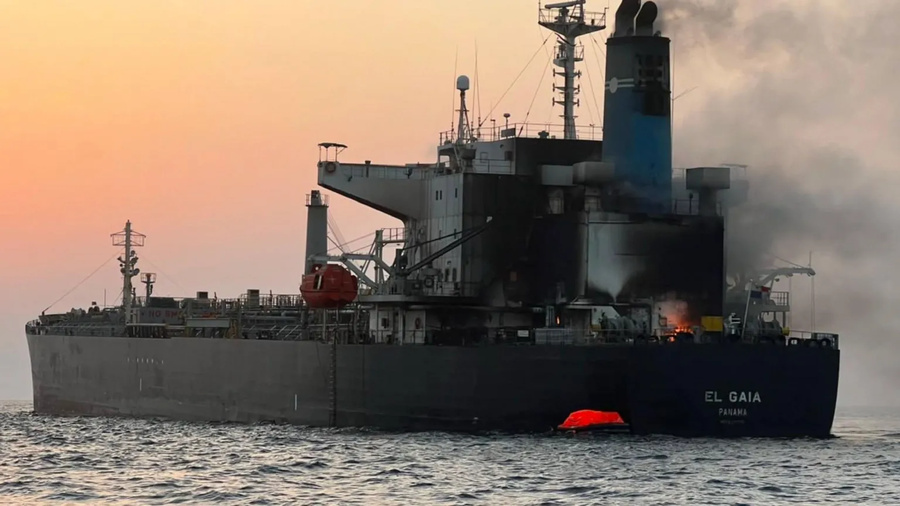
A tanker was struck by an unknown projectile while entering the Strait of Hormuz on 21 September 2026, leaving two crew members with minor injuries as attacks on commercial shipping continued in the waterway.
UK Maritime Trade Operations (UKMTO) reported that the tanker remained under its own power and continued towards its next port of call. No environmental impact was reported.
Maritime security firm Vanguard Tech referred to the vessel as La Stephanie, according to Seatrade Maritime News. The closest match in Pole Star Global’s database was the 72,825 dwt LR Stephanie, an Isle of Man-flagged tanker operated by Universal Tankers in Greece.
The incident followed three tanker attacks reported on 17 and 18 September 2026. One involved a Marshall Islands-flagged tanker that suffered a hull breach and onboard fire. The fire was extinguished and all crew were reported safe.
Iran also claimed responsibility for an attack on the Togo-flagged tanker Trend. Associated Press reported on 18 September 2026 that Iran’s Islamic Revolutionary Guard Corps said it had struck the tanker for attempting to transit the Strait of Hormuz without authorisation. AP said it could not immediately independently confirm the claim.
The tanker incidents come as US and Iranian authorities continue to give competing accounts of control and commercial traffic through the Strait of Hormuz.
US Central Command (CENTCOM) spokesperson Captain Tim Hawkins told Al Jazeera on 16 September 2026 that US forces had assisted commercial vessels carrying more than 900 million barrels of crude oil through the strait since early May. Hawkins also said more than 100 ships attempting to breach the US blockade had been redirected.
CENTCOM Commander Admiral Brad Cooper said in a video released on 19 September 2026 that US forces had assisted more than 2,000 commercial ship transits through the strait in recent months. He also said the US had supported the movement of more than 1 billion barrels of oil out of the Gulf during the previous couple of months.
The Joint Maritime Information Center (JMIC), however, reported a divergence between independent vessel-tracking data and figures from the US Naval Cooperation and Guidance for Shipping (NCAGS).
According to JMIC data cited by Seatrade Maritime News, independent tracking showed single-digit numbers of vessels transiting in each direction. US NCAGS data showed an average of more than 30 vessel transits per day during the previous 72 hours.