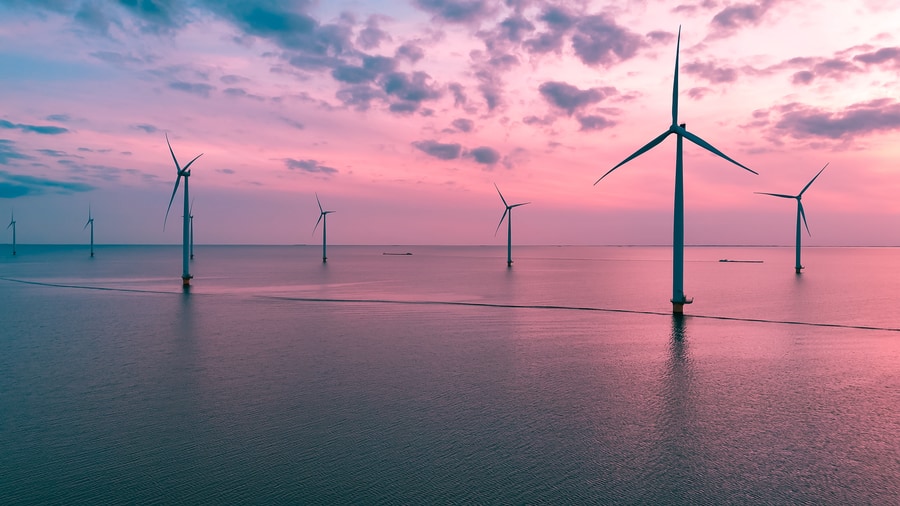
Governments should accelerate offshore wind development to reduce exposure to future energy crises, according to GWEC.
In its 2026 Global Offshore Wind Report, GWEC said offshore wind projects should be treated as nationally significant energy infrastructure in planning, procurement and investment frameworks. The report includes an eight-point action plan for policymakers.
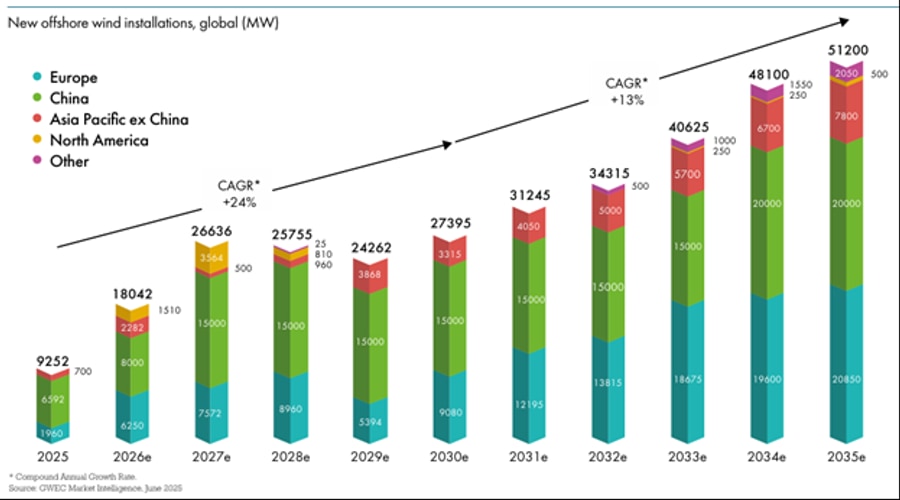
More than 9GW of new offshore wind capacity was connected to grids worldwide in 2025, making it the third-highest year for installations. Total global installed capacity reached 92.5GW, enough to power more than 100m homes.
Growth is expected to accelerate. More than 50GW of offshore wind projects are under construction worldwide, while annual installations are forecast to double in 2026, triple by 2031 and exceed 50GW per year by 2035.
GWEC expects offshore wind to record a compound annual growth rate of 24% between 2026 and 2030. More than 327GW of new capacity is forecast to be added over the next decade, lifting global offshore wind capacity to 420GW by the end of 2035.
Rebecca Williams, deputy CEO of GWEC, said offshore wind built at scale can support secure, clean power systems with high and predictable electricity generation. She also said recent energy crises have shown the risks of continued reliance on imported fuels.
China led annual installations for the eighth consecutive year in 2025, commissioning 6.6GW. Europe added nearly 2GW, including 1GW in the UK, 500MW in Germany and 400MW in France. China accounts for 52% of the global offshore wind market.
However, GWEC said deployment remains slower than required. Offshore wind capacity awarded through auctions in 2025 totaled 11.4 GW, only one-fifth of the 2024 record. Around 25GW of projects outside China are still awaiting final investment decisions.
The action plan calls for governments to fast-track offshore wind as critical energy infrastructure, strengthen cooperation with industry, counter misinformation, improve auction frameworks, shorten permitting, increase financing, expand supply chains and support industrial electrification.