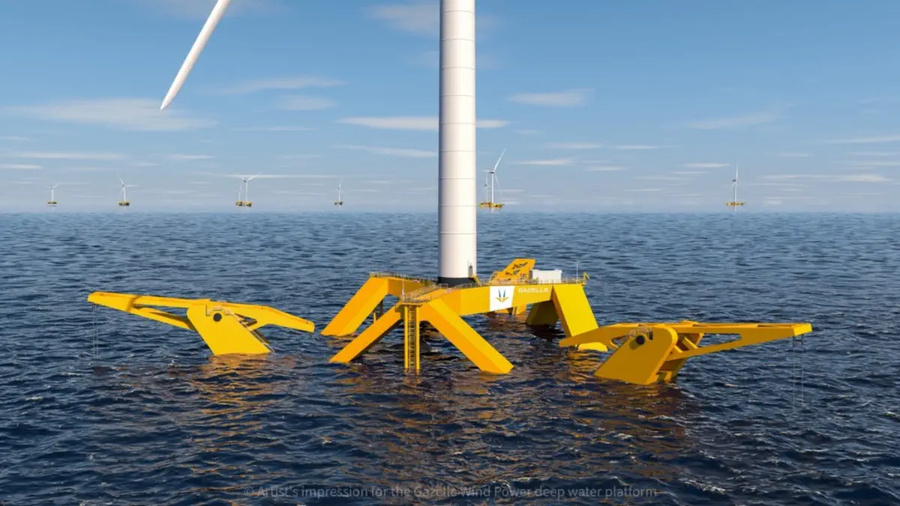
Gazelle Wind Power has developed and tested a floating offshore wind platform design for turbines of 18 MW and above as part of work with a major Asian utility on a project at a typhoon-prone site.
The platform was assessed under power-production and survival conditions. For the typhoon-prone site, the assessment used a 50-year extreme wind speed of 59.8 m/s at a hub height of 155 m and a 50-year significant wave height of 14.2 m.
Simulation results showed roll and pitch angles below 5 degrees. Tower-top accelerations and tower-base loads also remained within the project’s design criteria.
The design uses a central counterweight and three Articulated Mooring Frames with near-vertical mooring lines. This arrangement provides passive restoring force in response to wind, waves and currents without requiring an active ballast system.
For the 18 MW+ configuration, Gazelle Wind Power introduced a tripod support structure, upgraded the Articulated Mooring Frames and revised the hull geometry. The changes are intended to improve hydrodynamic performance, mooring flexibility and load distribution while reducing structural weight and increasing damage tolerance.
A preliminary costing exercise compared the platform with benchmark semi-submersible designs. The assessment indicated potential reductions of about 44% in CAPEX and 52% in LCOE compared with the benchmark case.
Gazelle Wind Power attributed the estimated reductions to lower structural and mooring requirements, a compact footprint, modular steel construction and the use of existing port infrastructure.
The platform also allows simpler installation and tow-to-port maintenance, reducing reliance on specialist offshore vessels.
Gazelle Wind Power and the utility also completed a basin-test campaign comparing physical test data with the numerical model. The results will be used for further model calibration and subsequent engineering work.