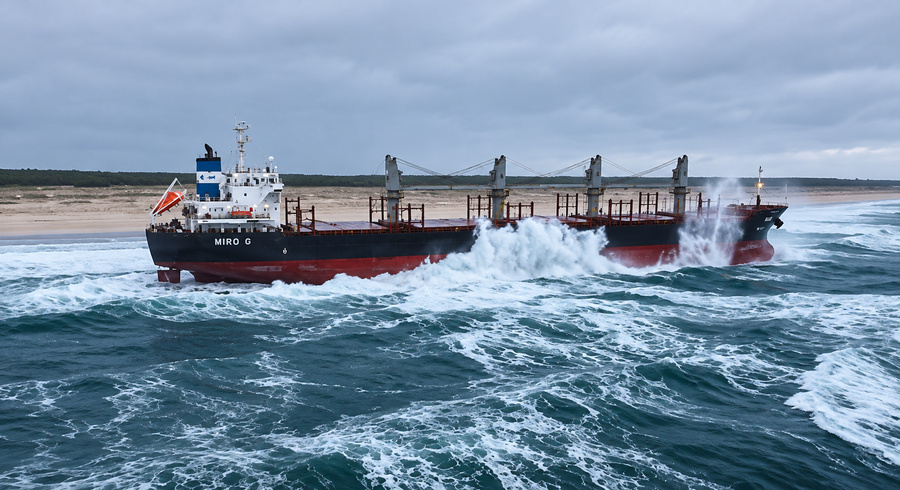
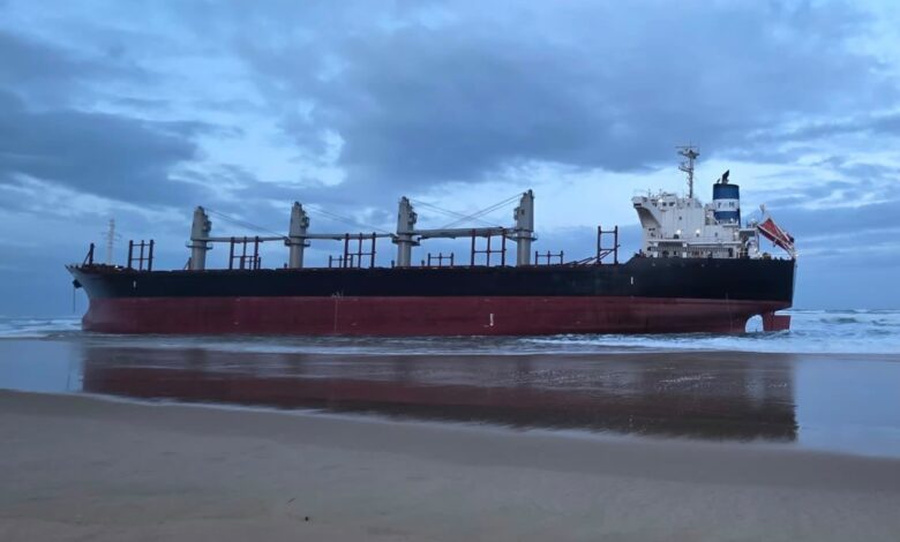
Salvage teams have successfully refloated the 28,200-dwt bulk carrier Miro G off France’s Atlantic coast, using a combination of deballasting, a long-distance towing system and favourable tidal conditions to recover the stranded vessel.
The operation was completed on 24 November 2026 at Cap de l’Homy near Lit-et-Mixe in the Landes department, four days after the vessel ran aground during a storm in the Bay of Biscay.
The refloating operation was coordinated by the French Atlantic Maritime Prefecture in cooperation with local authorities. The shipowner appointed SMIT Salvage to carry out the recovery, supported by Les Abeilles International and French Navy specialists.
As part of the salvage preparations, the recovery team removed ballast water that had previously been taken aboard to stabilise the vessel against wave action. A helicopter delivered an auxiliary generator to the ship to power the pumps required for deballasting.
A 1,900-metre high-strength synthetic towing system was established between the bulk carrier and the emergency response tug Abeille Bretagne. Personal watercraft and a rescue boat assisted with the connection in the shallow waters around the stranded vessel.
Taking advantage of improved weather and the afternoon high tide, the tug pulled Miro G free from the beach, allowing the vessel to be moved into deeper water.
Fishing vessels carrying pollution response equipment were positioned nearby as a precaution. A subsequent aerial survey by a French Navy Falcon 50 aircraft found no visible signs of marine pollution around the grounding site or along the vessel’s transit route.
Tugs and pusher vessels mobilised by the Port of Bordeaux were assigned to assist the bulk carrier’s onward passage to Le Verdon, where an underwater hull inspection by divers was planned.
The Malta-flagged bulk carrier, built in 2011 and measuring 169 metres in length, was sailing in ballast towards Rouen when it encountered manoeuvring difficulties on 19 November. All crew members were subsequently evacuated.
Before the recovery, dismantling the vessel at the grounding site had been considered as an alternative should attempts to refloat it prove unsuccessful.