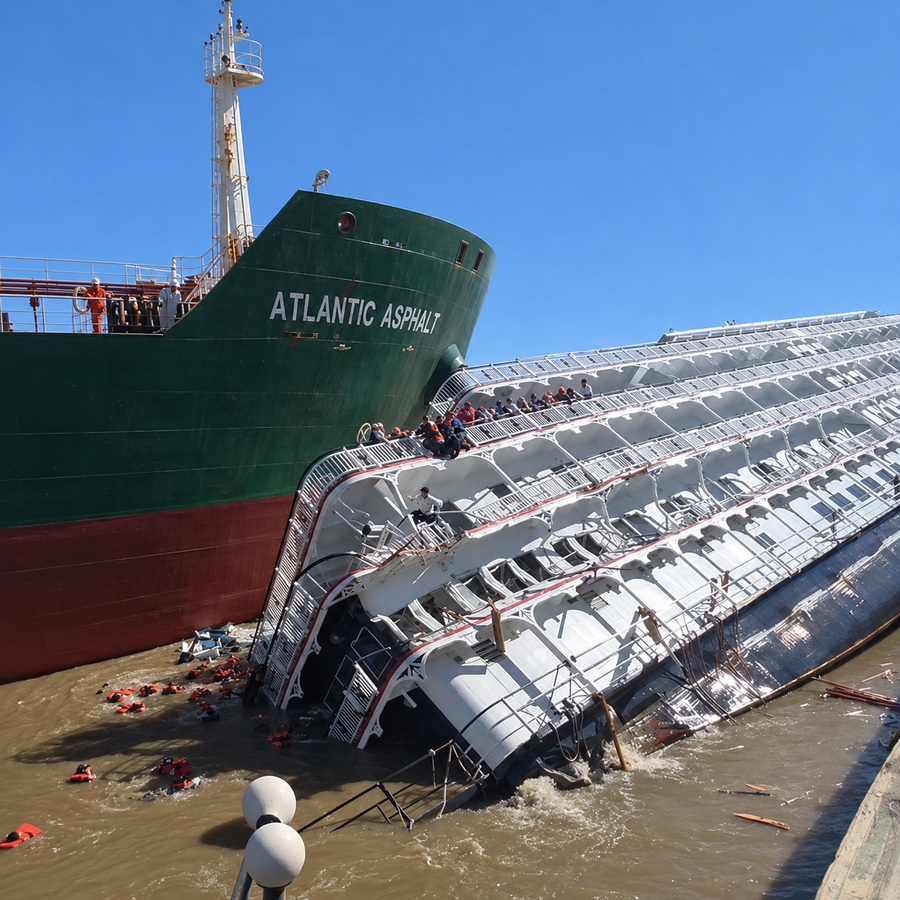
An Atlantic Asphalt steering failure occurred approximately two minutes before the tanker struck the docked passenger vessel American Heritage in New Orleans on 13 November 2026, according to preliminary findings released by the U.S. National Transportation Safety Board (NTSB).
NTSB senior marine accident investigator Bart Barnum said an initial examination of the tanker’s voyage data recorder (VDR) showed that its rudder remained to starboard after a steering malfunction at approximately 12:26 p.m. local time.
The tanker was travelling upriver on the Mississippi River near the Crescent City Connection Bridge when the malfunction occurred. It subsequently veered towards the river’s eastern bank and struck American Heritage at approximately 12:28 p.m.
Investigators have not determined what caused the steering problem. The NTSB is continuing to examine the vessel’s steering system and other evidence collected following the collision.
The agency recovered the tanker’s VDR and downloaded more than nine hours of information, including bridge audio, rudder angle, propulsion performance and vessel speed.
According to Barnum, the recordings contain sounds consistent with the vessel’s whistle, radio warnings and requests for assistance, commands to deploy anchors and emergency ship-handling instructions.
Investigators are examining whether the tanker deployed its anchors and, if so, how far they were lowered. Interviews with the crew and further analysis of electronic evidence are continuing. The NTSB expects to publish a preliminary report within approximately 30 days.
American Heritage, operated by American Cruise Lines, was berthed at Thalia Street Wharf when the collision occurred. The passenger vessel began taking on water and capsized approximately 22 minutes after being struck.
The NTSB identified 140 passengers and 50 crew members aboard the vessel, while Atlantic Asphalt carried 19 crew members. According to the City of New Orleans’ official response statement, everyone involved was accounted for, with no fatalities. A total of 32 people were transported to hospitals.
In a separate statement, American Cruise Lines credited Captain Leonard Stewart and the crew with organising a rapid evacuation. The company said Stewart remained on the bridge as the vessel capsized, requesting assistance and attempting to keep it alongside the dock.
The Port of New Orleans has filed a federal lawsuit seeking compensation for damage to its terminal facilities, alleging losses of at least $1 million.
Recovery operations have also included preparations to remove fuel from the capsized passenger vessel.
As HMT News previously reported, the U.S. Coast Guard initially indicated that the tanker appeared to have lost steering control. The latest NTSB findings provide a more detailed sequence of events, although the underlying cause remains under investigation.