
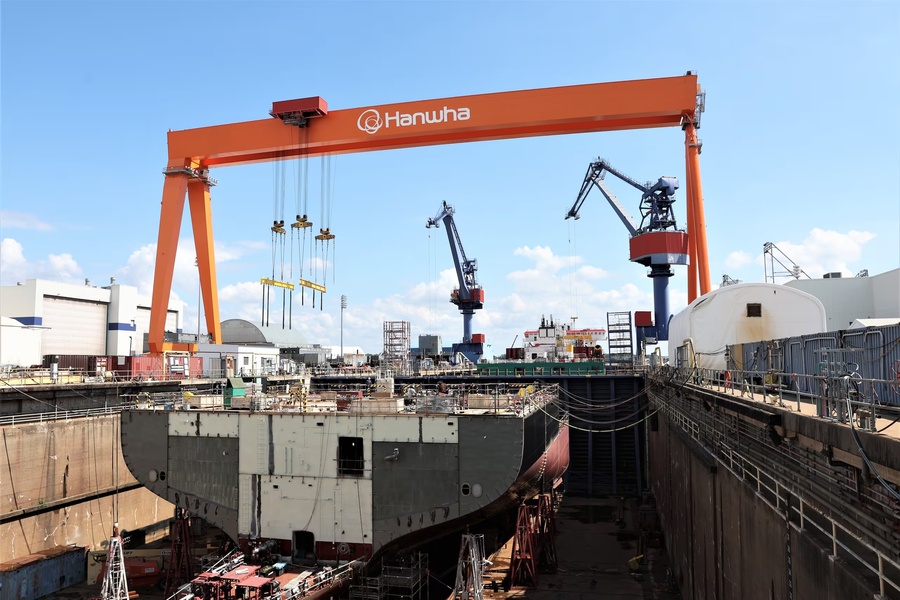
Hanwha Defense USA (HDUSA) has secured a $269 million LSM construction contract from TOTE Services, its first order to build a ship for the U.S. Navy. The award covers one Medium Landing Ship, while three further vessels remain options.
Construction at Hanwha Philly Shipyard is scheduled for Q4 2027. Hanwha acquired the yard in 2024 and has since invested in staffing and technical systems to prepare it for federal shipbuilding programmes, including naval work, according to HDUSA president and chief executive Michael Coulter.
TOTE Services disclosed the award on 30 October 2026. It had invited eligible American yards to bid in July and said HDUSA’s competitive offer, together with its agreement to the subcontract conditions, determined the selection.
The award forms part of a wider $2.2 billion Vessel Construction Manager (VCM) contract held by TOTE Services. Its base scope covers a maximum of eight LSMs, within a planned Navy and Marine Corps fleet of 35. The programme’s first delivery is expected in 2030.
TOTE Services said it was continuing contract talks with Bollinger Shipyards and Fincantieri Marinette Marine. As construction manager, it coordinates public-sector specifications with shipyard execution, maintains common vessel configurations and uses block purchasing across the programme.
Businesskorea reported that the LSM will transport Marines, their materiel and stores for dispersed operations along contested coastlines, including in the Indo-Pacific. The ship uses Damen’s LST-100 design, with a length of 100 metres, a beam of 16 metres and an approximate range of 7,400 kilometres.
The report said the Navy intends to combine a proven commercial design with construction at several yards to bring the vessels into service faster. The Philadelphia order is a firm commitment for one ship; the options provide for additional construction if exercised.
The yard and TOTE Services have already worked together on the National Security Multi-Mission Vessel programme, delivering four ships using the VCM approach. HDUSA also deployed staff to Philadelphia in early 2026 to support preparations for naval construction. Coulter said the company would work with TOTE Services to meet delivery commitments within the agreed budget.
The shipyard’s expansion programme extends beyond the LSM order. Hanwha has outlined plans for two additional dry docks as well as three piers and a facility for producing blocks, with a goal of reaching annual output of up to 20 ships. Its July technology update said welding robots developed at Geoje were being introduced in Philadelphia during 2026.
That update also identified November 2026 as the target for deploying enterprise resource planning and production-management systems. Development had started in November 2024, followed by the implementation phase from March 2025. These were stated project targets, rather than a confirmation that deployment had been completed.
Financial pressure remains part of the yard’s operating background. Businesskorea reported a 2025 net loss of 126.9 billion won and negative equity. A Hanwha Systems disclosure reproduced by Kiwoom Securities also records a loss and negative equity for that year. The report cited analysts who said further funding could be necessary as investment increased.
Elsewhere in the U.S. market, HD Hyundai USA and Kiewit Maritime announced their proposed HD Kiewit Shipbuilding venture on 22 October 2026. The partners plan a new yard at a site already used for industry, targeting construction in 2027 and full operations in 2029.
The partners will initially explore naval support ships and merchant vessels, together with opportunities to supply blocks and modules to other American builders. The equipment plans combine robot-assisted welding, digital-twin tools and manufacturing automation. The partners also intend to train local workers.
A separate presidential memorandum dated 13 August 2026 sets out a conditional overseas-build model for specified surface combatants, CONSOL tankers and roll-on/roll-off vessels. It requires investment in a U.S. yard, American workforce training, technology licensing and a domestic supply chain, with overseas construction limited to the initial two ships.
The memorandum also requires a contract-specific national security determination and a 30-day interval after Congress receives it before a waiver-based contract can be made. LSMs are not named among its specified classes. The announced HDUSA award places construction in Philadelphia.