
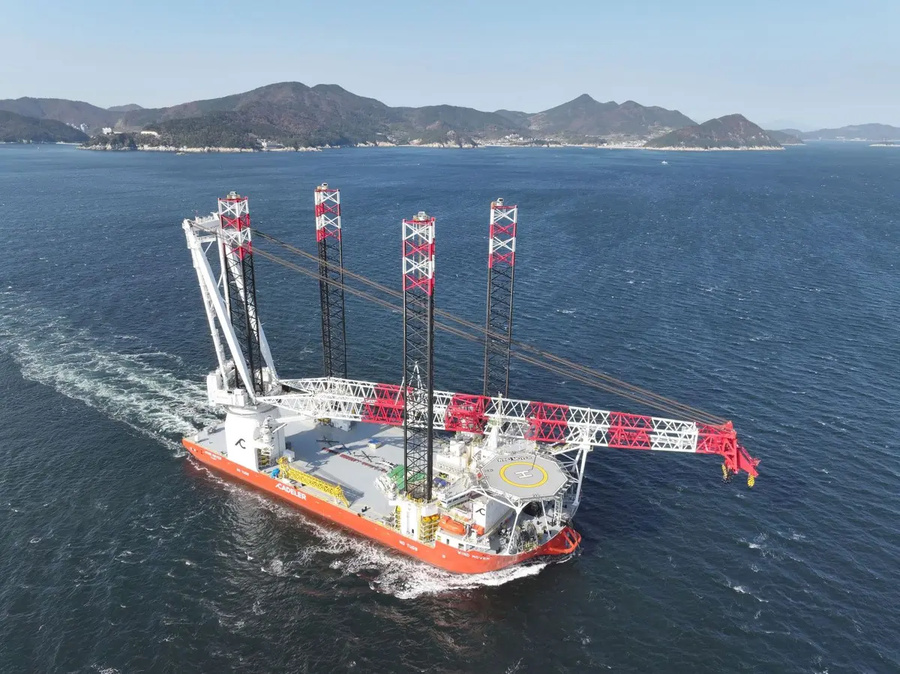
Cadeler’s wind turbine installation vessel (WTIV) Wind Mover is preparing for the Inch Cape turbine installation campaign offshore Scotland, with the first turbine installation now expected around 16 November 2026.
According to Inch Cape’s weekly offshore operations notice issued on 2 November, Wind Mover is jacked up within the wind farm site while awaiting entry to the Port of Dundee for its first turbine component load-out.
The vessel is expected to jack up at Dundee towards the end of the week beginning 2 November to load its first shipment of turbine components. The installation programme will cover 72 Vestas V236-15.0 MW turbines at the 1.1 GW offshore wind farm.
Wind Mover arrived at the project area on 30 October, according to AIS information reported by Offshore Wind. The project’s Notice to Mariners No. 23-26, issued on 27 October, had outlined an initial operation in which the vessel would enter the offshore site and jack up at a designated safe-haven position before proceeding to Dundee.
The Port of Dundee is serving as the turbine marshalling, assembly and load-out base. Under the project’s published turbine logistics plan, Wind Mover will transport turbine sets offshore in batches of four.
The port is handling 576 major turbine components, comprising 288 tower sections, 216 blades and 72 nacelles. More than 130 personnel are involved in handling, storage, assembly and preparations for offshore transport across a 170,000-square-metre site.
Each turbine comprises a four-section tower, three blades measuring 115.5 metres each and a nacelle containing the main electrical equipment. The turbine towers are being assembled at the quayside, with the tallest reaching 127.4 metres. Inch Cape is scheduled to become the first UK offshore wind farm to use the V236-15.0 MW model.
Installation will be followed by offshore turbine commissioning activities supported by Acta Marine’s service operations vessel (SOV) Acta Hercules. Technicians will access the turbines through a walk-to-work system, with additional support planned from the crew transfer vessels (CTVs) NOS Exceller and NOS Empowerer.
The project’s Notice to Mariners states that turbine installation and commissioning activities are scheduled to continue until September 2027.
During construction and commissioning, rolling 500-metre safety zones will be established around the offshore substation, turbines and their foundations where construction work is taking place. Up to ten such zones may be active simultaneously, depending on the presence of construction vessels.
Separate 50-metre pre-commissioning safety zones will apply around relevant offshore structures or foundations before the wind farm is commissioned. The marine notice identifies up to 73 possible zones of this type across the 72 turbines and one offshore substation.
The Inch Cape wind farm is being developed approximately 15 to 22 kilometres off Scotland’s Angus coastline in the North Sea. Its 72 turbines will be installed on a combination of 54 monopile foundations and 18 jacket foundations.
All 54 monopile foundations and their transition pieces have been installed. Seaway7’s heavy-lift vessel Seaway Alfa Lift, which previously completed the transition piece installation campaign, is now engaged in the foundation pin pile installation programme.
The project’s 2 November weekly operations notice confirms that jacket pin pile installation is continuing and will remain underway for several weeks. The work involves 54 pin piles ahead of the subsequent installation of 18 jacket foundations.
During the earlier transition piece campaign, Seaway Alfa Lift transported and installed six units per voyage from the Port of Leith, as detailed in HMT News’ coverage of the completed foundation work.
Other offshore construction activities are continuing alongside turbine preparations. N-Sea is carrying out inter-array cable installation using the cable-laying vessel Altera, while the multi-purpose vessel North Sea Enabler is assigned to cable burial operations.
Installation of the two offshore export cables has been completed, with remaining joint burial work continuing. The cables will connect the offshore substation to the onshore grid infrastructure at Cockenzie, East Lothian.
The project is owned by ESB and Red Rock Renewables through an equal joint venture. It is targeting first electricity generation before the end of 2026, followed by full commercial operation in 2027.