
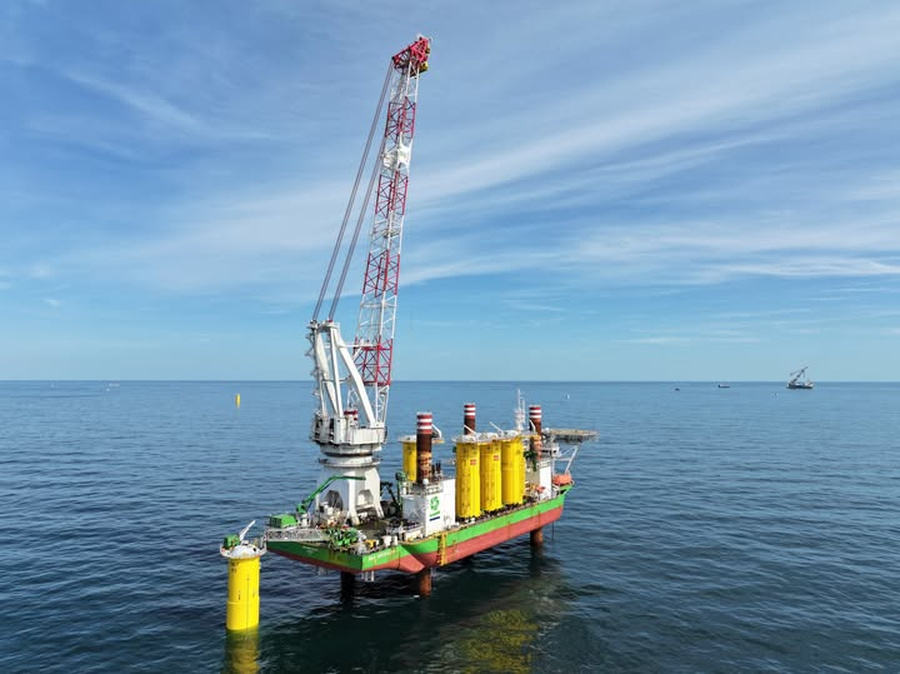
DEME has completed the installation of all 68 foundations at Vattenfall’s 980 MW Nordlicht I offshore wind farm in the German North Sea ahead of schedule, concluding a major offshore construction phase involving large monopiles and transition pieces.
The completion was reported on 2 November 2026, following the installation of the final monopile at the end of September and the subsequent installation of the remaining transition pieces.
Nordlicht I is located approximately 85 kilometres north of the island of Borkum and is expected to become Germany’s largest individual offshore wind farm when operational.
Each of its 68 foundations consists of a monopile embedded in the seabed and a transition piece connecting the foundation to the future turbine tower.
The monopiles were manufactured by EEW Special Pipe Constructions in Rostock, Germany, while CS WIND Offshore produced the transition pieces at its Aalborg facility in Denmark.
DEME handled the offshore transportation and installation of the foundation components. The preceding transport of the 68 monopiles from Rostock to Eemshaven in the Netherlands was undertaken by Wagenborg on behalf of DEME.
According to Vattenfall’s published foundation specifications, the monopiles measure up to 80.5 metres in length and weigh as much as 1,290 tonnes each. The transition pieces reach approximately 23.7 metres in height.
The size of these structures required a logistics chain linking fabrication sites, transport vessels, a staging port and offshore installation equipment.
Wagenborg began delivering monopiles from Rostock to Eemshaven during the summer. The components were moved using barges and tugs before being transferred for offshore installation.
As detailed in an earlier HMT News report on the Nordlicht I monopile transport campaign, Wagenborg deployed the tug Waterland, alongside other towing vessels and barges, to support the movements.
At Eemshaven, the monopiles were transferred to DEME’s offshore installation vessel Orion, which carried out the installation work at the wind farm site.
The first monopile was installed on 1 July 2026. The final monopile followed at the end of September, leaving the remaining transition pieces to be fitted before the foundation campaign could be completed.
Manufacturing and shipment of the transition pieces progressed separately from the monopile transport operations.
On 20 October, CS WIND Offshore confirmed in its official production update that the final four transition pieces had been loaded onto a barge at Aalborg, completing the load-out of all 68 units for Nordlicht I.
The completion of offshore installation, reported on 2 November, marks the end of this foundation work package. Manufacturing completion, departure from the fabrication facility and offshore installation were separate milestones in the delivery process.
Other construction activities are continuing.
TKF is manufacturing the project’s cables, while Vestas is producing turbine tower sections. The first tower sections have already arrived in Esbjerg, Denmark, with blade and nacelle manufacturing expected to begin in the coming months.
Nordlicht I is designed for 68 Vestas V236-15 MW turbines and has a published project capacity of approximately 980 MW.
The 15 MW figure identifies the turbine model’s rated capacity, while 980 MW is Vattenfall’s stated capacity for the wind farm. The developer’s project information does not explain the difference between the nominal total of the turbine ratings and the published wind farm capacity.
The wider Nordlicht development also includes Nordlicht II, a planned 630 MW offshore wind farm comprising 44 turbines.
CS WIND Offshore has already begun manufacturing the 44 transition pieces for Nordlicht II following the completion of its Nordlicht I production programme.
Under Vattenfall’s published project schedule, Nordlicht I is targeting commercial operation in 2028, followed by Nordlicht II in 2029.
The two projects will have a combined installed capacity of more than 1.6 GW, with expected annual electricity generation of approximately 6 TWh once both are fully operational.
Vattenfall is incorporating environmental measures into the construction programme, including the use of lower-emission steel for parts of the turbine towers and measures intended to limit disturbance during foundation installation.
Monitoring of birds and marine mammals is continuing, using radar, cameras and acoustic systems to collect information on wildlife activity.
The completed foundation campaign marks the conclusion of a sequence of heavy-component manufacturing, transport, transfer and offshore installation operations involving suppliers and maritime contractors in Germany, Denmark and the Netherlands.
Although Nordlicht I’s foundations are now installed, further turbine, electrical and commissioning work remains before the wind farm can enter commercial operation.