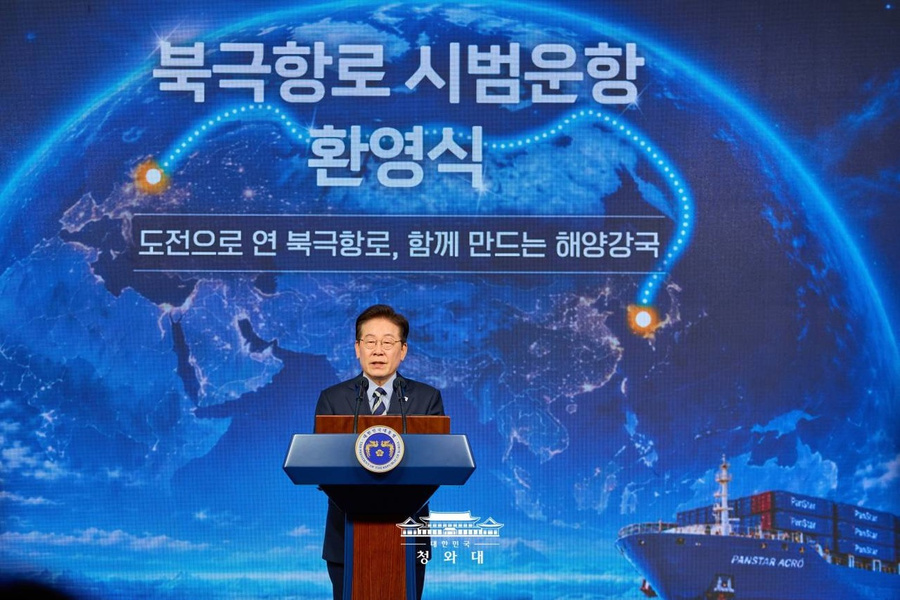
South Korea plans further Arctic shipping trials in 2027 with container vessels and vehicle carriers, following PanStar Acro’s return from Europe. President Lee Jae Myung welcomed the crew in Busan on 13 October 2026 and pledged to develop the route while respecting international sanctions.
The 2,758-TEU vessel returned on 11 October 2026 after a 50-day round trip. It had left Busan New Port on 22 August 2026 and reached Felixstowe in 20 days and five hours, according to the Ministry of Oceans and Fisheries. The ship subsequently called at Rotterdam and Gdansk before taking the Arctic route back to Busan.
Lee said the trial provided experience of summer navigation without an icebreaker escort and handling floating ice. He presented Arctic shipping as an additional option when established maritime routes face disruption.
Cargo figures showed the challenge of building demand in both directions. The outbound shipment comprised 737 TEU of exports against a target of 1,300 TEU. On the return leg, the vessel carried 1,743 TEU of empty containers and no import cargo, according to ministry figures released through the office of opposition legislator Kang Seung-kyoo and reported by Reuters.
Securing freight for the homeward journey remained an unresolved task, Lee said. He argued that accumulating operating experience and consolidating cargo could help reduce costs and make services more dependable.
Oceans Minister Hwang Jong-woo said the government aims to introduce regular services in 2030. He separately put the prospect of economic viability at around 2040 and said South Korea would also examine the Northwest Passage linking Asia and North America.
The present route runs along the Arctic coastline of Russia, raising concerns about engagement with Russian entities. Lee promised adherence to international rules and sanctions principles, alongside consultation with partner countries.
In his official remarks, Lee also outlined continued investment in Arctic research, cleaner ship technology, lower-carbon fuels, sea-ice forecasting, navigation support and training for polar operations. He linked the initiative to Busan’s port and logistics capabilities and the shipbuilding and manufacturing industries of Ulsan and South Gyeongsang Province.