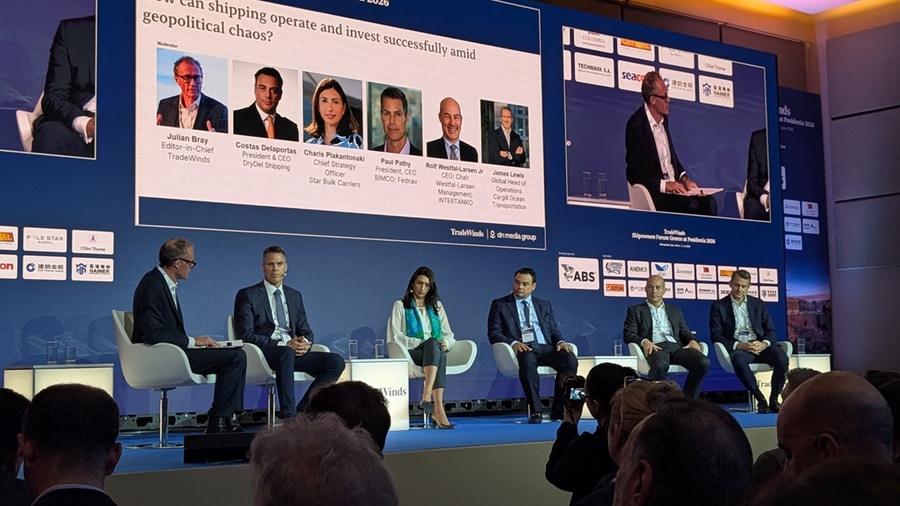
Shipping leaders at the TradeWinds Shipowners Forum during Posidonia said geopolitics is now reshaping global shipping markets, not merely disrupting vessel operations.
Speakers pointed to conflicts, sanctions, trade disputes and security threats as forces influencing trade flows, fleet deployment, financing, vessel values and risk management across the industry.
Star Bulk chief strategy officer Charis Plakantonaki said geopolitics is redefining markets across shipping segments. She cited the US-China trade war, Covid-19, the Ukraine conflict, Red Sea attacks and renewed tensions in the Persian Gulf as developments that have already shifted cargo patterns.
According to Plakantonaki, China moved part of its trade from the US to Brazil, while Europe replaced Russian trade with flows from other countries. She also said more than 200 vessels are currently trapped in the Gulf, while higher oil prices have reduced average dry bulk speeds to less than 11 knots.
Although the Persian Gulf situation is creating higher insurance costs, sanctions exposure and security risks, Plakantonaki said the dry bulk sector is seeing a net positive effect for now.
Cargill Ocean Transportation vice president James Lewis described the market as structurally more difficult, with the pace of change now the central challenge. He said flexibility in charters, cooperation with partners and technology are becoming critical tools for operators responding to sudden changes.
Fednav chief executive and BIMCO president Paul Pathy said shipping companies have traditionally adapted well, but the speed and intensity of events now require strategies to evolve faster.
The panel also addressed US-China tensions and whether shipping may be forced to align with one side. Pathy said he does not expect that outcome, arguing that business interests remain strong in both countries.
For the tanker sector, Intertanko chair Rolf Westfal-Larsen Jr warned that shipping, especially tankers, is increasingly being used as a political weapon. He said direct attacks on vessels and seafarer deaths have marked a significant turning point, adding that owners must avoid trades where the risks outweigh commercial returns.
The shadow fleet was another major concern. Westfal-Larsen estimated that around 1,500 dark fleet tankers are operating outside normal regulatory frameworks, creating risks for international safety. Pathy said stronger and equal enforcement is needed to protect compliant operators and maintain a level playing field.
Asset values and sanctions exposure are also becoming harder to manage. DryDel Shipping chief executive Costas Delaportas said legitimate cargoes can become problematic when rules change suddenly. He also pointed to fuel supply delays, with some ships waiting around 10 to 12 days for bunkers in certain locations.
The forum’s closing message centered on flexibility, diversification, contractual protection and conservative financial management. Plakantonaki summed up the mood by stressing the need for strong balance sheets, saying cash is again a decisive advantage in a more volatile shipping market.