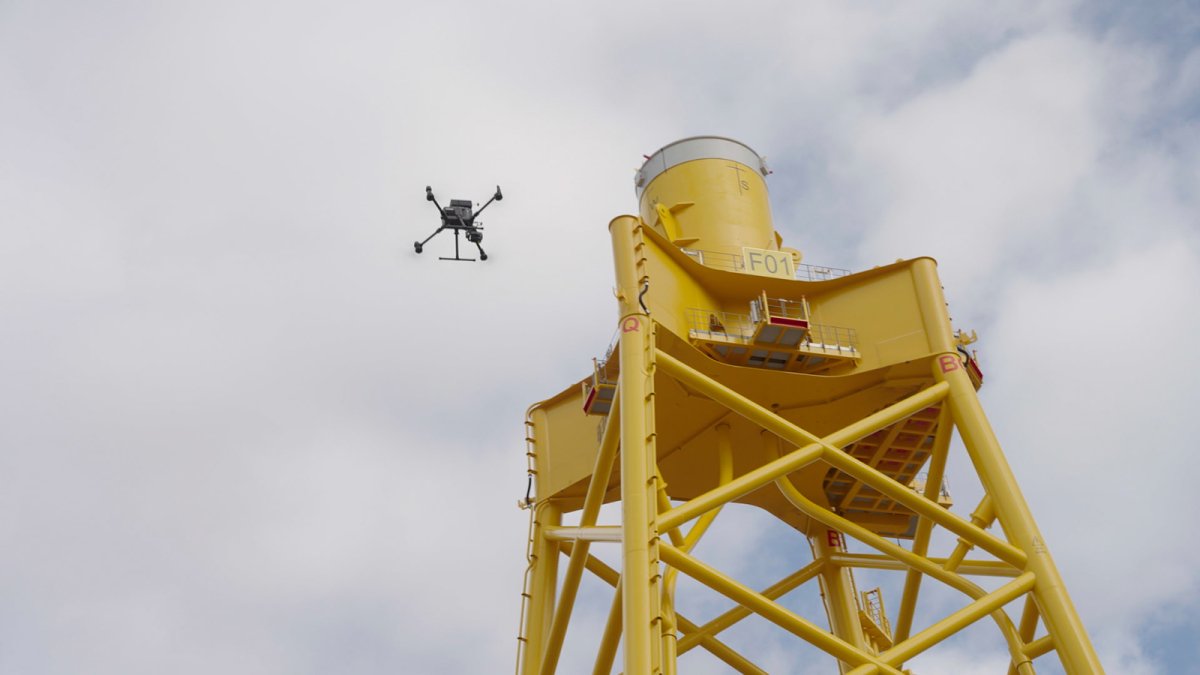
Navantia Seanergies has carried out its first visual inspection of an offshore wind jacket using an autonomous aerial drone at its Fene shipyard in A Coruña.
The system, developed by Navantia Seanergies, was demonstrated with support from three major offshore classification societies: Bureau Veritas, DNV and Lloyd’s Register.
The test was observed by representatives from the three classification bodies. It verified the drone’s ability to support visual inspection work on large offshore structures. The technology was created through an innovation project involving Navantia Seanergies and the Robotics, Vision and Control Research Group at the University of Seville, linked to AICIA.
During the demonstration, footage from the drone was transmitted live to a room inside the shipyard. Participants viewed the structure through normal images and several magnification levels, including optical zoom up to x40 and digital zoom up to x80. This allowed defects to be identified and located with precision.
The test also confirmed that x5 zoom provides visual capacity equivalent to that of an experienced operator, in line with offshore industry standards.
Carla Chawla, director of the Navantia Seanergies Fene shipyard, said the system will bring greater efficiency and safety to final inspections of large offshore units involving clients and classification societies.
María Antonia Gálvez, business development manager at DNV, said the innovation represents a major improvement for inspection quality and safety. Javier González, floating wind manager at Bureau Veritas, pointed to savings in working hours for inspectors and operators.
The initiative is part of the Navantia Seanergies Centre of Excellence, Coex Green Energies, and supports the transformation, modernization and digitalization of the Fene yard. It also follows earlier work such as ePark+, focused on autonomous inspection solutions for offshore wind farms.
After the demonstration, participants reviewed the next steps, including training the shipyard team to use the technology and gradually adding it to industrial inspection processes.